
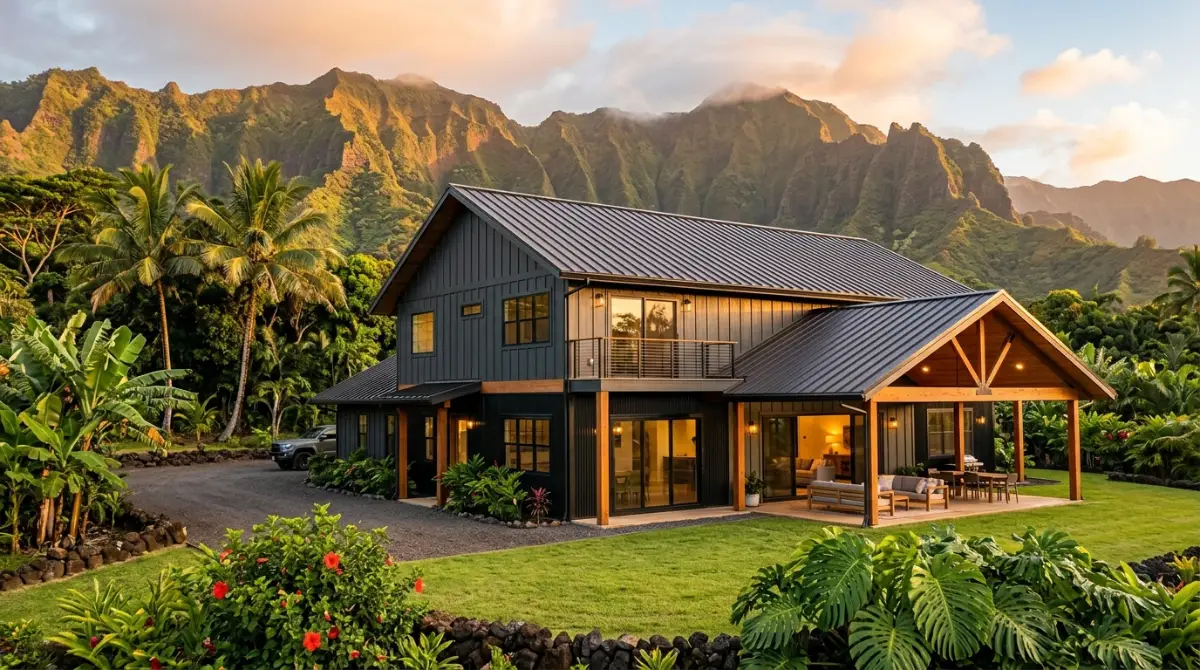
Hawaii · 2026 Cost Guide
Hawaii Barndominium Cost Per Sq Ft (2026): Building Codes, Cesspools, Water & Island Land Guide
If you are researching the Hawaii barndominium cost per sq ft in 2026, you are looking at one of the most expensive barndominium markets in the United States. Hawaii is not simply a mainland construction market with higher labor rates. The state’s island geography, imported construction materials, limited buildable land, transportation costs, specialized permitting, wastewater requirements, water-supply issues, coastal hazards, volcanic hazards and county-specific regulations can all change the economics of a barndominium project.
That is why a barndominium that looks inexpensive when priced as a steel shell can become dramatically more expensive after you add the slab, engineering, transportation, labor, utilities, wastewater system, water storage, interior construction, site preparation and required permits.
This guide focuses specifically on Hawaii barndominium costs in 2026 and the issues that make building a barndominium in HI different from building one in Texas, Tennessee, Indiana or other mainland states.
Hawaii Barndominium Cost Per Sq Ft in 2026
Current 2026 market research places Hawaii’s estimated barndominium cost at approximately $250 to $380 per square foot for a turnkey build, while an erected shell is estimated at approximately $85 to $140 per square foot.
Those figures are useful as an initial planning range, but they should not be interpreted as a Hawaii-wide contractor price list. The published figures are directory estimates based on builder pricing, kit information and regional construction cost data rather than a database of completed Hawaii barndominium transactions.
| Barndominium Size | Estimated Shell Cost | Estimated Finished Cost |
|---|---|---|
| 1,000 sq ft | $85,000–$140,000 | $250,000–$380,000 |
| 1,200 sq ft | $102,000–$168,000 | $300,000–$456,000 |
| 1,500 sq ft | $127,500–$210,000 | $375,000–$570,000 |
| 2,000 sq ft | $170,000–$280,000 | $500,000–$760,000 |
| 2,400 sq ft | $204,000–$336,000 | $600,000–$912,000 |
| 2,500 sq ft | $212,500–$350,000 | $625,000–$950,000 |
| 3,000 sq ft | $255,000–$420,000 | $750,000–$1,140,000 |
The finished figures represent the building itself rather than the complete cost of acquiring and developing a piece of land. Land, major site work, utility extensions, water infrastructure, wastewater systems and other property-specific expenses can sit outside the advertised building rate. Our Barndominium Cost Calculator and Land Cost Calculator can help you model the building and land budgets separately.
Why Hawaii Barndominium Prices Are So High
The first mistake people make when researching Hawaii construction is comparing the price of a metal building package with the price of a finished residence. The second mistake is assuming that Hawaii’s cost premium is primarily caused by labor.
Labor matters, but Hawaii has several cost layers that can affect a project before a contractor even begins interior construction.
- Construction materials frequently have to travel long distances before reaching the project site.
- Inter-island transportation can affect material and equipment logistics.
- Specialized trades may be less available than in large mainland construction markets.
- Steep or difficult terrain can make grading and access expensive.
- Some rural parcels require private water or rainwater catchment systems.
- Wastewater may require a state-approved individual wastewater system.
- Existing cesspools can create additional development or conversion issues.
- Coastal properties can trigger Special Management Area and shoreline requirements.
- Flood, tsunami, erosion and storm-surge exposure can change the site design.
- Hawaii Island properties require careful consideration of volcanic hazard zones.
- County regulations can differ even though the project is inside the same state.
In other words, the steel frame is only one part of the Hawaii barndominium budget.
Hawaii Barndominium Shell Cost vs Finished Home Cost
A shell quote is particularly easy to misunderstand in Hawaii.
A shell may represent the metal or post-frame structure, exterior components and erection work, while leaving major portions of the residence unfinished. Depending on the contractor, a shell may not include the final electrical system, plumbing, insulation, HVAC, drywall, kitchen, bathrooms, flooring or interior partitions. Our Barndominium Kit Cost Calculator and Barndominium Kits Guide explain what kit suppliers commonly include or exclude.
This distinction matters because a low advertised price can make a Hawaii barndominium appear dramatically cheaper than it will actually be when completed.
When comparing builders, ask each contractor to identify exactly what is included in the shell price. A useful comparison should separate:
- Foundation and slab
- Structural frame
- Roofing
- Exterior wall system
- Windows and exterior doors
- Insulation
- Interior framing
- Electrical
- Plumbing
- Water heater
- HVAC or cooling systems
- Drywall and interior finishes
- Kitchen
- Bathrooms
- Flooring
- Exterior drainage
- Porches and covered outdoor areas
In Hawaii, the shell-versus-turnkey distinction becomes even more important because logistics and site infrastructure can represent a large part of the total project budget. Our Barndo Material Cost Estimator shows how material choices alone move the total.
How Much Does a 2,000 Sq Ft Barndominium Cost in Hawaii?
A 2,000 square foot Hawaii barndominium is a useful example because it is large enough for a conventional family layout without automatically becoming an enormous custom residence.
Using the current published Hawaii planning range, the building itself could fall roughly in the $500,000 to $760,000 finished range, before land and many site-specific infrastructure expenses.
But the actual project budget should be developed from the property outward rather than from the building inward.
For example, a relatively straightforward parcel with good road access, nearby electrical service, an existing public water connection and sewer availability could behave very differently from an acreage parcel that needs:
- Long driveway construction
- Extensive grading
- Retaining structures
- Private wastewater treatment
- Rainwater catchment
- Large storage tanks
- Water treatment equipment
- Generator or backup power
- Long utility runs
- Special engineering
Therefore, a Hawaii barndominium budget should always be split into building cost and land-development cost.
Hawaii Construction Costs and the 2026 Market
Hawaii’s construction environment remains substantially different from most mainland markets. State economic data from the Hawaii Department of Business, Economic Development & Tourism shows that the Honolulu construction cost index for single-family residences increased 6.3% year over year in the first quarter of 2026. Hawaii’s 2026 construction reporting also showed changes in private building authorizations across the counties. These figures do not provide a barndominium price, but they demonstrate why using old Hawaii construction numbers can produce an unrealistic budget.
For a barndominium project, the most useful approach is to obtain current bids after the site has been evaluated. A 2021 or 2022 estimate should not automatically be treated as a reliable 2026 Hawaii construction budget.
Hawaii Building Codes for Barndominiums
One of the most important questions is whether a metal building can legally be used as a residence.
The answer depends on the actual design and the applicable building regulations. Hawaii’s state building-code framework is based on nationally recognized codes including the International Building Code, International Residential Code, International Energy Conservation Code, National Electrical Code and Uniform Plumbing Code, along with Hawaii-specific requirements.
Hawaii law also recognizes county authority in administering and adapting building requirements. That means a property owner should not assume that a building approach accepted on one island will automatically receive the same treatment in another county.
For a barndominium, the structural engineer and design professional should determine the applicable code path before the steel package is ordered.
Do You Need a Building Permit for a Hawaii Barndominium?
For a residential barndominium, you should assume that a building permit and associated approvals will be required unless a specific exemption clearly applies.
Hawaii County, Maui County, Kauai County and the City and County of Honolulu all operate their own permitting systems and requirements. Kauai, for example, provides a residential permit checklist and requires applicants to address both building and zoning-related submissions.
Maui County states that a building permit is required for construction, alteration, moving, demolition, repair and use of buildings and structures within the county.
The practical lesson is simple: do not order a complete metal building package first and ask the county whether it can become a residence later.
Hawaii Residential Fire Sprinkler Requirements
Fire protection is another issue that can materially affect the cost of a new residential barndominium.
Hawaii’s recent state residential code adoption incorporated requirements associated with automatic residential fire sprinklers for newly constructed residential dwelling units. Legislative materials discussing the 2024 state residential code specifically identify residential sprinkler requirements.
For a new barndominium, the final design should therefore establish the applicable fire-sprinkler requirements before plumbing and mechanical systems are finalized.
This is another reason why a Hawaii barndominium should be designed as a residence from the beginning rather than treating the project as an agricultural metal building that will later be converted into a house.
Hurricane Wind Design for a Hawaii Barndominium
Hawaii does not have the snow-load problem found in northern states, but that does not mean structural design is simple.
Wind is a major consideration. Roof-to-wall connections, wall-to-foundation connections, doors, windows, roof systems, fasteners and the overall structural load path need to be designed for the conditions applicable to the site.
Hawaii law establishes a statewide building-code framework that includes hurricane-resistant and other hazard-related standards. Proposed legislation in recent sessions has also focused on stronger hurricane protection for new residential construction, demonstrating how seriously wind resilience is being considered in the state.
For a barndominium, the important question is not simply whether the steel building is advertised as “hurricane rated.” The entire residential structure must work as a system.
Hurricane-Resistant Barndominium Features to Discuss With Your Engineer
- Roof uplift resistance
- Structural connections
- Anchorage to the foundation
- Garage-door wind rating
- Window and exterior-door ratings
- Roofing attachment
- Continuous load path
- Water intrusion resistance
- Storm-resistant exterior openings
- Emergency power and water planning
Do not let a cheap shell package dictate the structural design. The building package should be selected after the project’s engineering requirements are understood.
Hawaii Barndominium Insurance and Wind Risk
Insurance should be investigated before purchasing land, not after construction begins.
A property may be exposed to multiple hazards at the same time, including wind, flooding, coastal erosion, wildfire or volcanic hazards. Insurance availability and pricing can therefore differ considerably between locations.
Ask your insurance professional about the exact parcel and proposed building type. A general statement that “metal buildings are safer” is not a substitute for a property-specific insurance quote.
Rainwater Catchment for a Hawaii Barndominium
Water is one of the most important Hawaii-specific subjects in this article.
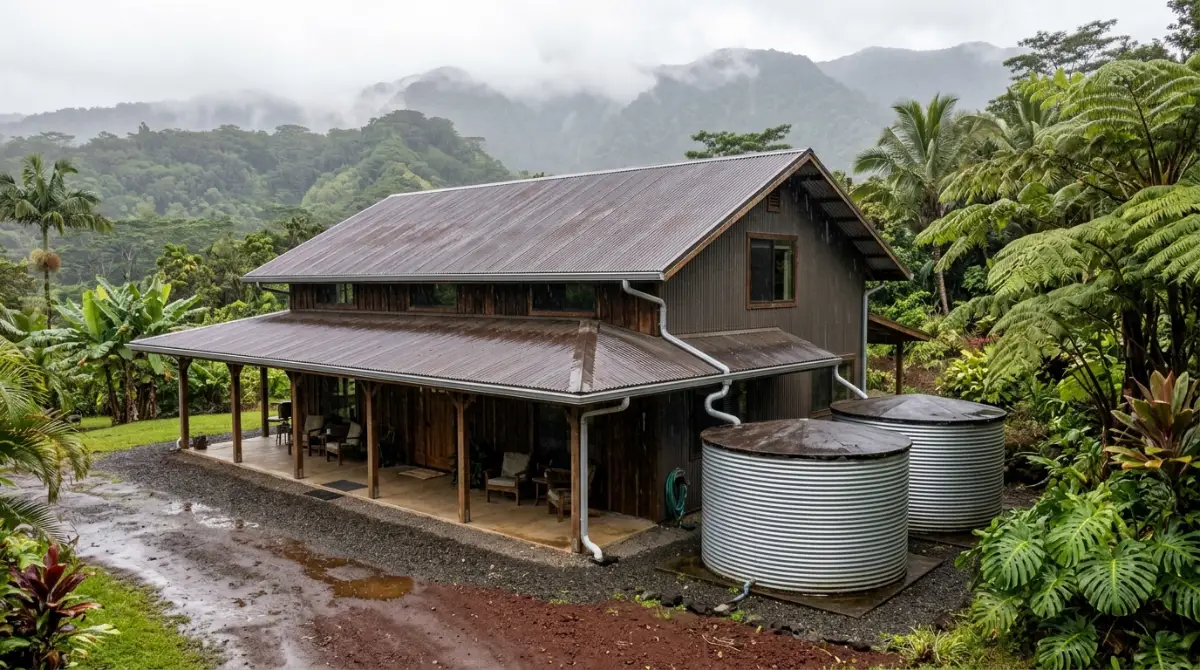
Some rural properties do not have the same public-water infrastructure available in developed neighborhoods. Rainwater catchment can therefore become part of the basic utility design rather than simply an optional sustainability feature.
The Hawaii Department of Health states that rainwater catchment systems on individual homes are not regulated by the Department of Health in the same way as regulated public water systems. However, DOH recommends careful system design, maintenance, testing and appropriate treatment when collected rainwater is used for domestic purposes.
A catchment system can include substantially more than a roof and tank.
- Roof collection area
- Gutters
- Leaf screens
- First-flush diversion
- Storage tanks
- Pumps
- Filtration
- Disinfection
- Pressure tanks
- Water testing
- Backup water supply
For a rural HI barndominium, the roof itself can therefore become part of the water-supply infrastructure.
How Roof Size Affects a Hawaii Rainwater Catchment System
A larger barndominium roof can provide more catchment area, which may be an advantage on a property dependent on rainwater. But a larger house also increases construction cost.
This creates an interesting design tradeoff: a simple rectangular barndominium with a large efficient roof may provide a better roof-to-floor-area relationship than a highly fragmented house with numerous roof sections.
Before finalizing the floor plan, a rural property owner should calculate expected water demand, tank capacity, rainfall patterns, dry-season conditions and backup-water requirements.
Hawaii Septic, Individual Wastewater Systems and Cesspools
Wastewater is one of the biggest differences between building a barndominium in Hawaii and building on a typical suburban mainland lot.
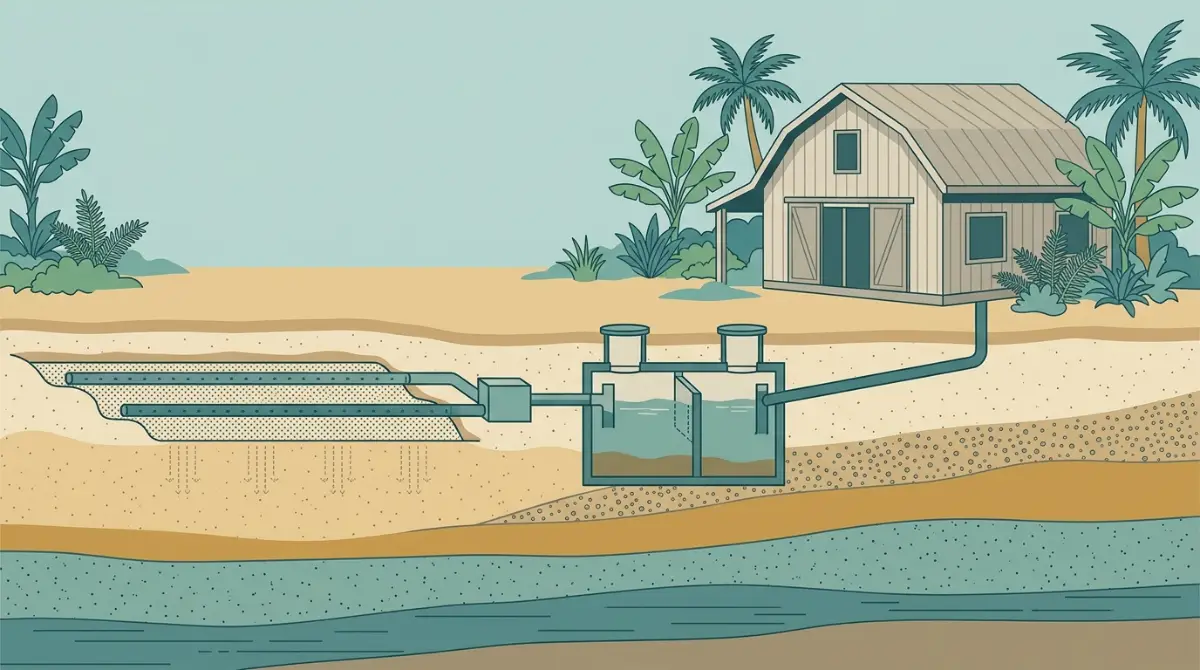
Hawaii’s Department of Health Wastewater Branch regulates Individual Wastewater Systems, commonly referred to as IWS. Approved approaches can include septic systems and certain aerobic treatment technologies.
The state wastewater program provides engineering and homeowner resources for designing and installing these systems.
For a new rural barndominium, the wastewater solution should be investigated before the house design is finalized because bedroom count, bathroom count, soil conditions, available area and site characteristics can affect the wastewater system.
Why Existing Cesspools Matter When Buying Hawaii Land
If you are buying an existing property and plan to replace or expand the residence, never ignore an existing cesspool.
Hawaii’s Department of Health describes cesspools as substandard systems that do not treat wastewater before disposal. State law requires cesspools, subject to applicable exemptions, to be upgraded, converted or connected to sewer by January 1, 2050.
There is an additional practical issue: certain building modifications can trigger wastewater-system requirements sooner. The Department of Health notes that changes affecting the nature or quantity of wastewater, such as adding bedrooms, kitchens or bathrooms, can create conversion or upgrade requirements in specific circumstances.
That means a property that looks cheap because it already has a house and wastewater system may not remain cheap after a major barndominium redevelopment.
2026 Hawaii Cesspool Conversion Changes
Hawaii also enacted Act 204 in July 2026 concerning cesspool conversions and a revolving loan fund intended to help finance conversions.
This does not make cesspool issues disappear, but it is important for Hawaii property owners because wastewater infrastructure can represent a major financial barrier on older rural properties.
If you are evaluating an existing parcel, check the property’s wastewater records and determine whether the proposed project could trigger conversion requirements before making a purchase decision.
Can a Hawaii Barndominium Use an Agricultural Building Exemption?
This is one of the most misunderstood issues in Hawaii barndominium research.
Hawaii Revised Statutes §46-88 (see the current HRS at the state Capitol site) provides exemptions for certain agricultural buildings and structures, but the statute specifically distinguishes qualifying agricultural structures from buildings used as dwellings or lodging units.
That means you should not assume that calling a residential barndominium a “farm building” eliminates the residential building permit process.
For example, Honolulu’s Department of Planning and Permitting explains that qualifying agricultural structures may be exempt under HRS §46-88 but also notes that these structures are not residential buildings and that additional limitations apply.
Maui County similarly treats the HRS §46-88 exemption as an agricultural-structure exemption rather than a shortcut for constructing a residence.
For a true barndominium used as a home, plan the project as a residence unless the county and appropriate professionals have confirmed a different legal classification.
Hawaii Agricultural Land and Farm Dwelling Rules
Agricultural zoning creates another layer of complexity.
Hawaii’s agricultural districts are governed by state land-use law administered through the State Land Use Commission, while county planning rules also affect development. Hawaii Revised Statutes §205-4.5 identifies farm dwellings, farm buildings and activities related to farming and animal husbandry among certain permitted agricultural uses, subject to the statutory conditions.
That does not mean every agricultural parcel automatically allows any size residential barndominium.
Before purchasing agricultural land for a barndominium, verify:
- State Land Use District
- County zoning
- Permitted residential use
- Farm-dwelling requirements
- Minimum lot requirements
- Access requirements
- Water availability
- Wastewater feasibility
- Flood hazards
- Special Management Area status
- Environmental restrictions
- Historic or cultural-resource constraints where applicable
A cheap agricultural parcel is not automatically a cheap residential building site.
Hawaii Special Management Area Permits for Coastal Properties
Coastal land can be extremely attractive for a Hawaii barndominium, but it can also be one of the most complicated places to build.
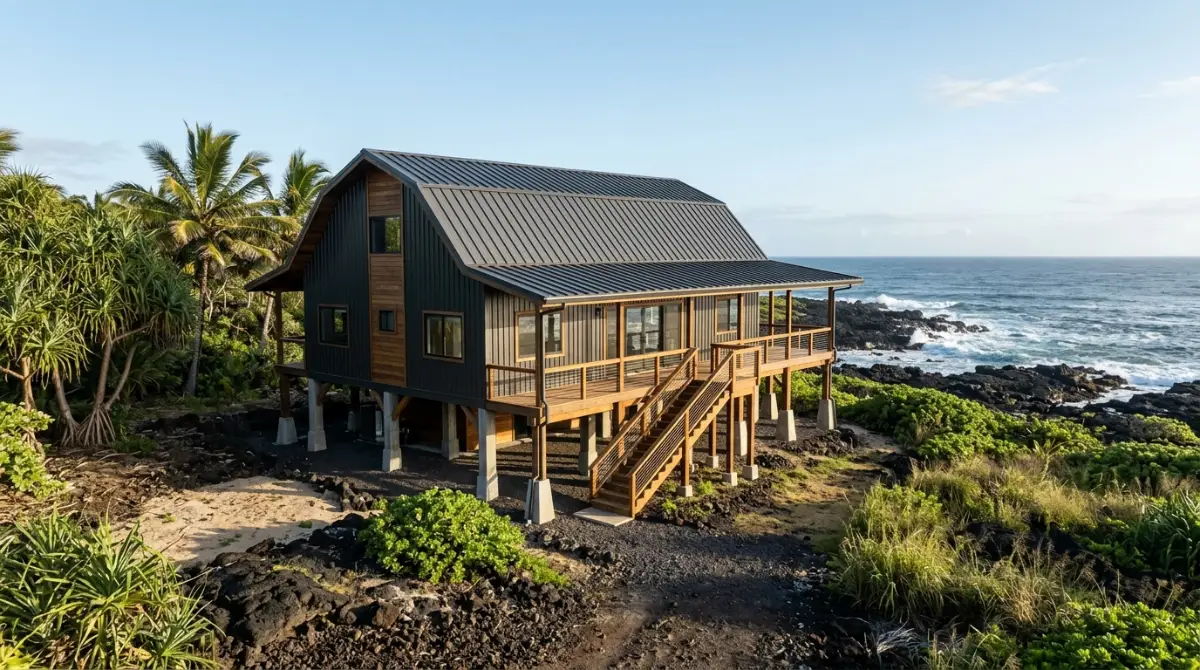
Hawaii’s Coastal Zone Management program uses Special Management Area, or SMA, permitting to regulate development near the shoreline.
The SMA process can apply to activities such as construction, grading, land-use changes and other development activities. County authorities administer the SMA system, while the state Office of Planning and Sustainable Development oversees the statewide coastal-management framework.
For a coastal barndominium, the question is therefore not simply “Is this lot zoned residential?” You also need to ask whether the parcel is inside an SMA and what additional approvals apply.
Hawaii Shoreline, Flooding and Sea-Level Rise
Sea-level rise is not a theoretical issue for coastal Hawaii construction.
Hawaii’s Climate Change Portal reports that sea level is rising and projects approximately 8 inches of additional sea-level rise by 2050 relative to 2020 under its intermediate scenario, with substantially larger long-term possibilities.
For a barndominium near the coast, this can affect site selection, finished-floor elevation, drainage, access, insurance, erosion exposure and the long-term usefulness of the property.
A beautiful ocean-view parcel may therefore be a more complicated construction site than an inland parcel only a short distance away.
Questions to Ask Before Building Near the Hawaii Coast
- Is the parcel inside a Special Management Area?
- Is it affected by shoreline setback requirements?
- Is it in a FEMA flood zone?
- Is there a tsunami evacuation zone?
- Is there a history of coastal flooding?
- Is the road vulnerable to flooding?
- Will the wastewater system remain functional during coastal flooding?
- What is the expected finished-floor elevation?
- Will the property require special foundation or drainage design?
- How will sea-level rise affect the property over the expected life of the home?
Hawaii Flood Zones and the FHAT Map
Hawaii’s Department of Land and Natural Resources maintains the Flood Hazard Assessment Tool, commonly known as FHAT, through the Hawaii NFIP program.
The tool allows property owners and buyers to investigate flood hazard information and compare parcel locations against FEMA flood data.
Before buying rural land for a barndominium, check the parcel using the Hawaii flood mapping tools and then confirm the result with the applicable county floodplain authority.
Do not rely on the seller’s statement that a property “has never flooded.”
Tsunami Risk and Hawaii Barndominium Site Selection
Hawaii’s geography makes tsunami planning another site-selection issue.
A property can look perfectly safe during normal weather and still be inside a tsunami evacuation area. The Hawaii Emergency Management Agency provides tsunami evacuation maps and county-specific resources.
If a proposed barndominium is close to the shoreline, investigate the evacuation zone before choosing the house location, driveway route, utilities and emergency-storage areas.
A slightly higher or more inland building site may offer a substantially better risk profile than the lowest portion of a coastal parcel.
Hawaii Island Lava Zones and Barndominium Construction
If you are building on Hawaii Island, volcanic hazards deserve their own section of the land-buying checklist.
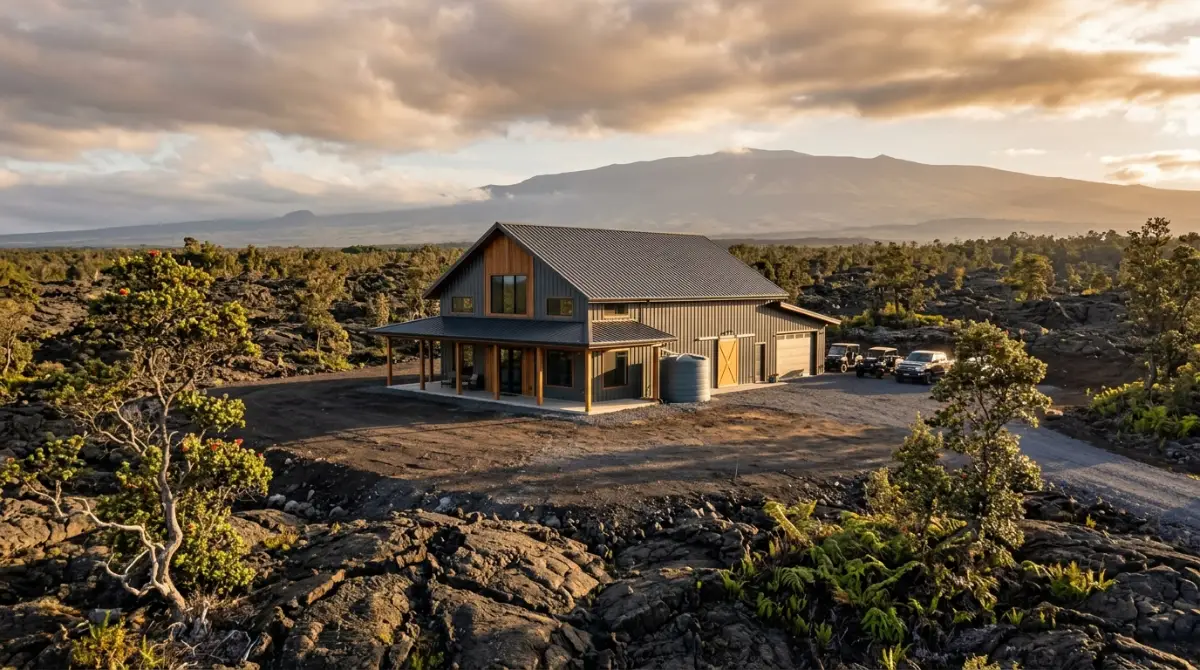
The Island of Hawaii contains active volcanic systems, including Kilauea and Mauna Loa. The state and the USGS Hawaiian Volcano Observatory maintain lava-flow hazard information divided into nine broad hazard zones.
Zone 1 represents the highest long-term lava-flow hazard, while Zone 9 represents the lowest relative hazard on the historic hazard map.
The important point is that lava hazard is not simply about whether lava has recently appeared on a property. The USGS hazard zones are based on long-term geological evidence and the historical distribution of lava flows.
For a Hawaii Island barndominium, investigate the property’s lava hazard zone before purchasing land.
What Lava Risk Means for a Barndominium Buyer
A metal building cannot be engineered to make a parcel immune to a major lava flow. The more practical strategy is to use hazard information as part of land selection.
Other volcanic hazards can also matter, including volcanic gases, ash, earthquakes, ground fractures and subsidence.
This is particularly important when evaluating inexpensive acreage on Hawaii Island. A lower land price does not necessarily represent a bargain if the site has difficult hazard exposure, insurance challenges, poor access or expensive infrastructure requirements.
Hawaii Wildfire Risk and Barndominium Design
Wildfire risk is another consideration, particularly in dry areas and communities affected by changing vegetation and weather conditions.
A barndominium should not be evaluated only by asking whether its primary structure is steel. The roof, exterior walls, windows, doors, decks, attached structures, landscaping and surrounding vegetation all influence wildfire exposure.
For properties in higher-risk areas, discuss defensible space and fire-resistant construction strategies with the local building department and design professionals.
Hawaii Foundation Costs and Difficult Terrain
Foundation design can vary dramatically from one Hawaii parcel to another.
A relatively flat site with favorable soil conditions may require conventional site preparation. A sloped parcel may require extensive grading, retaining walls, engineered foundations, drainage systems or specialized access.
Volcanic terrain introduces another consideration. Some Hawaii Island parcels have rugged lava surfaces that can complicate excavation, utilities and foundation preparation.
Do not assume that a simple rectangular barndominium footprint automatically means a simple foundation.
Driveway and Site Access Costs in Hawaii
Site access is often overlooked when people calculate the Hawaii barndominium cost per square foot.
The steel package, appliances, concrete, drywall and other materials have to reach the property.
A narrow rural road, steep driveway, bridge restriction or difficult turning area can increase transportation and construction logistics costs.
Before finalizing a building footprint, determine:
- Where construction trucks will enter
- Whether concrete trucks can reach the slab
- Where steel components can be unloaded
- Whether cranes or lifting equipment can access the site
- Whether temporary construction staging is possible
- Whether the driveway needs widening
- Whether drainage improvements are required
A beautiful remote lot can become an expensive construction site if equipment access is difficult.
Inter-Island Shipping and Material Logistics
One of the biggest Hawaii-specific cost factors is geography.
Construction materials do not always move directly from a nearby mainland supplier to the building site. Depending on the project and supplier, materials may move through ports, warehouses and inter-island transportation networks before reaching the property.
This makes delivery planning more important than it is for many mainland barndominium projects.
Ask your builder:
- Where will the steel package be manufactured?
- How will it reach Hawaii?
- Who pays freight?
- Who pays port or handling charges?
- Is inter-island transportation included?
- What happens if a component arrives damaged?
- How are replacement components shipped?
- How long are material lead times?
A slightly more expensive local or regionally available product may sometimes make more financial sense if it reduces shipping complexity and project delays.
Hawaii Barndominium Cost by Island and County
There is no single Hawaii construction market.
The four major county-level markets—Honolulu, Hawaii, Maui and Kauai—can behave very differently because of land availability, labor, infrastructure, permitting, topography and transportation.
| County | Islands | Main Due-Diligence Items |
|---|---|---|
| Honolulu | Oahu | Zoning, agricultural-structure rules, SMA and coastal review, drainage, land availability |
| Hawaii County | Hawaii Island | Lava hazard zones, rainwater catchment, IWS feasibility, rural access, volcanic terrain |
| Maui County | Maui, Molokai, Lanai | Wildfire exposure, flood-development rules, rebuilding demand, access and agricultural zoning |
| Kauai County | Kauai | Rainfall, steep terrain, drainage, access, electronic permit review |
Oahu Barndominium Cost Considerations
Oahu is the state’s largest population center and has extensive infrastructure compared with many rural areas on other islands. However, that does not automatically make every Oahu barndominium inexpensive.
Land availability, zoning, development restrictions and high construction demand can dominate the economics.
Rural Oahu properties can also have unique agricultural and land-use requirements. Honolulu’s Department of Planning and Permitting maintains specific rules for agricultural structures and other development categories.
For an Oahu barndominium, investigate zoning and permitted residential use before spending money on building plans.
Oahu Locations That Require Extra Due Diligence
- North Shore
- Windward Oahu
- Central Oahu agricultural areas
- Leeward rural properties
- Coastal parcels
- Properties near drainage channels
Oahu can offer easier access to suppliers and trades than some neighbor islands, but land and permitting constraints can offset that advantage.
Hawaii Island Barndominium Cost Considerations
Hawaii Island can offer more acreage opportunities than Oahu, but it introduces some of the state’s most distinctive construction risks.
Volcanic hazard zones, large distances between communities, rural roads, water availability, rainwater catchment and private wastewater systems can all become important.
Areas around Hilo, Puna, Kona, Waimea, Kohala and South Kona can have very different construction conditions.
Hilo and East Hawaii
Hilo and the wetter eastern side of the island can create very different drainage, roofing and moisture-management requirements from drier Kona-side locations.
Roof drainage, exterior moisture control and site grading deserve particular attention on properties receiving substantial rainfall.
Kona and West Hawaii
West Hawaii often presents a different combination of dry climate, solar exposure, water considerations and lava terrain.
Properties dependent on catchment water should be evaluated based on actual rainfall patterns, roof area and household demand rather than simply assuming that a large roof guarantees adequate water.
Puna
Puna requires particularly careful land due diligence because of volcanic hazards, lava-flow history, rural infrastructure and wastewater considerations.
Never purchase inexpensive Puna acreage for a barndominium without checking the applicable lava hazard information, road access, water source, wastewater feasibility and insurance situation.
Maui County Barndominium Cost Considerations
Maui County includes Maui, Molokai and Lanai, and these areas should not automatically be treated as one identical construction market.
Maui has experienced major disaster-recovery and rebuilding activity, which can affect contractor availability, permitting workloads and construction resources.
Maui County also requires building permits for construction and maintains separate flood-development requirements for properties in flood hazard areas.
For rural Maui projects, investigate access, water, wastewater, wildfire exposure, agricultural zoning and topography before selecting the barndominium footprint.
Kauai Barndominium Cost Considerations
Kauai’s geographic isolation and terrain make logistics particularly important.
The county operates an electronic building-permit review system and provides residential permitting checklists for applicants.
Rainfall, steep terrain, drainage and access can be major site-development factors depending on the location.
For a Kauai barndominium, a property that is only a short driving distance from a town may still require substantial site work if the building pad is difficult to access or the parcel has drainage and slope constraints.
Hawaii Barndominium Design Ideas That Actually Make Sense
A Hawaii barndominium should not simply copy a Texas barndominium floor plan and move it to the Pacific. Our popular barndominium floor plans are a good starting point for living-plus-shop layouts that can be adapted to island conditions.
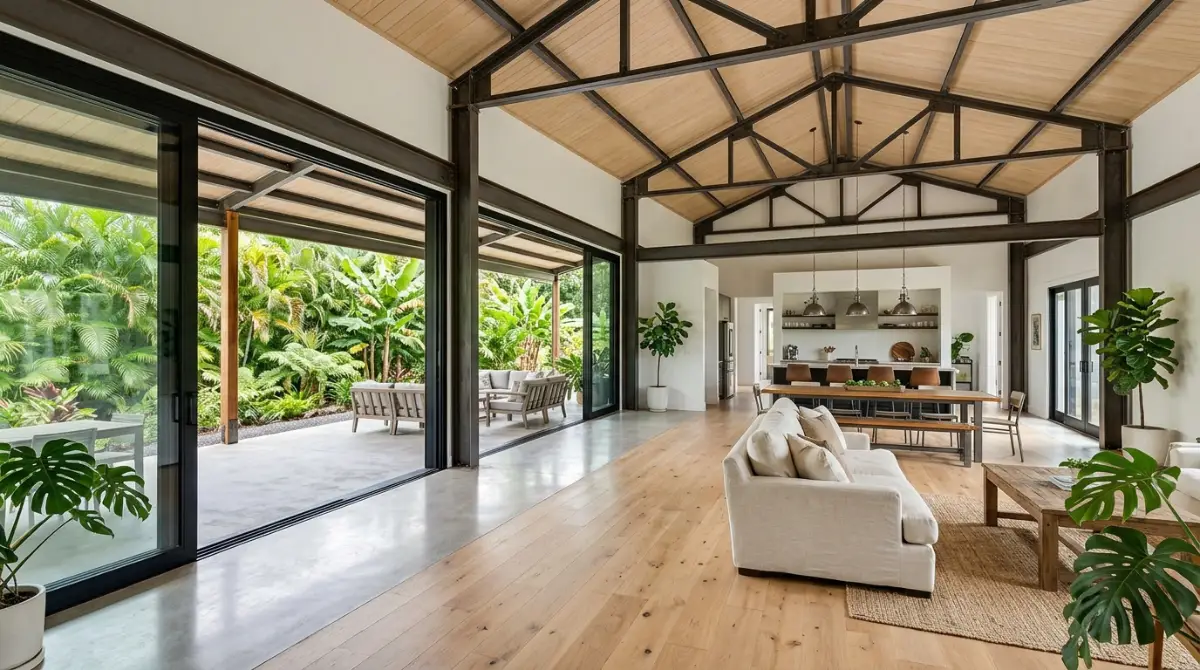
The climate and lifestyle support a different design approach.
Large Covered Outdoor Living Area
A covered lanai-style outdoor space can provide valuable living area without requiring the same level of interior conditioning as an enclosed room.
The design should account for wind exposure, rain direction, drainage and corrosion protection.
Simple Rectangular Building Footprint
A straightforward footprint can reduce unnecessary structural complexity and make the roof easier to manage for both drainage and rainwater collection.
High-Performance Ventilation and Cooling
Rather than relying on a single central HVAC concept, the design can be evaluated for zoned cooling, ventilation and humidity control appropriate to the island’s microclimate. Insulation matters here too, so see our guide on whether spray foam insulation is mandatory for a barndominium.
Dedicated Storage and Utility Space
Water equipment, filtration, pumps, electrical equipment, tools and emergency supplies can consume significant space on rural properties.
Designing utility areas into the original plan is generally better than trying to add them later.
Should a Hawaii Barndominium Have a Large Garage or Shop?
One of the biggest advantages of the barndominium concept is combining living space and shop space.
In Hawaii, the shop may be particularly useful for equipment, agricultural tools, vehicles and storage. But the additional square footage also affects the foundation, structure, roof, electrical service and site-development requirements.
Before adding a very large shop, decide whether the space will genuinely be used.
A 1,500-square-foot residence with a 1,000-square-foot shop is a very different project from a 2,500-square-foot fully finished house, even if the total roof area looks similar.
Hawaii Barndominium Budget Checklist: Hidden Costs and Everything Else
The biggest budget mistakes usually happen outside the advertised price per square foot. Use this single list as both a hidden-cost check and a final budget checklist before committing to construction.
- Land purchase
- Surveying
- Geotechnical investigation
- Architectural or design services
- Structural engineering
- Permit fees
- County planning approvals and zoning review
- SMA review where applicable
- Flood-related requirements
- Site grading
- Retaining walls
- Driveway construction
- Drainage systems
- Foundation
- Steel or post-frame shell
- Roofing
- Windows and doors
- Insulation
- Electrical service extension
- Electrical and plumbing
- HVAC
- Fire sprinklers where required
- Water connection
- Rainwater catchment equipment
- Water filtration
- Water storage
- Septic or IWS system
- Cesspool conversion
- Utility trenching
- Construction equipment access
- Freight and inter-island transportation
- Temporary utilities
- Insurance
- Emergency power
- Appliances
- Kitchen and bathroom upgrades
- Flooring and interior finishes
- Lanai or covered outdoor space
- Landscaping
- Contingency reserve
Why the Cheapest Hawaii Barndominium Quote May Not Be the Cheapest Project
Suppose one contractor quotes a low shell price but excludes freight, engineering, foundation preparation and exterior openings.
Another contractor may provide a higher initial quote but include engineering coordination, delivery, erection and a more complete weather-tight shell.
The second contractor may ultimately be cheaper.
Always compare quotes using a scope-of-work document rather than the headline price.
How to Compare Hawaii Barndominium Builders
Ask every builder the same questions.
- What exactly is included in the quoted price?
- Does the price include foundation work?
- Does it include engineering?
- Does it include freight to the island?
- Does it include inter-island transportation?
- Who handles building permits?
- Who coordinates county inspections?
- Who handles plumbing and electrical permits?
- Is wastewater included?
- Is water infrastructure included?
- Is rainwater catchment included?
- What wind design criteria are being used?
- What fire-sprinkler requirements apply?
- What insulation system is included?
- What windows and exterior doors are included?
- What warranty is provided?
- How are material delays handled?
- What happens if a damaged component needs replacement?
- What work is performed by subcontractors?
- Who is responsible for final completion and certificate of occupancy?
Hawaii Barndominium Financing
Financing a Hawaii barndominium can require more preparation than financing a conventional home because lenders may be unfamiliar with the specific construction method or the property’s infrastructure.
A lender may want detailed construction plans, contractor information, engineering documents, permits, appraisal information and a clearly defined construction budget.
If the property uses a private water system, IWS, catchment system or unusual agricultural-land arrangement, those issues should be explained to the lender before closing.
Do not build your financial plan around the shell price alone. Run the numbers through our Free Home Loan Calculator to see a realistic monthly payment, and if you already own property, our Home Equity Calculator can estimate how much equity may be available.
Can You Build a Barndominium on Cheap Hawaii Land?
Yes, but cheap land should trigger more questions rather than excitement.
When a parcel is substantially cheaper than surrounding properties, investigate the reason. This single checklist works for any parcel you are considering, cheap or not.
- Can I legally build a single-family residence here, and which county department handles the building permit?
- What zoning district is the parcel in, and is it in the State Agricultural District?
- Is a farm dwelling allowed, and is residential use permitted?
- Is there legal road access, and is the road privately maintained?
- Is the road suitable for construction equipment, and can equipment reach the building site?
- Is electricity nearby?
- Is public or county water available?
- Can a rainwater system support the planned residence?
- Is an IWS feasible, and is there an existing wastewater system or cesspool?
- Could the proposed residence trigger cesspool conversion?
- Is the parcel in a flood hazard area or a tsunami evacuation zone?
- Is it inside an SMA, and what is the shoreline setback?
- Is it in a high lava-flow hazard zone or otherwise exposed to volcanic hazards?
- Is wildfire risk significant?
- What fire protection requirements and structural wind criteria apply?
- Can the planned barndominium be insured and financed?
In Hawaii, the land-development cost can completely change the economics of a bargain parcel.
Hawaii Barndominium Land Due-Diligence Table
Before making an offer on land, collect the following information:
| Item | What to Verify |
|---|---|
| Zoning | Residential, agricultural or other permitted use |
| State Land Use | Urban, Agricultural, Conservation or other designation |
| Water | Public water, private source or rainwater catchment feasibility |
| Wastewater | Sewer, IWS feasibility or existing cesspool condition |
| Flood | FEMA and Hawaii flood hazard information |
| Coastal | SMA, shoreline and erosion considerations |
| Tsunami | Evacuation-zone status |
| Volcanic | Lava-flow hazard zone where applicable |
| Wildfire | Local fire exposure and access |
| Access | Legal and physical construction access |
| Utilities | Electricity, communications and other services |
| Topography | Slope, drainage and building-pad feasibility |
Hawaii Barndominium Cost-Saving Strategies
Saving money does not necessarily mean choosing the cheapest steel package. For a broader, state-independent approach, read our complete guide to planning a barndominium on a budget.
Choose a Simple Footprint
A rectangular building can simplify framing, roofing, foundation layout and interior planning.
Design the Roof for Multiple Purposes
In a catchment-dependent property, the roof can provide both weather protection and water collection.
Reduce Unnecessary Interior Complexity
Every additional bathroom, kitchen area, plumbing branch and complicated wall layout adds cost.
Use a Rational Wet-Core Layout
Keeping bathrooms, kitchen plumbing and utility spaces relatively close can reduce unnecessary pipe runs.
Build the Infrastructure Correctly the First Time
It is usually cheaper to install appropriate drainage, water storage and utility infrastructure during construction than to retrofit it after the house is finished.
Do Not Sacrifice Structural Resilience
Hawaii is not the place to save money by weakening connections, using unsuitable exterior openings or ignoring wind exposure.
Hawaii Barndominium vs Traditional Home
A barndominium can offer advantages such as large open spans, flexible shop space and efficient building geometry. But the metal-building concept does not automatically eliminate the major costs of residential construction.
Both a conventional home and a barndominium still require foundations, plumbing, electrical systems, bathrooms, kitchens, insulation, windows, doors, HVAC or ventilation systems, site development and regulatory approvals.
The financial advantage depends on the specific design and contractor rather than on the word “barndominium.” Our Barndominium vs House comparison walks through the trade-offs.
Is a Hawaii Barndominium Actually Cheaper Than a Conventional House?
Sometimes it can be, particularly when the project takes advantage of a simple structural system and combines a residence with a shop or large open-span area.
But Hawaii’s high construction costs mean that the expected savings should be calculated using the complete project budget.
If a barndominium requires expensive engineering, imported materials, specialized labor, complex interior finishing and extensive site infrastructure, the difference from a conventional home can become much smaller. Use our Barndominium vs House Cost Calculator to price both options at the same size and finish level.
Hawaii Barndominium Cost Per Sq Ft: What the Number Does Not Tell You
The phrase Hawaii barndominium cost per sq ft is useful for comparing early concepts, but it should never be treated as a complete project budget.
For example, two 2,000-square-foot homes can have dramatically different total costs if one sits on a serviced residential lot and the other sits on remote agricultural acreage.
The building size is identical. The development conditions are not.
That is why serious Hawaii planning should use at least three separate numbers:
- Building cost
- Site and infrastructure cost
- Land cost
Only after those three categories are combined do you have a meaningful project budget.
Hawaii Barndominium Cost Example: Rural 2,000 Sq Ft Project
Imagine a buyer owns a rural Hawaii parcel and wants a 2,000-square-foot barndominium with an attached shop.
The first budget should establish the building range using current Hawaii market estimates.
The next step is to investigate the property itself using the land checklist above: water source and catchment feasibility, sewer or IWS, any existing cesspool, equipment access, grading, flood and SMA status, volcanic exposure, wind design requirements and fire-sprinkler requirements.
Only after these questions are answered should the buyer turn the initial per-square-foot estimate into a real construction budget.
Hawaii Barndominium Building Timeline
Hawaii projects can take longer than a mainland buyer expects because several approvals may have to be coordinated before construction begins.
A practical sequence is:
- Choose the property.
- Verify zoning and land-use eligibility.
- Check flood, tsunami, coastal and other hazards.
- Determine water availability.
- Determine wastewater feasibility.
- Complete surveys and site investigations.
- Develop preliminary building plans.
- Complete structural engineering.
- Prepare permit documents.
- Submit county applications.
- Resolve plan-review comments.
- Finalize construction pricing.
- Order long-lead materials.
- Prepare the site.
- Construct the foundation.
- Erect the shell.
- Complete mechanical, electrical and plumbing work.
- Install interior finishes.
- Complete inspections.
- Obtain final approval for occupancy.
Ordering the steel package before the site and permitting process is understood can create unnecessary financial risk.
How to Get a More Accurate Hawaii Barndominium Estimate
The best way to improve your estimate is to stop using a generic statewide number as soon as you have a property in mind.
Enter the property-specific information into your project estimate and obtain contractor pricing based on the actual location.
At minimum, provide the builder with:
- Island
- County
- Property location
- Lot size
- Approximate building footprint
- Heated living area
- Shop area
- Number of bedrooms
- Number of bathrooms
- Water source
- Wastewater method
- Desired finish level
- Existing driveway condition
- Electrical availability
- Known flood or coastal conditions
- Target construction schedule
The more information the builder has, the less likely you are to receive a misleading headline estimate.
Use a Hawaii Barndominium Cost Calculator
If you are still in the planning stage, a calculator can help you estimate the building portion of the project before you request contractor quotes.
Our Barndominium Cost Calculator can be used as an initial planning tool for estimating the building budget based on size and project assumptions.
For a Hawaii project, remember that the calculator should be treated as a starting point. Site development, water, wastewater, coastal approvals, land and island-specific logistics may require separate estimates.
Hawaii Barndominium Cost Per Sq Ft: Frequently Asked Questions
How much does a barndominium cost per square foot in Hawaii in 2026?
Current published 2026 estimates place Hawaii barndominiums at approximately $250–$380 per square foot for turnkey construction and approximately $85–$140 per square foot for an erected shell. These are planning estimates rather than guaranteed Hawaii contractor bids.
How much does a 2,000 sq ft barndominium cost in Hawaii?
Using the current statewide planning range, a 2,000-square-foot finished barndominium is roughly $500,000–$760,000 for the building itself. Land, site work, utilities, water and wastewater can add substantially to the total project cost.
Why are Hawaii barndominiums more expensive than Texas barndominiums?
Hawaii has higher construction costs because of geographic isolation, imported materials, transportation, labor availability, limited buildable land and additional site-development requirements. Rural properties can also require private water and wastewater infrastructure.
Can I build a barndominium on agricultural land in Hawaii?
Possibly, but agricultural land does not automatically mean that any residential design is permitted. State land-use requirements, county zoning and farm-dwelling rules must be reviewed before purchasing the property.
Can I call my Hawaii barndominium an agricultural building to avoid permits?
Not simply because the structure has a metal frame or is located on agricultural land. HRS §46-88 provides specific exemptions for qualifying agricultural structures and excludes structures used as dwellings or lodging units from the basic exemption.
Do Hawaii barndominiums need fire sprinklers?
Residential sprinkler requirements are part of Hawaii’s modern residential-code framework, so the applicable requirements should be confirmed during design and permitting for a new dwelling.
Can I use rainwater for a Hawaii barndominium?
Individual residential rainwater catchment systems are used in Hawaii, particularly where public water is unavailable. The Hawaii Department of Health recommends careful design, maintenance, testing and appropriate treatment when catchment water is used for domestic purposes.
Can I build a barndominium on land with a cesspool?
It depends on the existing system and the proposed project. Major modifications that increase wastewater flow can trigger wastewater requirements, and Hawaii law requires applicable cesspools to be upgraded, converted or connected to sewer by January 1, 2050.
Is Hawaii Island a good place for a barndominium?
It can be, especially for buyers looking for acreage, but the property must be investigated for lava-flow hazard, water, wastewater, access, flood exposure, utilities and insurance before purchase.
Are coastal Hawaii properties good for barndominiums?
They can offer an attractive lifestyle, but coastal properties require additional due diligence involving flooding, tsunami exposure, shoreline rules, Special Management Area requirements, erosion and long-term sea-level rise.
Which Hawaii island is cheapest for a barndominium?
There is no reliable statewide rule saying one island is always the cheapest. Land price, access, water, wastewater, labor, material transportation and site conditions can make one parcel dramatically more expensive than another regardless of island.
Is a Hawaii barndominium cheaper than a conventional home?
It can be, but the savings depend on the design and scope. A barndominium still requires residential foundations, engineering, plumbing, electrical, insulation, interior finishes and regulatory approvals.
Does the Hawaii barndominium cost per square foot include land?
No. The published building-cost figures discussed in this article are building estimates. Land, major site development, water, wastewater and other property-specific expenses need to be budgeted separately.
Final Thoughts on Hawaii Barndominium Cost Per Sq Ft
The Hawaii barndominium cost per sq ft is among the highest in the United States, but the statewide number only tells part of the story.
The real challenge is not simply constructing the steel building. It is finding a property where the building can be legally permitted, structurally engineered, supplied with water, connected to an appropriate wastewater system, reached by construction equipment and protected from the site’s specific natural hazards.
For HI buyers, the smartest approach is therefore to evaluate the land and infrastructure before becoming attached to a particular barndominium floor plan.
A relatively simple building on a well-served parcel can make more financial sense than a cheaper-looking building on remote acreage with difficult access, private water, wastewater problems, flood exposure or extensive grading.
If you are comparing Hawaii with other states, you can also return to our Barndominium Cost Per Sq Ft by State guide to compare Hawaii with mainland markets. Western and Pacific-region guides worth comparing include Alaska, California, Washington and Oregon, and you can browse every state in our Barndominium Cost hub. For broader planning, our Barndominium in 2026: Plans, Cost & Finishing guide is a useful companion read.
And if you already know your approximate square footage, use the Barndominium Cost Calculator to build an initial project estimate before requesting detailed contractor quotes.
Bottom line: In Hawaii, the cheapest barndominium is not necessarily the one with the lowest steel price. It is the project where the land, infrastructure, engineering, permitting, transportation and finished building are planned together from the beginning.