
If you want to learn how to design a floor plan that truly works for your family, you need to look beyond just square footage.
I’ve drawn hundreds of house plans over the past decade. With that experience, I can tell you one thing with confidence: your floor plan matters ten times more than your finishes. It doesn’t matter if you spend thousands on expensive tile. If walking through the house is a pain, you’ll hate it.
Before you fall for a pretty 3D rendering, consider these common mistakes I see my clients make – and how you can avoid them.
1. Stop Chasing Square Footage
People often come to me saying, “I need about 2,500 square feet.” When I ask why, they usually don’t have a good answer.
I tell them: how you live matters more than how many square feet you have.
- Cook every day? Build a kitchen that works for you.
- Work from home? Make sure you have a room with a door you can close.
- Young kids? Put the laundry room near the bedrooms.
Let your actual needs drive the size of your house — not some random number in your head.
2. Cut Down on Hallways
If you want to learn how to design a floor plan that truly works for your family, you need to look beyond just square footage. I’ve seen 2,000 sq ft floor plans where nearly 300 sq ft is just hallway. Dead space. You can’t live there. You just walk through it.
Modern house plans are about using every inch wisely. An open concept living area (kitchen, dining, living all together) makes the house feel bigger and saves you from wasting money on halls that go nowhere.
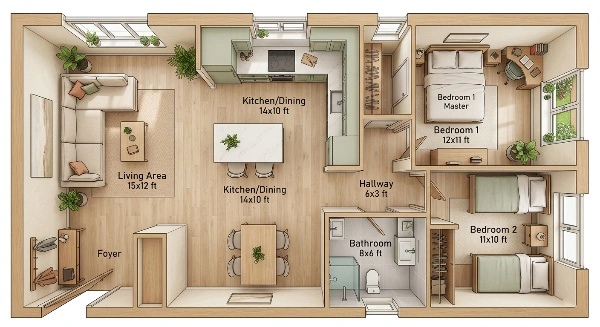
3. Windows Aren’t Just for Looks
Some people put all their windows on the front of the house and leave the back dark and depressing. That’s a mistake.
Try to put windows on two sides of every main room. Cross-light changes everything.
And pay attention to which direction your windows face. A giant wall of glass on the wrong side can turn your house into an oven in the summer. Looks great on Pinterest. Not so fun when your AC is running nonstop.
4. Your Bedroom Doesn’t Need to Be a Hotel Lobby
Some clients ask for a massive master bedroom. When I ask why, they say, “We want a sitting area.”
But let’s be honest — when’s the last time you actually sat in a chair in your bedroom just to sit? Most people pile laundry on that chair and call it a day.
Instead of a huge empty bedroom, use that space for a walk-in closet or a bigger bathroom. Those will actually improve your daily life.
5. Use the Internet the Right Way
I tell my clients the same thing every time: “Research like crazy. Just don’t copy blindly.”
Here’s a process that works:
Step 1: Gather ideas. Save floor plans, elevation photos, and room layouts you like. Create a folder or a Pinterest board. This helps you learn what’s possible.
Step 2: Identify what you actually need. That giant window wall looks amazing – but do you need it facing west in Texas? Probably not. That open shelving is beautiful – but are you willing to dust it every week?
Step 3: Take your research to an architect. Let them tell you which ideas work for your site, your climate, and your budget. A good architect will say, “That’s a great idea, but here’s how we need to change it for your situation.”
Step 4: Trust the professional. You did your homework. Now let them do theirs.
The internet is an incredible tool for learning. But it’s a terrible architect. Use it to get inspired. Then hire someone to turn that inspiration into a house that actually works for you.
6. Don’t Over-Plan for the Future
Some people worry about “what if” scenarios – another kid, a parent moving in, a home office – and end up building a house that’s far too big for their needs today.
A better approach: Add one flexible room that can adapt as your life changes. Use it as an office today, a guest room tomorrow, or a nursery whenever. That’s enough. You don’t need to plan for every possible future.
7. Find Someone Who Will Tell You “No”
The best architect isn’t the one who says “yes” to everything.
“You want a 10‑foot kitchen island? Sure!”
“You want a two‑story great room with a bridge? Absolutely!”
A good architect will say, “Let’s talk about why you want that,” or even, “That’s a bad idea and here’s why.”
When hiring someone, ask about a time they talked a client out of something. If they can’t give you an answer, keep looking.
Final Thought
Building a house is stressful. Small mistakes will happen. A window might show up the wrong size. Something will go over budget.
But if your floor plan is solid – if the layout actually works for how you live – those other problems become manageable. Standing in that kitchen with morning light and a cup of coffee, you’ll know it was worth it.
Get the plan right first. Everything else is just decoration.
1 thought on “How to Design a Floor Plan: 7 Expert Tips Before You Build”