
Washington · 2026 Cost Guide
Washington Barndominium Cost Per Sqft (2026)
WA building codes, snow load, earthquake and wildfire design, critical areas, wells and septic, and the rural land costs that shell prices leave out.
If you are researching Washington barndominium cost per sqft, the price of the metal structure is only the beginning of the calculation. In Washington, the final cost can be heavily influenced by the county, rural land-use rules, critical areas, septic requirements, water availability, earthquake design, snow load, wildfire exposure, slope, drainage and the amount of site work required.
Washington barndominium cost per sqft varies more than in most states. Washington is particularly interesting for barndominium construction because the state has very different building environments. A rural property east of the Cascades can have a completely different construction profile from acreage in the Puget Sound region, the Olympic Peninsula, southwest Washington or the Columbia Basin.
This 2026 guide focuses specifically on Washington, or WA, including current construction-cost benchmarks, Washington residential building codes, rural zoning, permit-exempt wells, septic systems, seismic hazards, wildfire requirements, critical areas and the site costs that can make a rural barndominium much more expensive than the advertised shell price.
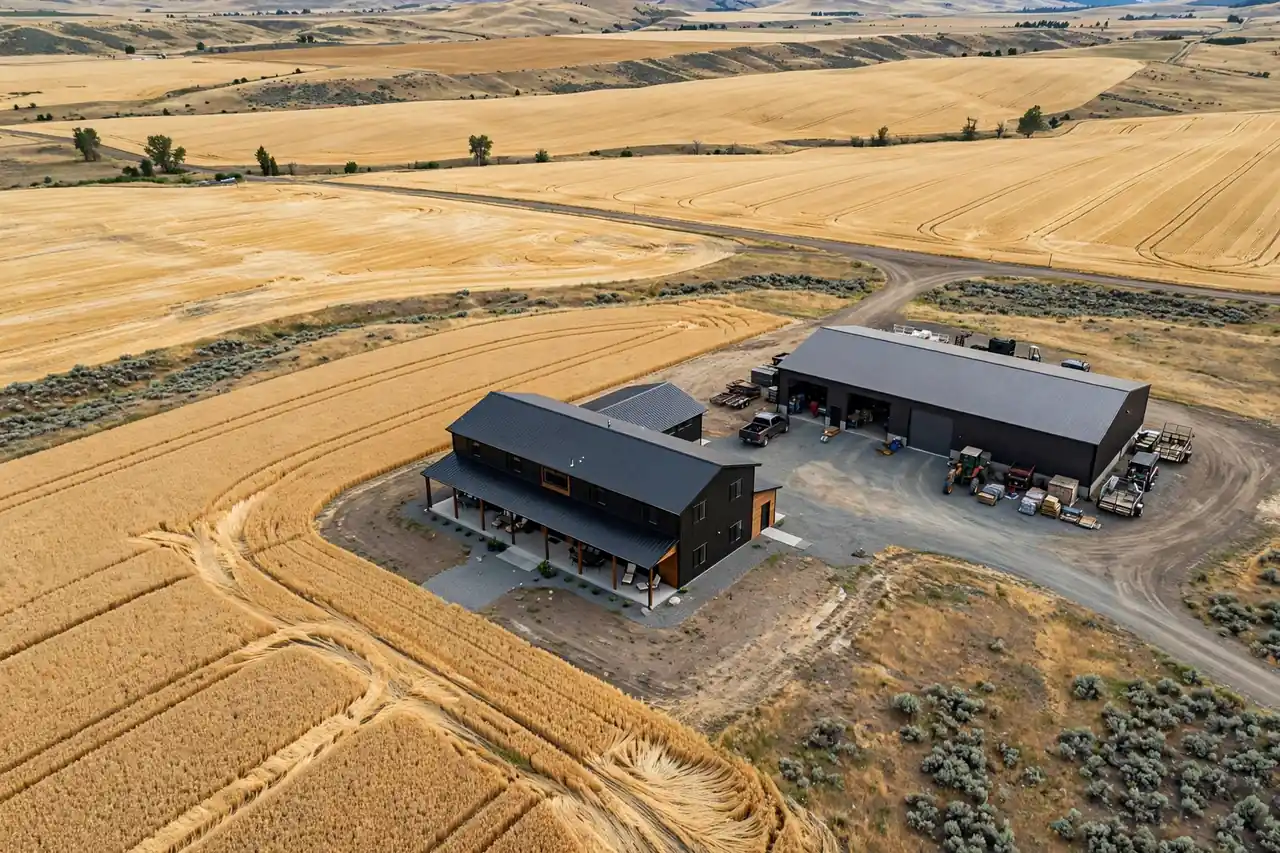
Washington Barndominium Cost Per Sqft in 2026
A 2026 state-level planning estimate places Washington at approximately $165 to $245 per square foot for a turnkey finished barndominium, with an erected shell at approximately $50 to $85 per square foot. These ranges are based on published builder pricing, kit data and regional construction-cost information rather than closed transaction records.
The two numbers should not be confused. A shell is the structural and exterior portion of the building, while a finished barndominium includes the residential systems and interior work required to turn that structure into a functioning home.
| Washington Build Type | 2026 Planning Range | General Meaning |
|---|---|---|
| Erected shell | $50–$85/sq ft | Structural/exterior building package; interior residential completion is not included |
| Turnkey finished barndominium | $165–$245/sq ft | Completed residential building with interior systems and finishes |
These figures exclude major property-development expenses such as land, well, septic and site work. Projects in the Puget Sound region, or on steep, forested or critical-area-constrained parcels, can exceed the upper end of the range because of labor, permitting, seismic engineering and site costs.
Washington Barndominium Cost Per Sqft for a 2,000 Sq Ft Home
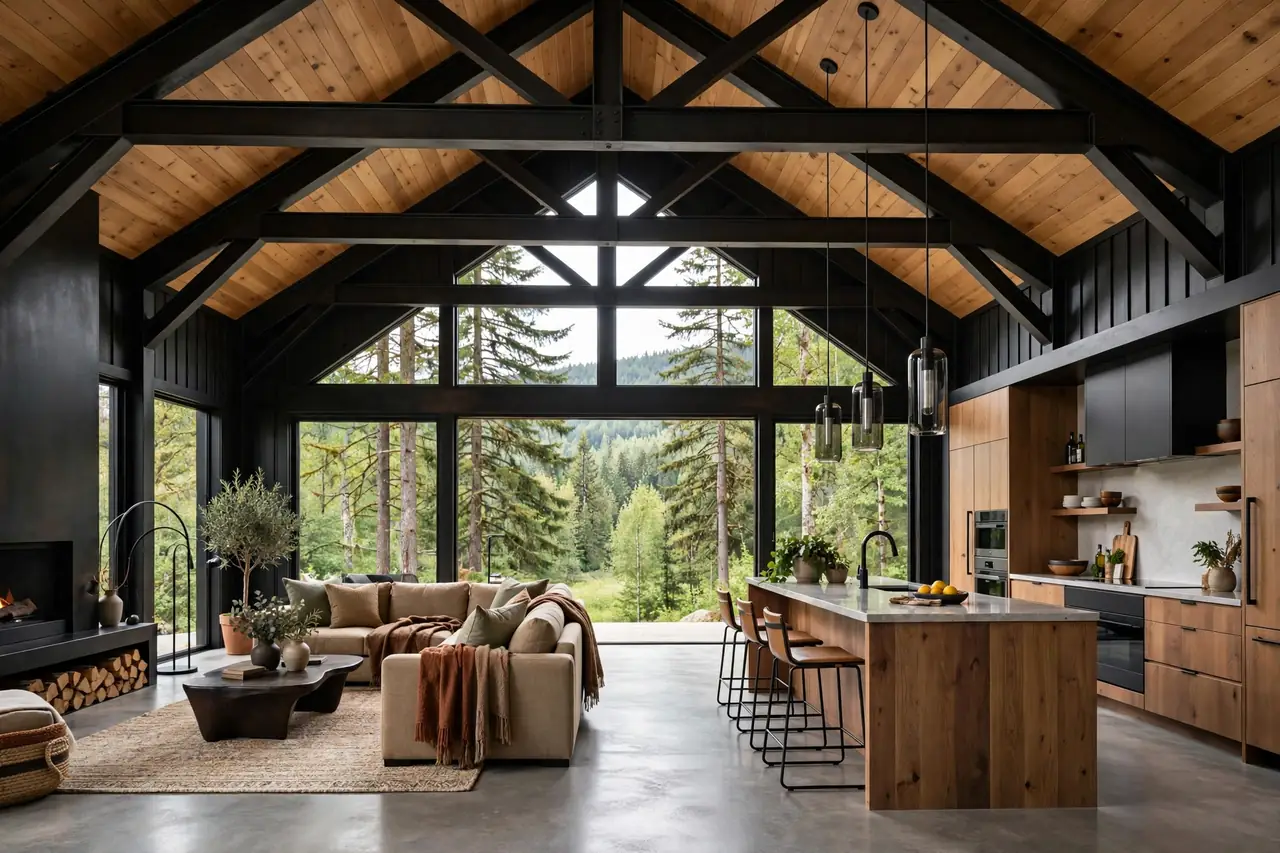
Using the Washington barndominium cost per sqft planning range, a 2,000-square-foot finished barndominium produces an estimated building cost of approximately $330,000 to $490,000.
| Size | Finished Building Estimate | Erected Shell Estimate |
|---|---|---|
| 1,500 sq ft | $247,500–$367,500 | $75,000–$127,500 |
| 2,000 sq ft | $330,000–$490,000 | $100,000–$170,000 |
| 2,400 sq ft | $396,000–$588,000 | $120,000–$204,000 |
| 2,500 sq ft | $412,500–$612,500 | $125,000–$212,500 |
| 3,000 sq ft | $495,000–$735,000 | $150,000–$255,000 |
These calculations represent the building itself. They should not be treated as the total amount required to turn a raw Washington parcel into a finished homesite. Our Barndominium Cost Calculator and Barndo Material Cost Estimator let you adjust size and finish level.
Washington Barndominium Shell Cost Per Sqft vs Finished Cost
The difference between a shell and a finished residence is especially important when comparing Washington barndominium advertisements. An erected shell may leave you responsible for the foundation, insulation, air sealing, electrical system, plumbing, HVAC, interior walls, drywall, flooring, cabinets, bathrooms, lighting, appliances and other residential work. A low shell quote can therefore be completely legitimate while still being nowhere near the final cost of the house.
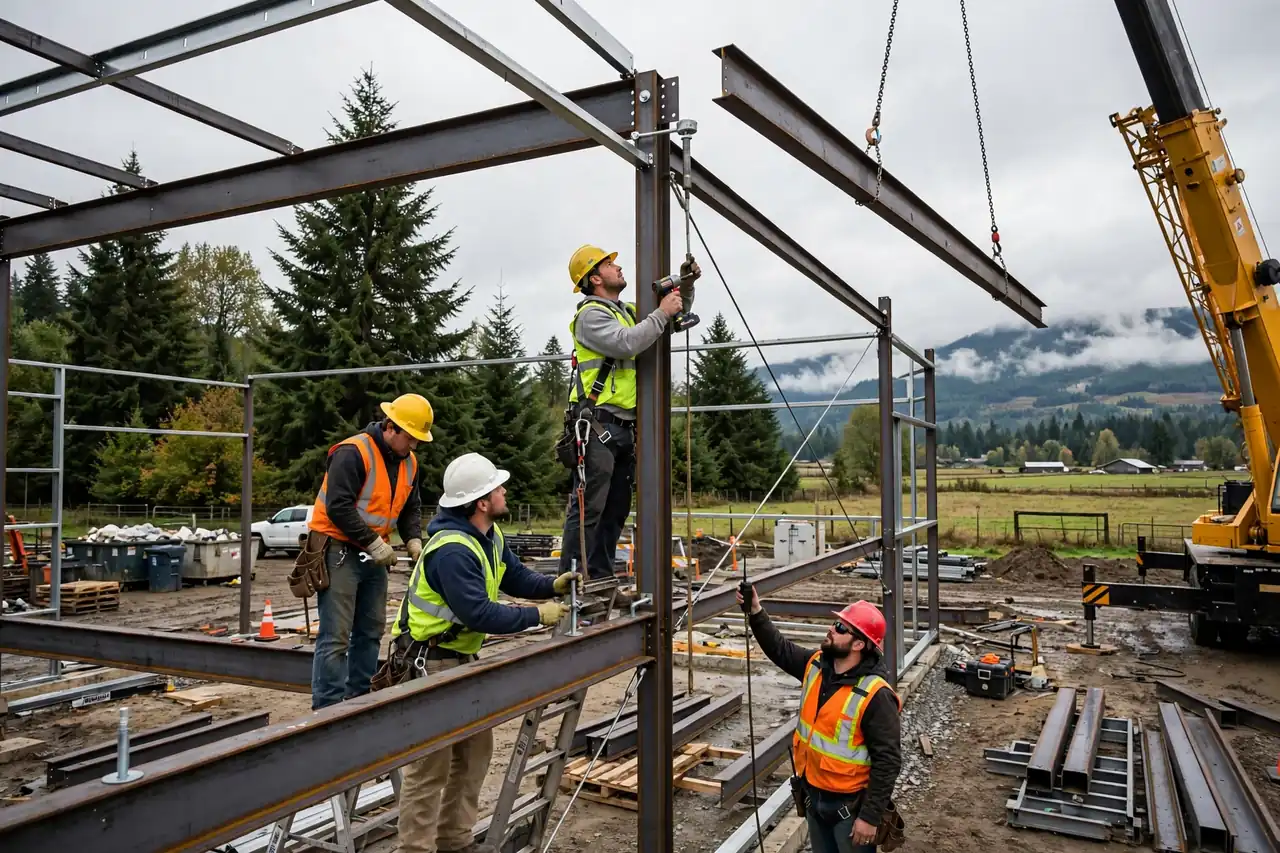
When comparing WA builders, request a written scope showing whether the quote includes the foundation, structural frame, roofing, exterior siding, windows, exterior doors, insulation, electrical, plumbing, heating and cooling, interior walls, flooring, kitchen, bathrooms, site preparation and utility connections.
Two contractors can quote the same number per square foot while offering dramatically different levels of completion. Our Barndominium Kit Cost Calculator and Barndominium Kits Guide explain what suppliers commonly include or exclude.
Why Washington Barndominium Cost Per Sqft Can Vary So Much
Washington’s geography creates unusually large differences between rural construction sites. Western Washington generally has a wetter climate, dense vegetation, steep terrain in many areas and substantial earthquake exposure. Eastern Washington can have colder winters, heavier snow in many areas, hotter summers, wildfire concerns and much drier conditions.
The Puget Sound region can also have expensive land and complex permitting environments, while a remote eastern Washington property may have cheaper land but require much longer utility extensions and private infrastructure. For that reason, the location of the parcel should be part of the budget before you choose the building design.
Washington Barndominium Building Codes in 2026
Washington regulates residential construction through the Washington State Building Code system. The currently adopted residential code is based on the 2021 International Residential Code with Washington amendments, effective statewide since March 15, 2024.
Washington is in another code transition. The State Building Code Council (SBCC) has been working through adoption of the 2024 International Residential Code and other 2024 model codes. According to the SBCC, final adoption of the 2024 IRC and IBC was targeted for October 16, 2026, final adoption of the 2024 energy codes for November 20, 2026, and the effective date of the 2024 codes is May 3, 2027. These dates have shifted before, so check sbcc.wa.gov for the current schedule. Until the new codes take effect, the 2021 codes remain the baseline.
That means a person preparing a new WA barndominium project should not assume that a plan purchased several years ago will satisfy the code applicable to the eventual permit. Before finalizing engineering or submitting plans, confirm with the local building department:
- Which residential code edition applies to the permit date
- Whether the jurisdiction has local amendments
- Which energy-code requirements apply
- Whether wildfire provisions affect the site
- Whether additional geotechnical information is required
- Whether the proposed shop and residence are treated as one residential structure or involve additional code requirements
Washington Residential Energy Code and Barndominium Design
Washington’s energy code is a major part of residential construction. The current residential provisions are based on the 2021 edition, effective statewide since March 15, 2024. A 2024 residential energy-code update is in progress, with the SBCC listing an effective date of May 3, 2027. This matters for anyone whose project will cross code-cycle dates.
For a barndominium, energy performance should be considered during the structural design rather than after the shell is complete. Important components include wall insulation, roof or ceiling insulation, slab insulation, air sealing, windows, doors, heating equipment, mechanical ventilation, water heating and conditioned versus unconditioned shop areas. A large shop connected to a smaller living area can be particularly useful because the entire structure does not need to receive the same conditioned-space treatment. See our guide on whether spray foam insulation is mandatory for a barndominium.
Official Washington Code Resources
Washington State Building Code CouncilAdopted codes, 2024 adoption schedule and amendments WSU Energy Program: Residential Energy Code
WSEC-R forms, resources and the 2024 update
Washington Snow Load, Frost Depth and Foundation Cost
Two structural conditions are easy to overlook when pricing a Washington barndominium: snow and frost. Neither is a single statewide number.
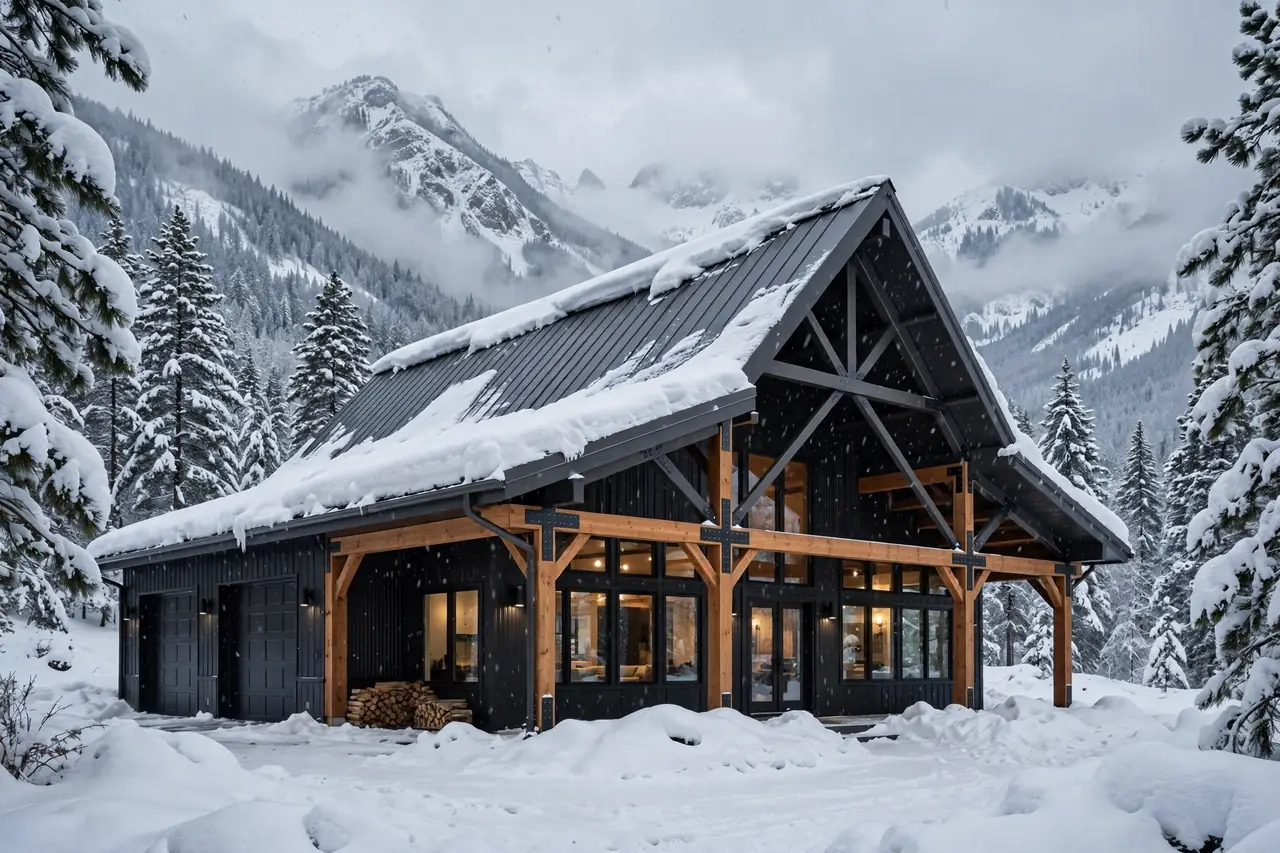
Snow load. Ground snow loads range from light in many western lowlands to heavy in the Cascades, mountain valleys and parts of northeastern and north-central Washington. Design values are set by the local jurisdiction, often by elevation. A metal roof can shed snow quickly, but the structure still has to be engineered for the design load, including drifting and sliding snow near doors and neighboring buildings. Ask your building department for the ground snow load at your exact site before ordering an engineered package, and do not reuse a roof design from another state or county.
Frost depth and foundation. Frost-protection depths are set locally and are generally shallower in western lowland areas and deeper in colder eastern and mountain areas. Confirm the required footing depth with your building department. Foundation cost also depends on soil bearing capacity, slope, drainage, groundwater, seismic anchorage requirements, shop slab thickness, heavy equipment loads and large overhead door openings. In seismically active areas the foundation and anchorage details are part of the engineering, not just the concrete volume.
Washington Rural Land and the Growth Management Act
One of the biggest Washington-specific issues for barndominium buyers is land use. The Washington Growth Management Act (GMA) requires applicable cities and counties to develop comprehensive plans and development regulations. The state’s rural planning framework is intended to control rural development, protect rural character and prevent inappropriate conversion of undeveloped land into sprawling low-density development.
This means acreage should never be evaluated simply by looking at the number of acres. A 10-acre property can be more difficult to develop than a smaller parcel if it has resource-land restrictions, critical areas, limited access or no suitable septic area.
Can You Build a Barndominium on Rural Land in Washington?
Potentially, but the answer depends on the specific parcel and county regulations. Washington’s rural planning rules specifically address agriculture, forest and mineral resource lands as well as critical areas. Counties can establish development regulations that affect rural residences and other uses.
Before purchasing WA acreage, verify county zoning, the comprehensive-plan designation, whether a single-family residence is allowed, resource-land classification, critical-area overlays, minimum lot requirements, access requirements, septic feasibility, water availability and building setbacks.
The phrase “buildable land” in a real-estate advertisement should therefore be treated as a starting point for investigation, not proof that your intended barndominium can be permitted. Our Land Cost Calculator can help set a realistic land budget.
Washington Critical Areas: The Five Issues Rural Buyers Need to Check
Washington’s Growth Management Act requires cities and counties to protect critical areas. These include wetlands, frequently flooded areas, critical aquifer recharge areas, geologically hazardous areas and fish and wildlife habitat conservation areas. For a rural barndominium project, critical-area review can affect the location of the home, driveway, septic system and other improvements.
Wetlands
Wetlands can create development buffers and restrictions that reduce the usable portion of a parcel. A large acreage parcel can therefore have surprisingly little practical building area if wetlands occupy a significant part of the property.
Frequently Flooded Areas
Washington requires local governments to address frequently flooded areas through their Critical Areas Ordinances. FEMA flood maps, channel migration zones and other science-based information can be used in the designation and regulation of these areas.
Geologically Hazardous Areas
These can include areas susceptible to erosion, landslides, earthquakes and other geological hazards. Such conditions can influence whether engineering studies or special development measures are required.
Aquifer Recharge Areas
Important groundwater-recharge areas can be subject to additional protection because development can affect groundwater quality and supply.
Fish and Wildlife Habitat
Rural property can also contain habitat that receives regulatory protection. This can affect clearing, grading, drainage and the location of development.
Official Land-Use Resources
RCW 36.70A: Growth Management ActComprehensive planning, rural lands and critical areas
Washington Barndominium Septic Requirements
For rural properties without centralized sewer, the onsite sewage system can be one of the most important components of the project. The Washington State Department of Health states that small onsite sewage systems (OSS) are widely used across Washington, and systems with design flows below 3,500 gallons per day are generally under the authority of the local health officer. Septic requirements can therefore involve the local health jurisdiction rather than simply the state building department.
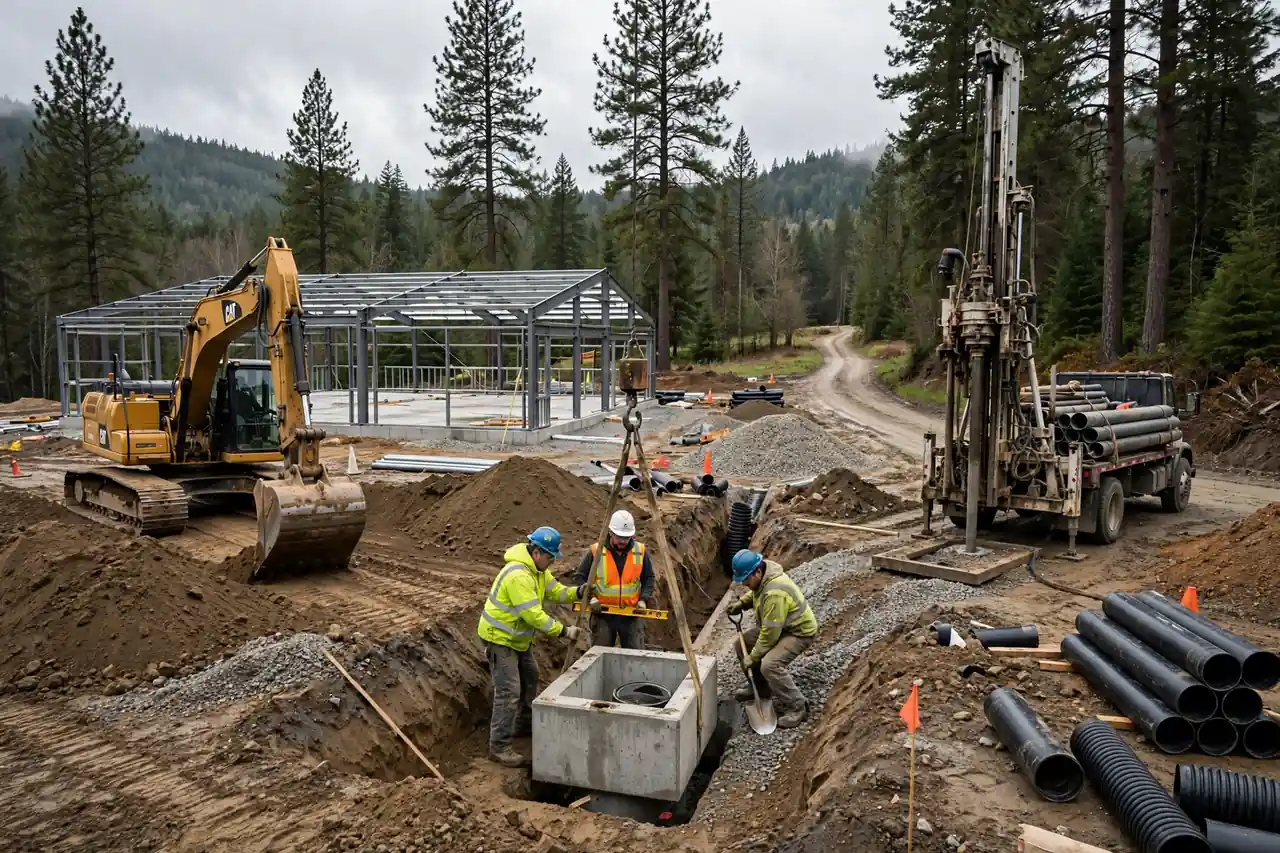
Before designing the house, determine whether the property has an existing septic approval, whether it can serve the proposed residence, whether a new system is required, whether the soils are suitable, where the drainfield and replacement area can go, what setbacks apply to wells and surface water, and whether the local health department has additional requirements. A septic evaluation should influence the building site instead of being treated as an afterthought.
Washington Barndominium Well Requirements
Private wells are common on rural Washington properties, but “there is groundwater” and “this property has a simple legal water supply” are not the same thing. Washington’s Department of Ecology identifies a groundwater permit exemption for certain small uses, including domestic use up to 5,000 gallons per day, irrigation of a lawn or garden up to one-half acre, and stockwater. However, permit-exempt use remains subject to Washington water law and local requirements.
Ecology also explains that a well notice of intent is generally required before drilling, and that drilling a well does not itself guarantee legal availability of water. If the proposed use exceeds the applicable exemption, a water-right application may be required before drilling.
Washington Permit-Exempt Well Changes Matter
Washington’s water rules can be especially important in watersheds where water availability is constrained. Newer domestic permit-exempt uses can be subject to different limits in certain circumstances, and other laws, including streamflow-restoration requirements, can affect new domestic use in some parts of the state. For a rural property, check water availability before assuming that a future well will solve the water question.
Official Well and Septic Resources
Washington Department of EcologyWell drilling, permit-exempt groundwater use and water rights Washington State Department of Health
Onsite sewage systems (OSS) and local health officer authority
Washington Wildfire and WUI Barndominium Requirements
Wildfire is a major consideration for parts of eastern Washington and other areas where homes meet wildland vegetation. Washington has a Wildland-Urban Interface Code framework, and the SBCC lists the WUI code amendments as “reserved” until statewide wildfire hazard and risk mapping is complete. Washington law also establishes provisions concerning wildfire-resistant and fire-hardened building materials. Requirements can differ by jurisdiction and mapped area, so check with your county.
A barndominium in a wildfire-prone area should be evaluated for more than its metal siding.
Wildfire-Resistant Features for a Washington Barndominium
Depending on the applicable requirements, wildfire-conscious design can involve Class A roof assemblies, fire-resistant exterior materials, protected openings, ember-resistant detailing, appropriate attic and roof ventilation, defensible space, accessible driveways, vegetation management and fire-resistant decks and exterior components. A metal building envelope can be helpful, but windows, vents, doors, roof edges, decks and other components still need attention.
Washington Earthquake Risk: Cascadia, Seattle and Tacoma Faults
Seismic design is one of the most important Washington-specific subjects for a barndominium. The Washington Geological Survey states that Washington has one of the nation’s highest risks of large damaging earthquakes because of its geologic setting and population distribution. The state is affected by the Cascadia Subduction Zone as well as numerous crustal and deep faults.
The Cascadia Subduction Zone is not the only concern. The Puget Lowland contains significant earthquake sources including the Seattle and Tacoma fault systems, while other active faults extend across the state. For a barndominium, seismic design can influence foundation connections, anchor bolts, structural steel connections, wall bracing, roof-to-wall connections, large garage or shop openings, shear walls, soil and foundation conditions and nonstructural components. The fact that a structure uses steel does not mean it is automatically appropriate for every seismic condition.
Washington Liquefaction and Soil Conditions
Earthquake risk is not limited to ground shaking. Washington Geological Survey and related hazard mapping also address liquefaction, which can occur in susceptible soils during strong earthquake shaking. This can matter particularly in areas containing loose, saturated sediments. A site investigation can therefore be important when the parcel has potentially problematic soils or when required by the building jurisdiction.
Washington Landslide Risk for Rural Barndominiums
Washington is also one of the states where slope conditions deserve serious attention. The Washington Geological Survey states that landslides are common in Washington because of unstable glacial sediments, earthquakes, steep terrain and wet-season conditions, and they are especially common during the winter wet season. This creates a specific warning for buyers searching for scenic acreage on hillsides or near coastal bluffs.
Before placing a barndominium on sloped land, investigate historic landslides, landslide susceptibility, existing drainage, cut slopes, fill areas, retaining walls, road stability, foundation conditions and potential runoff concentration. The Washington Geological Survey provides mapped landslide inventories and susceptibility information through its geologic information resources.
Washington Geological SurveyEarthquake, liquefaction and landslide hazard information
Washington Rain, Drainage and Construction Stormwater
Western Washington’s wet climate makes water management particularly important. During construction, disturbed soil can produce sediment that reaches streams and other waterways. Washington’s Department of Ecology regulates construction stormwater through its Construction Stormwater General Permit for regulated sites. The current permit took effect January 1, 2026 and requires covered operators to use stormwater pollution-prevention planning and erosion and sediment controls. This can become relevant to larger rural projects involving significant clearing, grading and excavation; confirm with Ecology or your county whether your site needs coverage.
Permanent Drainage After Construction
Stormwater planning does not stop when the house is finished. A large barndominium roof can generate significant runoff, especially during heavy rainfall. The building plan should consider gutters, downspouts, discharge locations, grading and the relationship between the house, driveway and septic system. On sloped land, poorly controlled runoff can also contribute to erosion and slope problems.
Washington Barndominium on Agricultural Land
Agricultural land can look attractive for a barndominium because it may provide large open parcels and room for shops, equipment and livestock. However, Washington’s rural planning rules specifically seek to protect agricultural, forest and mineral resource lands from incompatible development.
Before purchasing agricultural acreage, determine whether the proposed residential use is allowed under the county’s zoning and comprehensive-plan framework. Do not assume that a large farm building or agricultural structure automatically gives you the right to create a residential barndominium inside it.
Washington Barndominium Shop House Design
A major advantage of the barndominium concept is combining a residence with a large shop or garage. Washington acreage owners may want space for vehicles, boats, tractors, woodworking, agricultural equipment or recreational equipment. Instead of treating the entire building as identical square footage, divide the design into conditioned living space, garage, workshop, equipment storage, mechanical room and covered outdoor area.
This can make the budget more efficient because a shop does not necessarily require the same interior finish and conditioning level as the living area. Browse popular barndominium floor plans to see how living-plus-shop layouts are typically split.
Washington Barndominium Cost Per Sqft by Region
Washington Barndominium Cost Per Sqft in Puget Sound and Western Washington
The Puget Sound region has strong seismic considerations, relatively expensive land in many areas, wet conditions and complex development environments. Rural acreage can also contain wetlands, steep slopes, critical areas or other constraints that reduce the practical building envelope. For properties around Seattle’s broader rural surroundings, Tacoma-area acreage or communities outside the urban growth areas, land-use due diligence should happen before the building design.
Washington Barndominium Cost Per Sqft on the Olympic Peninsula
The Olympic Peninsula can offer attractive acreage and rural settings, but wet conditions, forest vegetation, steep terrain, landslide exposure, private wells and septic systems can affect development costs. Coastal or bluff properties require additional hazard screening.
Washington Barndominium Cost Per Sqft in Southwest Washington
Areas around Vancouver and southwest Washington can combine relatively accessible markets with rural properties farther from urban centers. Floodplain, wetlands, landslide conditions and access should be checked before treating a parcel as a simple rural building lot.
Washington Barndominium Cost Per Sqft in Central Washington
Central Washington offers a different environment, with hotter summers, colder winters in many locations and significant wildfire considerations. Large acreage can be appealing for shop-house designs, but private water, septic, access and wildfire exposure can become major budget variables.
Washington Barndominium Cost Per Sqft in Eastern Washington
Eastern Washington is one of the areas where wildfire, drought, winter temperatures, snow load and rural infrastructure can become especially important. Properties around Spokane, Wenatchee, Yakima, Tri-Cities and surrounding rural communities can have very different site conditions, so city-level assumptions should not be used for an entire region.
Washington Barndominium Cost Per Sqft in the Columbia Basin
The Columbia Basin can offer relatively open rural properties and space for large shops, but water availability, irrigation arrangements, soil conditions and utility access need to be investigated.
Washington Barndominium Cost Per Sqft: Site Costs That Can Surprise Buyers
| Potential Cost | Why It Can Matter in WA |
|---|---|
| Land-use review | GMA, zoning and rural development regulations can affect the project |
| Critical-area review | Wetlands, flood areas, habitat, aquifer recharge and geological hazards can restrict development |
| Septic | Rural homes often depend on onsite sewage systems |
| Well | Private water supply may be required on acreage |
| Water-right analysis | Permit-exempt use does not eliminate all water-law considerations |
| Driveway | Long or steep rural access can require substantial construction |
| Clearing | Forested parcels can require extensive vegetation removal |
| Grading | Slope and drainage conditions can increase earthwork |
| Geotechnical work | Seismic, landslide or soil conditions may require professional evaluation |
| Snow-load engineering | Heavier design loads can increase structural steel and foundation cost |
| Wildfire mitigation | WUI requirements may influence exterior construction and site design |
| Utility extension | Remote parcels may require long electrical or other utility runs |
| Stormwater controls | Large disturbed sites can trigger construction stormwater requirements |
How to Evaluate Washington Land Before Buying It
The best time to discover a development problem is before purchasing the property.
- Identify the county and confirm the zoning designation.
- Check the comprehensive-plan designation.
- Determine whether a single-family dwelling is permitted.
- Check agricultural and forest-resource restrictions.
- Screen wetlands and critical areas.
- Check floodplain and channel-migration information.
- Review landslide and geological-hazard maps.
- Check wildfire and WUI information.
- Confirm legal access.
- Investigate water availability and whether a well is feasible.
- Check septic feasibility.
- Identify utility locations.
- Ask the county for the design snow load, frost depth and which building-code requirements will apply.
- Estimate site-development costs before finalizing the building budget.
How to Lower Your Washington Barndominium Cost Per Sqft
Use a Simple Building Shape
A rectangular building with a straightforward roof and limited exterior complexity can reduce structural and construction complexity.
Keep Expensive Finishes in the Living Area
Do not spend residential-level finish money on shop space that does not need it.
Group Plumbing
Keeping bathrooms, kitchen plumbing and mechanical equipment reasonably close together can reduce unnecessary plumbing complexity.
Design Around the Land
A cheap building site that requires major excavation can become more expensive than a slightly more expensive area of the parcel that already has favorable grade and access.
Investigate Critical Areas Early
A professional or jurisdictional determination before design can prevent a situation where the preferred building location turns out to be unavailable.
Compare Complete Scopes
Never compare Washington builders solely by their advertised square-foot number. Compare the exact inclusions and exclusions.
Questions to Ask a Washington Barndominium Builder
- Which Washington code edition is included in the quote?
- Will you provide structural engineering, and for what snow load and seismic design category?
- Does the price include the foundation and seismic anchorage?
- Does it include insulation, air sealing and HVAC?
- Does it include electrical and plumbing?
- Does it include windows and doors?
- Does it include permits?
- Does it include site preparation, well and septic work, and driveway construction?
- Does it include wildfire-related construction requirements?
- Which work is subcontracted?
- What items are specifically excluded?
- Is the shop area priced differently from the living area?
Example Washington Barndominium Cost Per Sqft Budget: 2,000 Sq Ft
Imagine a buyer owns a rural Washington parcel and wants a 2,000-square-foot finished barndominium. The statewide planning range produces an estimated building cost of approximately $330,000–$490,000. That number should then be separated from the property-development budget.
If the parcel already has a good driveway, electricity at the building location, an approved septic system and an adequate water source, the additional development work may be relatively limited. Another property with the same 2,000-square-foot building could require a new well, septic system, long driveway, clearing, grading, engineering and critical-area review. The two properties may have the same house but completely different project budgets.
Washington Barndominium Financing
Barndominium financing can require more documentation than financing a conventional existing house. Rural WA projects can add another layer because the lender may want information about the land, utilities, well, septic system, access and construction budget. Before committing to a floor plan, ask lenders whether they finance new barndominium construction, post-frame residential construction, steel-frame homes, rural acreage construction, construction-to-permanent loans, land plus construction transactions and owner-builder projects, if applicable.
Ask what they require for plans, builder qualifications, appraisal, draw schedules and contingency funds. Our Free Home Loan Calculator can estimate a monthly payment before you commit.
Washington Barndominium Cost Per Sqft vs a Traditional House
A barndominium is not automatically cheaper than a conventional Washington home. The concept can create efficiencies when the structure has a simple shape, large open spaces and a combined living-and-shop layout. However, once the structure becomes a finished residence, it still needs electrical, plumbing, heating, insulation, windows, bathrooms, kitchen systems and other residential components.
The meaningful comparison is complete barndominium construction plus site development against complete conventional-home construction plus site development. Comparing a shell package against the finished price of a traditional house will produce a misleading result. Our Barndominium vs House Cost Calculator and comparison guide price both at the same size and finish.
Washington Barndominium Cost Per Sqft Checklist: Wildfire, Seismic and Site
- Check WA wildfire/WUI requirements
- Check Cascadia and local fault information
- Check liquefaction information where applicable
- Check landslide hazards
- Check wetlands, frequently flooded areas, aquifer recharge areas and habitat constraints
- Confirm zoning, rural residential eligibility and agricultural/forest-resource restrictions
- Check well feasibility, water availability and septic feasibility
- Check legal access and utility distance
- Confirm design snow load and frost depth
- Determine applicable building code and energy code
- Check stormwater requirements
- Obtain site-specific contractor estimates
Washington Barndominium Cost Per Sqft: Frequently Asked Questions
How much does a barndominium cost per sqft in Washington?
A 2026 state-level planning estimate places Washington finished barndominiums at approximately $165–$245 per square foot, with erected shells around $50–$85 per square foot. These figures are estimates and exclude major site-development expenses.
How much does a 2,000 sq ft barndominium cost in Washington?
At $165–$245 per square foot, a 2,000-square-foot finished building works out to approximately $330,000–$490,000 before separate land-development expenses.
Can I build a barndominium on rural land in Washington?
Potentially, but the property must satisfy the applicable county zoning, comprehensive-plan and development regulations. Resource lands and critical areas can significantly affect development.
Does Washington require septic for rural barndominiums?
When centralized sewer is unavailable, an onsite sewage system may be necessary. Small OSS systems are generally regulated by the local health officer under Washington’s onsite sewage framework.
Can I drill a well for a Washington barndominium?
Private wells are common, but drilling a well does not automatically guarantee legal availability of water. Washington has a permit-exemption system for certain small groundwater uses, including domestic use up to 5,000 gallons per day, while other uses can require a water right.
Which building code applies to a Washington barndominium in 2026?
The 2021 International Residential Code with Washington amendments is currently in effect. The 2024 codes are scheduled to take effect May 3, 2027, so confirm the edition that applies to your permit date.
How much snow load does a Washington barndominium need to handle?
It depends on the site. Ground snow loads range from light in many western lowlands to heavy in mountain and northeastern areas, and the local building department sets the design value.
Are Washington barndominiums affected by earthquakes?
Yes. Washington has significant seismic hazards, including the Cascadia Subduction Zone and numerous crustal faults. The Washington Geological Survey identifies the state as having one of the nation’s highest risks of large damaging earthquakes.
Do Washington barndominiums need wildfire-resistant construction?
Wildfire and WUI requirements can apply depending on the jurisdiction and mapped area, and the state’s wildfire mapping and code framework continues to evolve.
Can wetlands stop me from building on Washington acreage?
Wetlands are protected critical areas under Washington’s Growth Management framework, and local critical-area regulations can affect where buildings, septic systems and other development may occur.
Is eastern Washington cheaper for a barndominium?
Construction and land conditions vary substantially across eastern Washington, so a statewide or regional average cannot determine the cost of a specific project. A property with inexpensive land can still require significant spending on water, septic, utilities, wildfire mitigation, snow-load engineering or site work.
Does a metal barndominium automatically have good earthquake performance?
No. Seismic performance depends on the complete engineered structural system, including foundations, connections, bracing, wall systems and site conditions. The material alone does not determine the building’s seismic performance.
Use the Barndominium Cost Calculator for a Washington Estimate
If you already know your planned Washington floor area, build type and general finish level, our Barndominium Cost Calculator can provide a starting estimate. Use it for preliminary planning, then replace the assumptions with actual site information and contractor quotes once you identify a Washington property.
Final Washington Barndominium Cost Guide for 2026
Washington barndominium cost per sqft is only a starting number, and construction cannot be accurately planned from a metal-building price alone. For 2026 planning, the current Washington barndominium cost per sqft benchmark is approximately $165–$245 per square foot for a finished barndominium and $50–$85 per square foot for an erected shell. That produces a building-only estimate of roughly $330,000–$490,000 for a 2,000-square-foot finished home.
But the building is only one part of the Washington project. Rural zoning can determine whether the property can contain a dwelling. Critical areas can restrict the building envelope. Septic conditions can determine where the house can be placed. Water availability can affect whether a private well is practical. Earthquake hazards and snow loads can influence structural engineering. Wildfire exposure can affect the exterior construction. Landslides can change the feasibility of sloped acreage. Stormwater requirements can become relevant during major site disturbance.
For that reason, the strongest way to budget a Washington barndominium is to divide the project into two major categories:
- Building budget: structure, foundation, interior, mechanical, electrical and finishes.
- Site-development budget: land preparation, access, water, septic, utilities, drainage, engineering and hazard-related requirements.
That approach gives you a much more realistic picture of what a WA barndominium will cost on the specific property you are considering.
Related: Barndominium Cost Per Sqft by State