
Home Loan Calculator
Calculate your mortgage payment, check home affordability, compare FHA vs Conventional vs VA vs USDA loans, barndominium financing, and generate a full amortization schedule — all in one free tool.
Conventional
Best credit needed
FHA Loan
Low down, easy qualify
VA Loan
Veterans only, $0 down
USDA Loan
Rural, $0 down
What Is a Home Loan Calculator — and Why Do You Need One?
A home loan calculator is a free online tool that estimates your monthly mortgage payment based on your loan amount, interest rate, and loan term. But the best calculators — like this one — go far beyond a basic payment estimate.
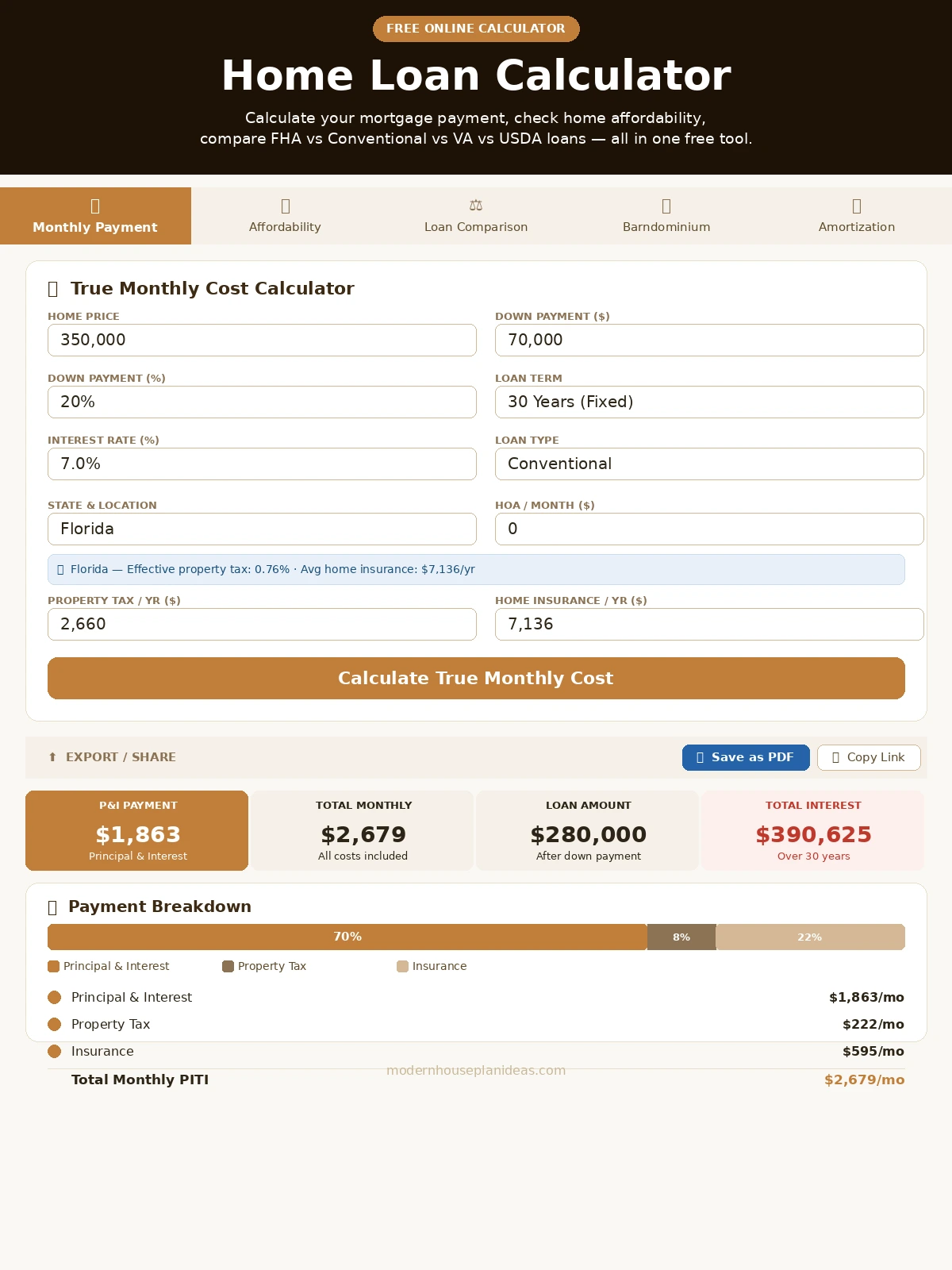
This free home loan calculator gives you five tools in a single page:
- 📌 True monthly cost — principal, interest, taxes, insurance, HOA, and PMI all included
- 📌 Affordability check — based on your income and debts, what’s the maximum home price you can comfortably buy?
- 📌 Loan type comparison — Conventional vs FHA vs VA vs USDA, side by side
- 📌 Barndominium financing — construction-stage cost breakdown for non-traditional builds
- 📌 Full amortization schedule — see every payment over the life of your loan, plus how extra payments slash interest
Whether you’re a first-time homebuyer just starting your search, or you’re deep in the mortgage process comparing offers from lenders, this calculator gives you the data you need to make a confident decision.
On a $350,000 home with 20% down ($280,000 loan) at a 7% interest rate, the difference between a 30-year and 15-year loan is more than $217,000 in total interest. Use the calculator above to run your own numbers — the results might surprise you.
Quick-Start Guide: How to Use Each of the 5 Calculator Tools
This home loan calculator has five tabs, each built for a different stage of the homebuying journey. Here’s exactly how to use each one.
Tool 1: Monthly Payment Calculator
Step 1: Enter Your Home Price and Down Payment
Start with the home price you’re targeting and how much you plan to put down. The down payment calculator works both ways — enter a dollar amount and the percentage auto-fills, or vice versa.
How much should you put down?
- 3% — Minimum for conventional loans (with PMI)
- 3.5% — Minimum for FHA loans
- 10% — Reduces PMI cost significantly, and lowers the VA funding fee tier
- 20% — Eliminates PMI entirely on conventional loans
- 0% — Available on VA and USDA loans for eligible buyers
Step 2: Choose Your Loan Term and Interest Rate
This home loan calculator supports 10, 15, 20, and 30-year fixed terms. Your interest rate dramatically affects your monthly payment — a 0.5% rate difference on a $300,000 loan equals roughly $100/month, or more than $36,000 over 30 years.
Step 3: Select Your State for Accurate Tax and Insurance Estimates
Property taxes vary enormously by state — from under 0.3% in Hawaii to over 2.1% in New Jersey. Select your state and the calculator auto-fills realistic estimates. You can always override these with your actual figures.
Step 4: Choose Your Loan Type
Pick Conventional, FHA, VA, or USDA. The calculator automatically applies the correct upfront fee and mortgage insurance for whichever type you select — for example, choosing VA will show the exact funding fee tier that applies based on the down payment you entered in Step 1.
Step 5: Add HOA Fees (If Applicable)
Homeowners Association fees are a real cost that many buyers forget to budget for. In planned communities and condos, HOA fees can range from $50 to $1,000+ per month. Enter your estimated HOA cost to get an accurate true monthly payment.
Step 6: Hit “Calculate” and Review Your Results
Your results show the complete payment breakdown with a visual chart. This home loan calculator displays your True Monthly Cost figure — not just the principal and interest that lenders advertise.
Tool 2: Affordability Calculator
- Enter your gross annual income and any existing monthly debts (car loans, student loans, credit cards).
- Enter your planned down payment, target interest rate, and loan term.
- Select your credit score range — the calculator applies a realistic rate adjustment based on typical lender pricing tiers.
- Choose a DTI rule (28/36 conservative, 36/45 moderate, or 43/50 stretch) to match how aggressively you want to borrow.
- Hit Calculate to see your max home price, max loan, estimated PITI payment, and a full DTI breakdown — plus five what-if scenarios from Conservative to Max Possible.
Tool 3: Loan Comparison
- Enter the home price, rate, and term you want to compare across loan types.
- Toggle loan types on or off — by default all four (Conventional, FHA, VA, USDA) are compared side by side.
- Review the table for down payment, upfront fees, monthly payment, and total lifetime cost — the best value in each row is highlighted.
Note: this tab compares principal, interest, and mortgage insurance only — it doesn’t include property tax, homeowner’s insurance, or HOA, since those costs are the same regardless of loan type. For your complete true monthly cost on a specific loan type, use Tool 1.
Tool 4: Barndominium Financing
- Enter your build details — square footage, cost per square foot, and land cost.
- Set your down payment, construction-loan rate, and permanent-loan rate separately, since these are usually different products.
- Choose a draw schedule (even, front-loaded, back-loaded, or custom %) to estimate how much of the construction loan is drawn — and accruing interest — at any given time.
- Hit Calculate to see your total project cost, cash needed at closing, permanent monthly payment, and full lifetime cost including both construction and permanent interest.
Tool 5: Amortization Schedule
- Enter your loan amount, rate, term, and start date.
- Add an extra monthly payment and/or a one-time lump-sum payment to see how much faster you’d pay off the loan.
- Hit Calculate to see your new payoff date, interest saved, and time saved — then switch between yearly and monthly views in the table below.
FHA vs Conventional vs VA vs USDA: Which Home Loan Is Right for You?
One of the most valuable features of this home loan calculator is the ability to compare all four major loan types side by side. Here’s what you need to know before you run the numbers in this home loan calculator (source: HUD.gov):
| Loan Type | Min. Down | Min. Credit Score | Mortgage Insurance | Who Qualifies |
|---|---|---|---|---|
| Conventional | 3% | 620+ | PMI until 20% equity | Most buyers with good credit |
| FHA | 3.5% | 580+ (500 with 10% down) | 1.75% upfront + 0.55%/yr MIP (in most cases, for life of loan) | First-time buyers, lower credit scores |
| VA | 0% | No official minimum | No PMI — one-time funding fee: 2.15% (<5% down), 1.50% (5–9.99%), 1.25% (10%+), first-time use | Veterans, active military, surviving spouses |
| USDA | 0% | 640+ recommended | 1% upfront + 0.35%/yr guarantee fee | Rural area buyers within income limits |
How Much House Can You Afford? Use the Affordability Calculator
The most common mistake first-time buyers make is working backward from a dream home price. If you’re deciding between a traditional home and a barndominium, our barndominium vs house cost comparison can help you set a realistic budget before you run affordability numbers. Instead, use the Affordability tab in this home loan calculator — it tells you your actual budget based on your income and existing debts, using the same guidelines lenders use.
The 28/36 Rule Explained
The home loan calculator Affordability tab uses the standard lender guideline — the 28/36 rule. Most mortgage lenders apply the 28/36 debt-to-income (DTI) rule. According to the Consumer Financial Protection Bureau (CFPB), DTI is one of the key metrics lenders use to determine how much you can borrow:
- Housing costs should not exceed 28% of your gross monthly income
- All monthly debts (housing + car loans + student loans + credit cards) should not exceed 36%
Example: If your household earns $90,000/year ($7,500/month), the 28% rule caps your housing payment at $2,100/month. The 36% total-debt rule works differently: it caps all your monthly debts combined at $2,700, so after subtracting your $400 in existing debts, it would allow up to $2,300 for housing. Since lenders always apply whichever rule is stricter, your actual max housing budget stays at $2,100/month — the 28% rule is the binding limit here, not the 36% one. Only when your existing debts are high enough that the 36% rule produces a lower number than 28% of income does the total-debt rule end up being the tighter constraint.
Amortization Schedule — See Every Payment Over the Life of Your Loan
The Amortization tab in this home loan calculator shows you exactly how each monthly payment is split between principal and interest — from your very first payment to your last.
Why the Amortization Schedule Matters in a Home Loan Calculator
In the early years of a 30-year mortgage, the vast majority of your payment goes toward interest, not equity. On a $300,000 loan at 7%, your first payment of roughly $1,996 breaks down like this:
- Interest: ~$1,750
- Principal: ~$246
By year 15, that same payment is roughly split 50/50. By year 28, most of your payment is principal. The amortization table makes this visible so you can make smarter payoff decisions.
The Power of Extra Payments
The extra payment feature inside this home loan calculator‘s Amortization tab is one of the most powerful tools available. Here’s what a small extra monthly payment does on a $300,000 loan at 7% over a 30-year term:
| Extra Monthly Payment | Interest Saved | Time Saved |
|---|---|---|
| $100/month | ~$69,000 | ~4 years 3 months |
| $200/month | ~$117,000 | ~7 years 2 months |
| $500/month | ~$200,000 | ~12 years 9 months |
Once you have your floor plan locked — our floor plan design guide can help — run your own numbers in the Amortization tab of this home loan calculator — results update live based on your actual loan details.
Barndominium Loan Calculator — Financing a Non-Traditional Build
A barndominium is a metal building converted into — or built as — a residential home. They’ve exploded in popularity across rural America for their durability, lower cost-per-square-foot, and open floor plans. But financing one is more complex than a standard mortgage.
Before diving into financing, it helps to understand what you’re getting into cost-wise. Our detailed barndominium cost and design guide for 2026 walks through post-frame vs steel-frame builds, finishing stages, and realistic budget expectations from foundation to move-in.
How Much Does a Barndominium Cost?
Before using the barndominium tab in this home loan calculator, get a realistic build cost estimate. Total build costs vary widely depending on size, location, and finish level. Buyers in Texas — the most popular state for barndominium builds — can find detailed regional pricing in our barndominium cost per square foot in Texas guide. For a full state-by-state breakdown, our free barndominium cost calculator estimates your total build cost based on size, location, and finish options.
Not sure whether a barndominium is right for you vs a traditional stick-built home? Our barndominium vs house cost comparison breaks down real 2026 numbers on construction time, financing, durability, and resale value side by side.
Why Barndominium Financing Is Different
If you’re still in the planning stage, our complete barndominium guide for 2026 covers everything from design to build costs before you think about financing. Most conventional lenders are reluctant to finance barndominiums because they’re harder to appraise — there aren’t always comparable sales nearby. That means buyers often need to look at alternative financing paths:
- Construction-to-Permanent Loan — Covers the build phase, then converts to a permanent mortgage. Best for new builds.
- USDA Construction Loan — Available in eligible rural areas with no down payment required. Income limits apply. Check property eligibility at USDA’s eligibility map.
- Portfolio Loan — The lender keeps the loan in-house rather than selling it, giving them flexibility on non-standard properties.
- Conventional Loan — Possible if the barndominium meets standard appraisal criteria and has comparable sales nearby.
The Barndominium tab in this home loan calculator breaks down your estimated costs across all construction stages and compares monthly payments across each financing option.
Planning to Build? Additional Resources
📚 Barndominium Planning Guides:
- How to plan a barndominium on a budget — Cost-saving strategies from shell to finish
- Best barndominium kits — buying guide and costs — Pre-engineered kit options vs custom builds
- Spray foam insulation for barndominiums — Why it’s the most critical finishing decision you’ll make
- How to design a barndominium floor plan — Layout tips for open-concept metal buildings
📈 2025 Mortgage Rate Context
As of 2025, 30-year fixed mortgage rates have been in the 6.5%–7.5% range for most buyers, according to Freddie Mac’s Primary Mortgage Market Survey. The rate you get depends on your credit score, loan type, down payment, and lender. Here’s a general guide:
- Credit score 760+: Best available rates
- Credit score 720–759: ~0.25% higher than best
- Credit score 680–719: ~0.5%–0.75% higher
- Credit score 640–679: ~1%–1.5% higher
Always get quotes from at least 3 lenders. Even 0.25% lower rate saves $15,000+ on a $300k loan over 30 years.
7 Ways to Get a Lower Mortgage Rate on Your Home Loan Calculator Results
Once you’ve run your numbers in this home loan calculator and seen how even a 0.5% rate difference affects your monthly payment, here’s how to actually secure a lower rate:
- Plan your build budget first — Before worrying about rates, use our cheap barndominium cost planning guide to lock in a realistic total build number. Then optimize financing around that figure.
- Improve your credit score — Even 20–30 points can move you into a better rate tier. Pay down credit cards before applying.
- Increase your down payment — Lower loan-to-value ratio = lower risk for lenders = better rate offered.
- Shop at least 3 lenders — Rate variation between lenders on the same buyer can exceed 0.5%. Bankrate’s mortgage rate comparison tool is a free starting point before approaching lenders directly.
- Consider buying points — One discount point (1% of loan) typically lowers your rate by 0.25%. Worth it if you plan to stay 7+ years.
- Lock your rate quickly — Once you have an accepted offer, rates can move. A rate lock protects you for 30–60 days.
- Choose a 15-year term if you can afford it — 15-year rates are typically 0.5%–0.75% lower than 30-year rates.
- Use a local credit union — Credit unions often offer below-market rates on mortgages to their members.
Frequently Asked Questions
How do I calculate my monthly mortgage payment?
Enter your home price, down payment, loan term, and interest rate into the Monthly Payment tab of this home loan calculator. The calculator instantly shows your principal and interest payment, then adds property taxes, homeowner’s insurance, HOA fees, and PMI for your complete true monthly cost.
What is the difference between FHA, VA, USDA, and Conventional loans?
Conventional loans require higher credit scores (620+) but have no mandatory mortgage insurance with 20% down. FHA loans allow lower down payments (3.5%) and are easier to qualify for but carry MIP for the life of the loan in most cases. VA loans are exclusively for eligible veterans and active military — no down payment, no PMI, and generally the lowest total cost. USDA loans offer zero-down financing for buyers in eligible rural areas with income limits. Use the Loan Comparison tab to see side-by-side monthly costs for your specific situation.
How much house can I afford on my salary?
A general rule: multiply your annual gross income by 2.5–3x for a rough maximum home price. For precision, use the Affordability Calculator tab in this home loan calculator. It applies the standard 28/36 debt-to-income rule lenders use — accounting for your income, existing monthly debts, down payment, and current interest rates.
What is PMI and when does it go away?
When using this home loan calculator, you’ll notice PMI (Private Mortgage Insurance) is automatically added when your down payment is below 20% on conventional loans. It typically costs 0.5%–1.5% of the loan amount annually. Once you reach 20% equity through payments and/or home appreciation, you can request cancellation — lenders are required to remove it automatically when you reach 22% equity (78% loan-to-value) based on the original purchase price — this is mandated by the Homeowners Protection Act.
Is it better to get a 15-year or 30-year mortgage?
A 30-year mortgage has a lower monthly payment, giving you more cash flow flexibility. A 15-year mortgage has a higher monthly payment but a significantly lower interest rate and you pay roughly half the total interest over the life of the loan. The best choice depends on your income stability, other financial goals, and how long you plan to stay in the home. Use the Loan Term toggle in this home loan calculator to compare both options instantly and see the exact interest difference for your loan amount.
How do extra mortgage payments work?
Extra payments apply directly to your loan principal, reducing the balance faster and dramatically cutting total interest paid. Even $100/month extra on a $300,000, 7% loan can save close to $70,000 in interest and cut over 4 years off a 30-year loan. Use the Amortization tab in this home loan calculator to calculate your exact savings — enter any extra monthly amount and see your new payoff date instantly.
Can I finance a barndominium with a regular mortgage?
It depends on your location and the lender. In areas with comparable barndominium sales, a conventional appraisal may be possible. Otherwise, a construction-to-permanent loan, USDA loan (if in a rural area), or portfolio loan are the most common paths. Don’t overlook insulation costs — spray foam insulation for barndominiums is one of the biggest finishing decisions you’ll make. The Barndominium Financing tab breaks down estimated costs and compares available loan types. For a full cost breakdown before you apply, use our free barndominium cost calculator — it estimates total build cost by state and finish level, giving you a realistic number before you walk into a lender’s office.
🏡 Ready to Run Your Numbers?
Scroll back to the calculator above. It takes less than 60 seconds to get a complete picture of your mortgage costs — for free, with no email required.
Already used it? Share this page with a friend who’s thinking about buying a home. ↑