
Home Equity Calculator
Unlock the money already in your home →
💎 Your home & loan details
📊 Your results
| Lender cap | Max total debt allowed | You could borrow |
|---|
Estimates only, based on the inputs and lender cap you provide — not a loan offer.
Actual borrowing power depends on your credit score, income, and lender guidelines. Verify with a licensed lender before major decisions.
Understanding Your Home Equity Calculator Results: A Complete Guide
If you just ran the numbers above, you’re probably staring at a dollar figure and a couple of percentages, wondering what they actually mean for your next move. Here’s every result explained in plain English, so you can walk into a conversation with a lender knowing exactly where you stand.
What Is Home Equity, Exactly?
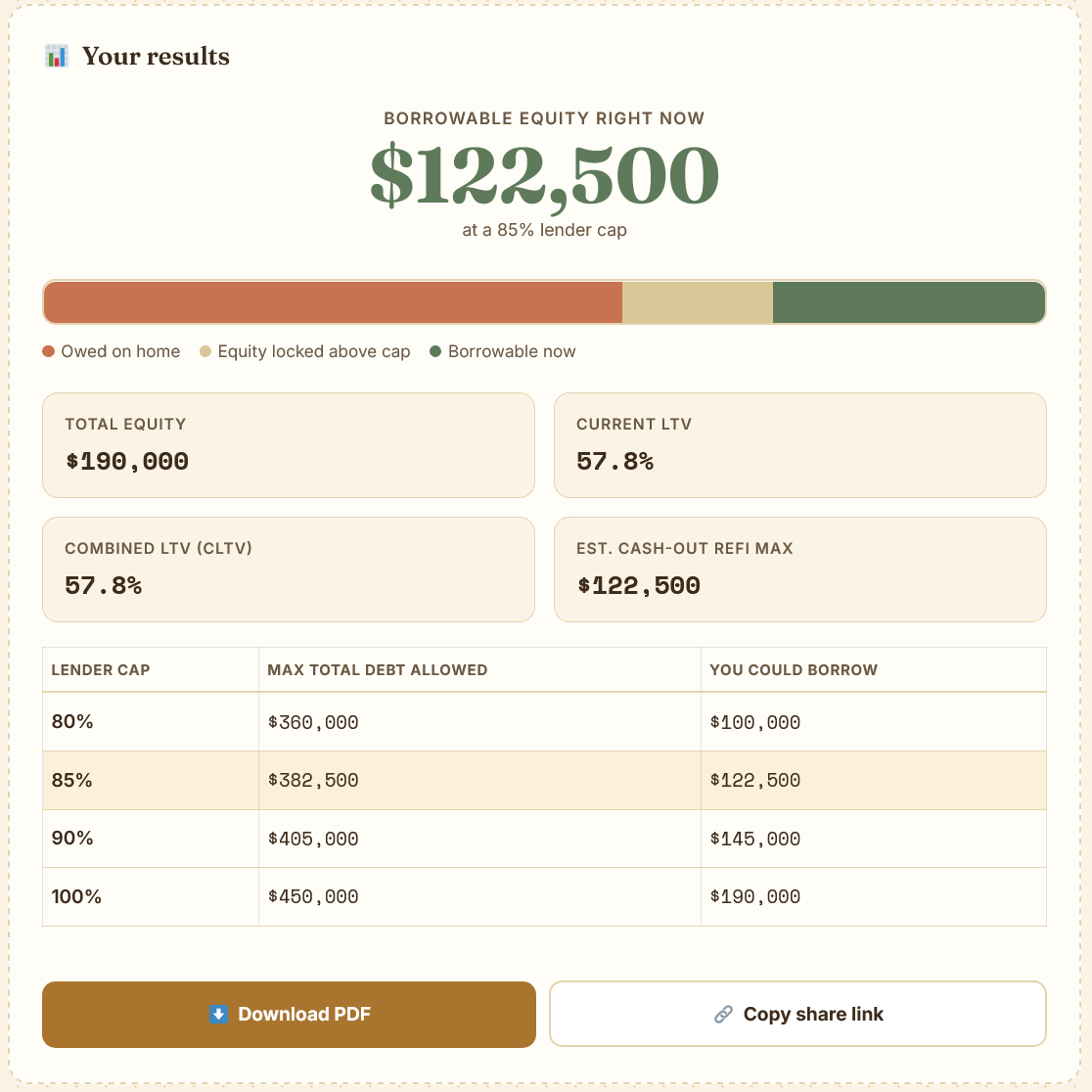
Home equity is simply the difference between what your home is worth and what you still owe on it. If your house is worth $450,000 and you owe $260,000 on your mortgage, you have $190,000 in equity. That’s the wealth you’ve built up through mortgage payments and appreciation — and it’s money you can potentially borrow against, without selling your home.
But here’s the part most homeowners get wrong: your total equity is not the same as your borrowable equity. Lenders will never let you borrow against 100% of your home’s value. That gap between “what you own” and “what you can actually access” is exactly what this calculator is built to show you.
Breaking Down Your Results
- Total Equity — your raw number: home value minus everything you owe (primary mortgage, plus any HELOC or second mortgage balance). This is your net worth tied up in the property, but it isn’t a spending number yet.
- LTV (Loan-to-Value) — your primary mortgage balance as a percentage of your home’s value. A $260,000 mortgage on a $450,000 home gives you an LTV of about 57.8%. Lower is better here.
- CLTV (Combined Loan-to-Value) — the same math, but adds any second mortgage or HELOC balance on top of your primary loan. This is the number lenders actually care about most, since it reflects your total debt against the home.
- Borrowable Equity — the headline number: the actual amount a lender might let you tap into, based on the lending cap you selected (typically 80%, 85%, or 90%). It’s almost always smaller than your total equity — that’s normal, not a bug.
- Estimated Cash-Out Refinance Max — roughly how much cash you could walk away with if you refinanced your entire primary mortgage into a new, larger loan at your selected cap.
Why Lenders Cap Your Borrowing at 80–90%
You might wonder why you can’t simply borrow every dollar of equity you have. Lenders keep a buffer because home values fluctuate. If they let you borrow up to 100% and prices dipped even slightly, you’d instantly be “underwater” — owing more than the home is worth. The 80–90% cap protects both you and the lender, and it’s standard practice across nearly every U.S. mortgage lender.
HELOC vs. Home Equity Loan vs. Cash-Out Refinance
Your “Borrowable Equity” figure applies to a few different products, and it’s worth knowing the difference before you call a lender:
- HELOC — works like a credit card secured by your home. You’re approved for a credit limit up to your borrowable equity amount, but you only draw — and pay interest on — what you actually use. Rates are usually variable.
- Home Equity Loan — gives you the entire borrowable amount as a lump sum upfront, with a fixed rate and fixed monthly payments. It’s a second mortgage sitting alongside your first.
- Cash-Out Refinance — replaces your existing mortgage entirely with a new, larger one, and you pocket the difference in cash. This resets your mortgage term and rate.
What Does “Locked Equity” Mean?
If part of your equity is marked as “locked” in the results above, that’s the slice of home value lenders won’t let you access, even though you technically own it — it’s the buffer above the lending cap that protects against market drops. It’s not lost money; it’s simply not liquid until you sell, pay down more debt, or your home value rises enough to shift the math.
Frequently Asked Questions
Can I use a home equity loan for anything I want?
Generally, yes — unlike a purchase mortgage, home equity funds aren’t restricted to a specific use. Common uses include renovations, debt consolidation, education costs, or covering large expenses. That flexibility is also why lenders and financial advisors urge caution: your home is the collateral.
Does my credit score affect the numbers this calculator shows?
No — this calculator estimates borrowing power based purely on your home’s value and existing debt, the math every lender starts with. Your actual approved amount, rate, and even eligibility will also depend on your credit score, income, and debt-to-income ratio, which a lender evaluates separately.
Why did my “Combined LTV” show a warning?
If your CLTV comes out above roughly 95%, very few lenders will extend additional credit, since there’s almost no equity cushion left. If your total debt actually exceeds your home’s value, you’re considered “underwater,” and home equity borrowing typically isn’t available until that changes.
How often should I recheck these numbers?
Home values shift with the local market, and your mortgage balance drops with every payment. It’s worth rerunning the calculator every six to twelve months, or any time you’re seriously considering a HELOC, home equity loan, or refinance.
The Bottom Line
Your calculator results give you a realistic, lender-style starting point — not a guaranteed offer. Use your “Borrowable Equity” number as a ballpark for what to expect, but treat the exact rate, terms, and approval as something only a licensed lender can confirm once they’ve pulled your credit and verified your income. Scroll back up and try adjusting the lender cap or adding a second lien balance to see how your numbers shift under different scenarios.