
Home › Calculators › Home Renovation Cost Calculator
Home Renovation
Cost Calculator
Pick your rooms, pick your finish level, get a real 2026 budget — kitchen, bath, flooring, roofing, and eight more categories, priced for your state. No signup, no email.
How this calculator works
Per-category pricing. Every category uses its own 2026 national cost-per-square-foot (or per-unit) range, split into four finish tiers — Budget, Mid-range, High-end, and Luxury.
State cost index. Your state multiplies every line item, reflecting real regional gaps in labor rates, permitting, and material freight — from roughly 15% below the national average to 35% above it.
Contingency. Industry guidance runs 10–25% depending on project scope and how much of the home is being opened up. We default to 15%.
How to Read Your 2026 Home Renovation Cost Estimator Results
A section-by-section walkthrough of what the Home Renovation Cost Estimator is actually calculating — so the total at the bottom means something.
Renovation budgets fail for one reason more than any other: homeowners price the project they imagine, not the project a contractor will actually bid. A “quick kitchen refresh” and a “kitchen remodel” can be the same room and a $60,000 gap. The Home Renovation Cost Estimator above exists to close that gap before you ever pick up the phone — it prices 11 renovation categories against real 2026 national contractor data, adjusts every line for your state’s labor and material costs, and hands you a number range you can actually plan around instead of a single guess.
This guide walks through exactly what the Home Renovation Cost Estimator is doing behind the scenes, so the total at the bottom of your results means something — and so you know which lever to pull if that number comes in higher than your budget.
How This Home Renovation Cost Estimator Builds Your Number
Every project you select runs through the same three-step math:
Base rate × quantity. Each category — kitchen, bathroom, flooring, roofing, and so on — has its own 2026 cost-per-square-foot or cost-per-unit range, split into four finish tiers (Budget, Mid-range, High-end, Luxury). Selecting “Mid-range Kitchen” at 200 sq ft pulls the national mid-range rate and multiplies it by your square footage.
State cost index. That subtotal is multiplied by a regional index built from labor rates, permitting costs, and material freight in your state. A renovation in Hawaii or New York runs 25–35% above the national baseline; the same project in Mississippi or West Virginia runs 15% below it.
Contingency buffer. The subtotal of every selected project is multiplied by your chosen contingency percentage — 10% for a tightly scoped, cosmetic job, up to 25% for an older home where opening a wall might reveal problems no one budgeted for.
A Sample Home Renovation Cost Estimator Walkthrough
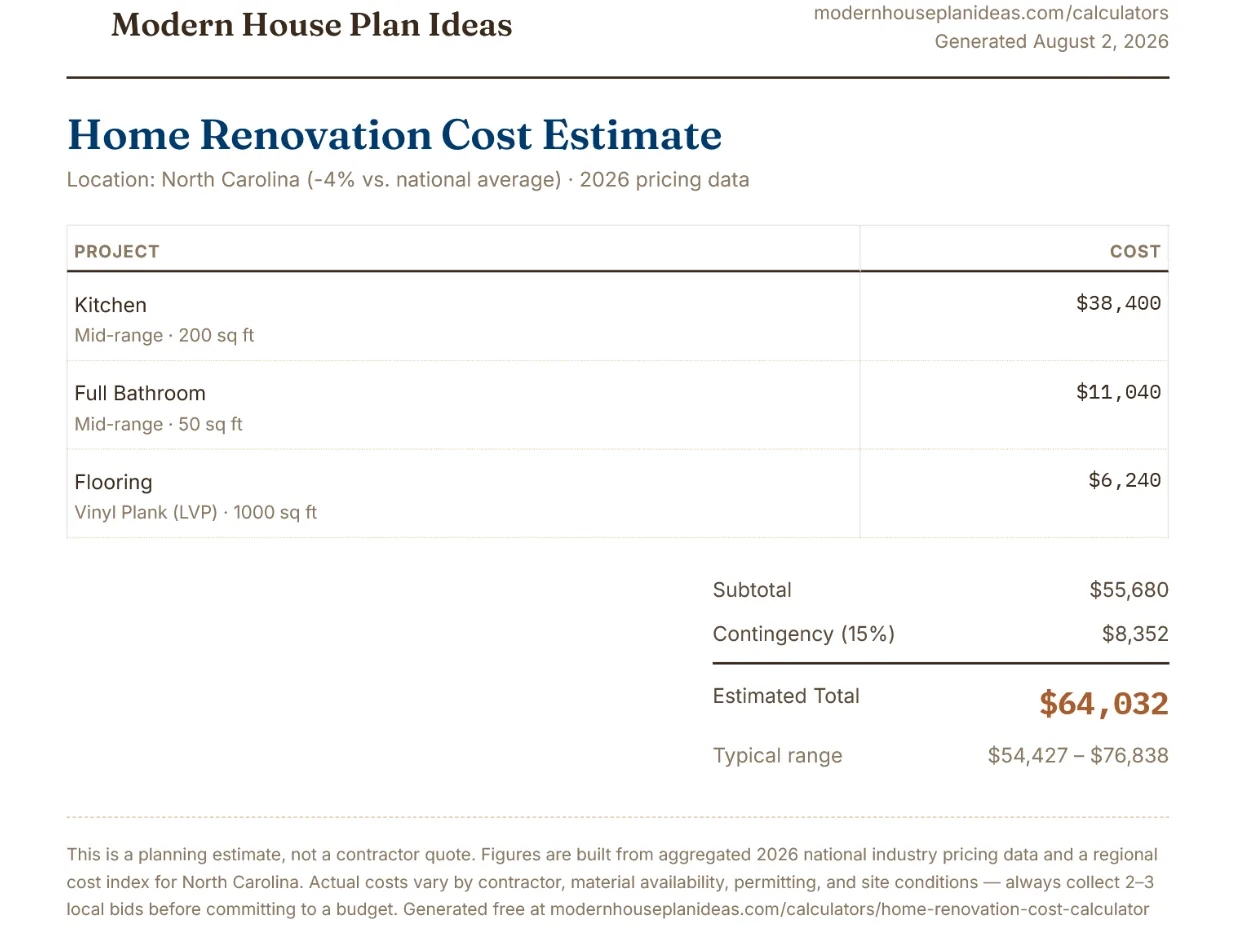
It helps to see the math run once with real numbers. Say you’re in North Carolina (state index roughly 0.96, just below the national baseline) and you select three projects: a 200 sq ft Mid-range kitchen, a 50 sq ft Mid-range full bathroom, and 1,000 sq ft of Mid-range flooring (luxury vinyl plank).
The Home Renovation Cost Estimator runs each line separately, then totals them:
- Kitchen: 200 sq ft × $200/sqft × 0.96 = $38,400
- Full bathroom: 50 sq ft × $230/sqft × 0.96 = $11,040
- Flooring: 1,000 sq ft × $6.50/sqft × 0.96 = $6,240
Subtotal: $55,680. Add a 15% contingency (recommended default) and the Home Renovation Cost Estimator’s final total lands at roughly $64,032, with a realistic range of about $54,600–$76,800. Move the same three projects to New York (index ~1.30) and the identical scope pushes past $86,000 before contingency — the exact same renovation, priced honestly for two different labor markets.
How Regional Costs Change Your Home Renovation Cost Estimator Total
The state index is the part of the tool most people underestimate until they see it in a side-by-side. A $50,000 project subtotal becomes roughly $67,500 in Hawaii, $65,000 in New York or Massachusetts, but only around $42,000 in Mississippi or West Virginia — a swing of over $25,000 for identical square footage and identical finish tiers. That gap isn’t padding; it reflects real differences in union labor rates, permitting fees, and the cost of trucking materials into high-demand metro markets versus lower-cost regions. If you’re comparing renovating in two different states, running both locations through the same Home Renovation Cost Estimator, with every other input held constant, is the only fair way to compare them.
What’s Actually Driving Each Category’s Price
The tiers in the Home Renovation Cost Estimator aren’t arbitrary — each one maps to a specific, real scope of work, so you can use the tool honestly instead of just picking the number you wish were true.
Kitchens — move the most per square foot of anything in the house because they combine four trades in one room: cabinetry, countertops, plumbing, and electrical. The jump from Budget to Luxury roughly triples, because Luxury usually means moving plumbing lines and custom cabinetry, not just new finishes.
Bathrooms — scale the same way, with one twist: a half bath costs meaningfully less than a full bath per square foot, not because it’s smaller, but because it skips the tub or shower pan and its waterproofing.
Flooring — pricing is really a material decision disguised as a room decision. Carpet and laminate sit at the low end; solid hardwood sits at the top. Once new flooring is in, check our 🪑 Room Furniture Fit Visualizer before you buy anything for the room.
Roofing — priced per square foot of roof surface, not floor area. Architectural asphalt is the current mid-market default; standing-seam metal costs more upfront but can outlast three asphalt roofs.
Windows & HVAC — priced per unit and as a flat whole-home project, the way contractors actually quote them. Both change your monthly bills going forward too — run the upgraded specs through our 🔌 Home Energy Cost Calculator to see the ongoing savings.
Timeline: Why It’s Not Just Weeks Added Up
If you select three or more categories, notice the timeline estimate doesn’t simply add every project’s duration together. A kitchen and a roof can genuinely run at the same time with different crews; a flooring install usually can’t start until painting is done. The Home Renovation Cost Estimator applies a concurrency discount once multiple trades are involved, because that’s how a real renovation actually unfolds — sequential where it has to be, parallel everywhere else.
When Your Total Means You Should Compare New Construction Instead
Every Home Renovation Cost Estimator total has a ceiling where it stops making sense — the point where you’re paying to work around a home’s existing layout instead of just building the layout you actually want. If your combined total here climbs past roughly 50–60% of what a comparable new build would cost in your state, run the numbers both ways before you commit. Our 🏗️ New Home Construction Cost Calculator uses the same state-level cost indexing as this tool, so the two totals are a fair comparison.
Which Renovations Actually Pay You Back
If resale value is part of your decision, cost and payback are two different numbers. According to the Cost vs. Value Report — the industry’s longest-running study comparing renovation cost against resale value across more than 100 U.S. markets — smaller, exterior-facing projects consistently recoup more of their cost than large interior remodels.
“A minor kitchen refresh routinely outperforms a full gut remodel on resale return — the Home Renovation Cost Estimator’s tier selector is a resale-strategy tool, not just a budget tool.”
Reading the Cost vs. Value dataThat doesn’t mean skip the high-end kitchen if you’re staying in the home for the next decade and want to actually enjoy it. If you’re weighing a renovation against the value it adds, our 🏦 Home Equity Calculator is a natural next step — it shows how much of that added value you could actually borrow against later.
How Homeowners Actually Pay for These Projects
Once you have a total, the next question is how to fund it — most renovations aren’t paid in cash. A home equity line of credit (HELOC) is the most common route for projects in the $20,000+ range — run your numbers through our 🏦 Home Equity Calculator first. For buyers purchasing a home that needs work, the FHA 203(k) rehabilitation loan rolls the purchase price and renovation cost into one mortgage. And before you lock in a High-end HVAC or window tier, check the ENERGY STAR rebate finder — federal and state rebates can meaningfully offset that line item. For general guidance comparing loan structures, the CFPB’s home-buying resources are a solid, neutral reference.
Getting the Most Accurate Results From This Home Renovation Cost Estimator
A few habits separate a useful Home Renovation Cost Estimator result from a misleading one:
- Measure, don’t guess. Pull actual dimensions for kitchens, bathrooms, and flooring rather than rounding from memory.
- Match the tier to the scope, not the budget. Pick the tier the room actually needs, then use the total to figure out what’s realistic — not the reverse.
- Raise your contingency on older homes. Pre-1990s homes carry meaningfully higher odds of hidden electrical, plumbing, or structural surprises.
- Decide DIY vs. contractor before you finalize a tier. Doing part of the work yourself changes the real total more than almost any other choice — run the project through our DIY vs Contractor Cost Calculator to see your actual breakeven point.
- Get local bids before you commit. This is a planning tool built on national and state-level data — use your PDF export as a conversation starter with 2–3 local contractors, not a number to hold them to.
Common Mistakes That Throw Off a Home Renovation Cost Estimator
Most of the gap between a calculator total and a contractor’s actual bid comes down to a handful of repeatable mistakes — not bad luck. Before you treat any Home Renovation Cost Estimator total as final, check it against these:
- Pricing the room, not the scope. Two “kitchen remodels” can differ by tens of thousands of dollars depending on whether plumbing and electrical are moving.
- Forgetting permit and inspection costs. Structural, electrical, and plumbing work almost always requires permits — that’s exactly what the contingency buffer is for.
- Ignoring the “while we’re in there” effect. Once a wall is open for one project, handling adjacent work at the same time is common and often cheaper.
- Comparing quotes from different scopes. Use your Home Renovation Cost Estimator PDF as the shared scope document every contractor is bidding against.
- Skipping the state adjustment mentally. A renovation cost quoted in a national article was likely built for a different state’s labor market — always re-run it through a regional Home Renovation Cost Estimator before assuming it applies to you.
Frequently Asked Questions
Is this a calculator or a cost estimator?
Both terms describe the same tool. We call it a Home Renovation Cost Estimator because that’s what it produces — a data-driven estimate, not an exact price — while the interface itself works like a calculator: select your projects, set your finish tiers, and it does the math live.
How accurate is this renovation cost estimator?
It’s built from aggregated 2026 national contractor and industry pricing data, adjusted by a state-level cost index. It’s designed to get you within a realistic planning range — typically the total shown, give or take about 15–20% — not to replace an in-person contractor bid.
Why did my state change the total so much?
Construction labor and material costs vary widely by state — often by 30 percentage points or more between the highest- and lowest-cost states. The index reflects that real gap rather than a flat national number.
Should I always pick the highest finish tier?
Only if you’re staying in the home long enough to enjoy it, or the room genuinely needs structural work. If resale value is the priority, mid-range finishes on kitchens and bathrooms tend to outperform luxury ones on cost recouped.
Can I download or share my estimate?
Yes — once you’ve selected at least one project, Download PDF generates a clean, itemized report, and Copy Share Link creates a URL that reopens your exact selections.
What if I’m renovating multiple rooms at once?
Select every category that applies — the Home Renovation Cost Estimator totals them together and applies a timeline concurrency adjustment, since trades working in parallel finish faster than the sum of each project’s timeline.
Is a Home Renovation Cost Estimator the same as a contractor’s quote?
No. A Home Renovation Cost Estimator prices a general scope against regional averages before you’ve talked to anyone; a contractor’s quote prices your specific home after they’ve seen the walls, wiring, and condition of what’s underneath the finishes. Use the estimator to walk into that conversation with a realistic number already in hand.
Is this Home Renovation Cost Estimator actually free?
Yes — no signup, no email capture, and no limit on how many times you run it. Adjust your projects, tiers, state, and contingency as many times as you need before downloading a PDF or sharing a link.