Maryland · 2026 Cost Guide
Maryland Barndominium Cost Per Sq Ft (2026)
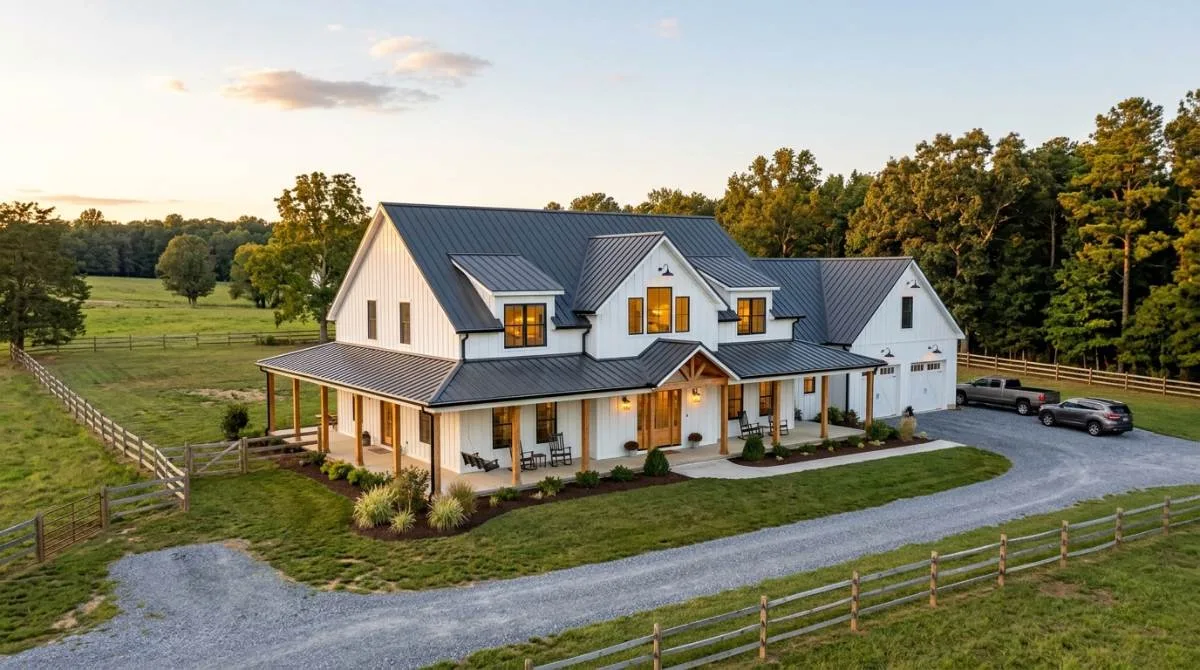
Maryland barndominium cost factors: MBPS building codes, Chesapeake Bay Critical Area, septic and well, stormwater, forest conservation and rural land.
Building a barndominium in Maryland is not like building one in a typical rural state. The state combines expensive construction markets, strong building regulations, county-level zoning, Chesapeake Bay protections, coastal flood risk and forest conservation rules, with big differences between Western Maryland, Central Maryland, Southern Maryland and the Eastern Shore.
So the useful question is not just “how much per square foot?” but what will a Maryland barndominium actually cost once the site, county approvals, septic or well, stormwater work, utilities, foundation and Maryland-specific land restrictions are counted. This guide is for homeowners, land buyers and farmers considering a rural or semi-rural barndominium in the Old Line State (also called the Free State).
Maryland Barndominium Cost Per Sq Ft in 2026
For 2026 planning, published estimates put Maryland toward the higher-cost end of the national market. A reasonable starting range is about $155–$230 per sq ft finished, with a basic structural shell around $50–$80 per sq ft. A Garrett County project can have a completely different cost structure from one in Montgomery, Anne Arundel or Howard County, or on the Eastern Shore.
| Size | Finished Planning Range | Shell Planning Range |
|---|---|---|
| 1,200 sq ft | $186,000–$276,000 | $60,000–$96,000 |
| 1,500 sq ft | $232,500–$345,000 | $75,000–$120,000 |
| 2,000 sq ft | $310,000–$460,000 | $100,000–$160,000 |
| 2,400 sq ft | $372,000–$552,000 | $120,000–$192,000 |
| 2,500 sq ft | $387,500–$575,000 | $125,000–$200,000 |
| 3,000 sq ft | $465,000–$690,000 | $150,000–$240,000 |
A 2,000 sq ft Maryland barndominium therefore deserves a preliminary construction budget near $310,000–$460,000. A shell may include the structural frame, exterior metal, roofing and siding, but it is not ready to live in. A finished home adds insulation, drywall or interior finishes, electrical, plumbing, HVAC, bathrooms, kitchen, flooring, doors, windows, lighting, cabinets, fixtures and final code work. Our Barndo Material Cost Estimator shows how materials alone move the number.
What Does a 2,000 Sq Ft Barndominium Cost in Maryland?
| Project Level | Approx. Construction Budget | Typical Characteristics |
|---|---|---|
| Basic | $310,000–$355,000 | Simple footprint, standard finishes, limited complexity |
| Mid-Range | $355,000–$415,000 | Better finishes, larger kitchen, upgraded HVAC and windows |
| Premium | $415,000–$460,000+ | High-end finishes, custom interiors, larger openings, upgraded systems |
These describe the construction portion only. A new driveway, well, septic system, heavy grading, retaining walls, a long electrical service, forest clearing, drainage work or environmental approvals can push the overall project much higher.
Why Maryland Barndominium Cost Runs Higher Than Expected
Drivers include high construction costs near metro areas, local zoning, county building amendments, Chesapeake Bay Critical Area limits, floodplain and coastal issues, septic and well requirements, stormwater and erosion control, forest conservation, long rural utility runs, grading and drainage, and heavier engineering and permitting on difficult parcels. Two identical 2,000 sq ft designs can have very different total costs.
Maryland Barndominium Cost: Building Codes & Permits
Maryland uses the Maryland Building Performance Standards (MBPS), which incorporate the International Building Code, International Residential Code and International Energy Conservation Code with Maryland modifications. Per the state’s 2026 code information, the adopted residential framework is the 2021 IRC, with the 2021 IBC and 2021 IECC, while Maryland was working through a 2026 process to adopt the 2024 editions with state amendments. Verify the effective code cycle with the local building department, and do not assume a plan designed around a newer national edition satisfies Maryland without modification.
Do Maryland Counties Have Different Requirements?
Yes. Local jurisdictions can modify the statewide framework for local conditions, and the Building Codes Administration keeps separate county resources because amendments and procedures differ. Identify the exact county and municipality before buying, then ask the building department about the current code, local amendments, permit process, zoning, setbacks, accessory-building rules and driveway requirements. A listing that says “buildable” does not mean your design will be approved.
Barndominium Building Permit Impact on Maryland Barndominium Cost
Treat a barndominium as permitted residential construction; a metal or agricultural look does not exempt it. Expect plans or engineering, structural and foundation details, energy-code documentation, site plan, zoning review, septic or sewer documentation, well information, stormwater requirements and other county approvals.
Maryland Barndominium Cost: Questions to Ask the County Before Designing
- Is the parcel legally buildable, what is the zoning district, and is residential occupancy permitted?
- What are the minimum lot size and the front, side and rear setbacks?
- Is the property in the Chesapeake Bay Critical Area, and does a Critical Area Buffer or floodplain affect the building envelope?
- Will a well, an onsite sewage system or a stormwater plan be required?
- Will forest be disturbed, and are there agricultural preservation easements or driveway and access rules?
Getting these answers before buying land saves far more than redesigning afterward.
Maryland Dept. of Labor — Building Codes AdministrationMBPS code adoption and county-by-county code informationMaryland OneStopState permit portal for septic, wells, erosion control and stormwaterMaryland Barndominium Cost: Septic & Well Requirements
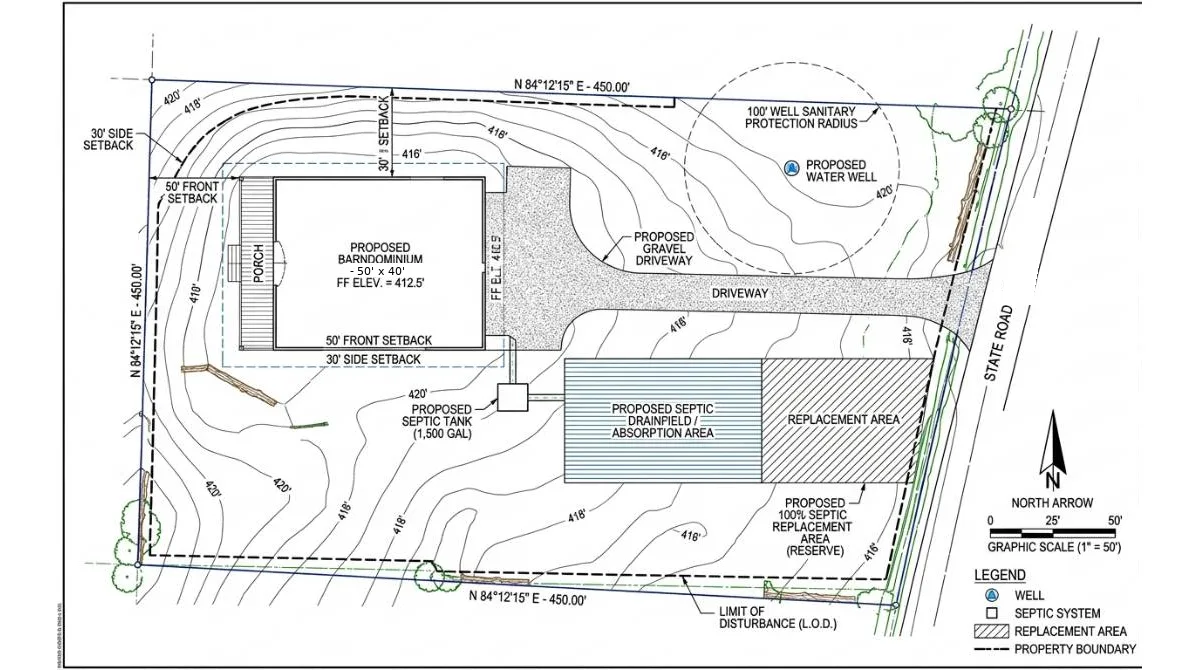
For a rural property, wastewater is often the most important site issue. Maryland regulates onsite sewage systems through the Maryland Department of the Environment (MDE) and local approving authorities, and the OneStop process requires a county land evaluation before the septic permit application. That makes septic suitability a land-purchase issue, not just a construction issue.
Why Septic Soil Testing Affects Maryland Barndominium Cost
A beautiful parcel can be a poor site if soils, groundwater, slopes, setbacks or available disposal area make a conventional system hard or expensive. Maryland rules include separation distances between disposal areas and wells. Before buying, find out whether there is an approved septic area, whether it supports the planned bedroom count, where the replacement area sits, whether the footprint conflicts with it, where the well can legally go, whether soils need an engineered or alternative system, and whether grading could interfere. A 3,000 sq ft, multi-bedroom home needs more careful wastewater planning than a small two-bedroom.
Maryland Barndominium Cost of a Well: Requirements
Without public water you may need a private well, and Maryland requires a well construction permit with local health authorities involved. Drilling price is only part of it: you need a viable location, adequate supply, separation from septic components and compliance with local rules. Ask for existing well records and whether an approved well already exists.
Design Well and Septic Together
The house, driveway, well, septic and replacement areas, drainage and setbacks all compete for the same usable land, so evaluate the rural site plan as one system before fixing the barndominium location.
Maryland Department of the EnvironmentOnsite sewage disposal, well construction, wetlands and stormwater programsMaryland Barndominium Cost: Stormwater & Erosion Control
Maryland’s erosion, sediment-control and stormwater programs aim to reduce erosion, pollution, stream damage and flooding from development. Per OneStop guidance, erosion and sediment-control approval applies to construction disturbing at least 5,000 sq ft of soil or involving at least 100 cubic yards of excavation, and stormwater management can apply to new development disturbing 5,000 sq ft or more. A construction stormwater general permit applies at one acre or more, so this matters even on large rural lots.
Why Drainage Work Raises Maryland Barndominium Cost on Rural Sites
A new house, metal roof, driveway, shop, parking and cleared land change runoff. Potential costs include grading, swales, infiltration practices, drainage channels, stormwater facilities, culverts, driveway drainage, erosion control, stabilization and revegetation. The cheapest building site is not always the cheapest overall; a slightly pricier parcel with a good building envelope can save substantial site money.
Maryland Barndominium Cost & the Chesapeake Bay Critical Area
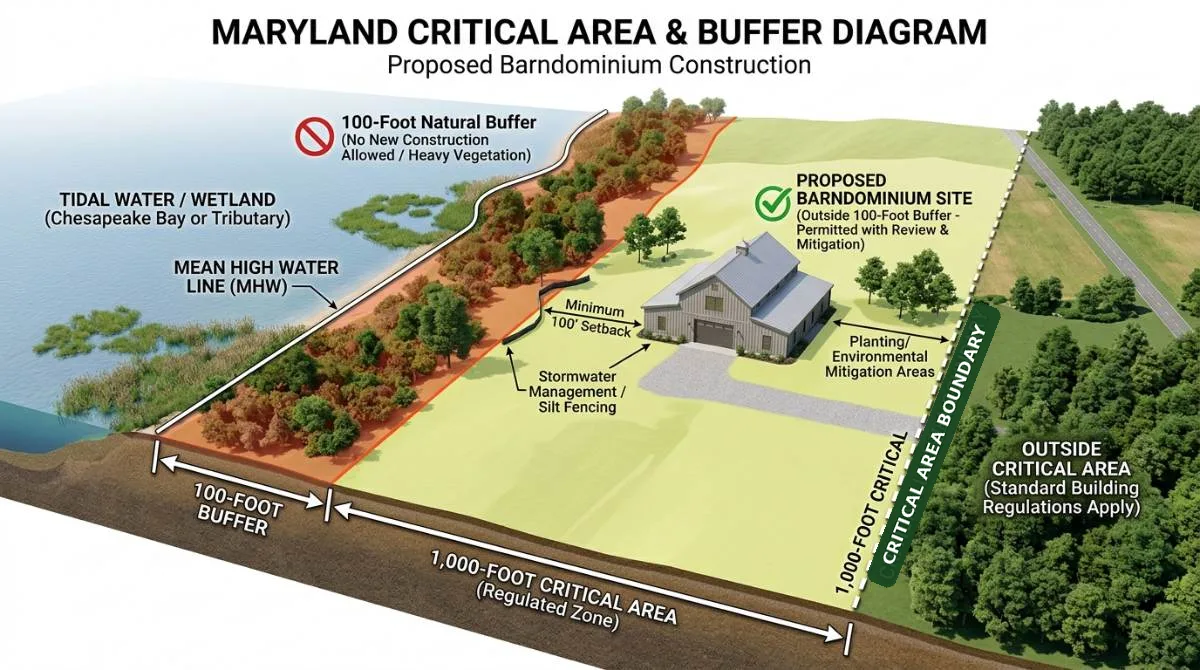
This is the most Maryland-specific issue in the guide. The Critical Area generally covers land within 1,000 feet of tidal waters and tidal wetlands, including the Chesapeake Bay, Atlantic Coastal Bays and their tidal tributaries. For a waterfront or near-water barndominium, these rules can dramatically affect where and how you build.
Critical Area Buffer and Maryland Barndominium Cost
The program generally sets a minimum 100-foot Buffer next to tidal waters, tidal wetlands and tributary streams. New disturbance of land or vegetation, structures and new lot coverage are generally restricted there, subject to rules and exceptions, and the Buffer can widen for steep slopes or constrained soils. A waterfront lot can have far less usable area than the listed acreage suggests.
Does Waterfront Make a Maryland Barndominium More Expensive?
It can. Expect added design and approval work for Critical Area and Buffer limits, tidal wetlands, flood hazards, shoreline erosion, stormwater, wetland permits, shoreline stabilization, elevation requirements and coastal construction limits. Never judge a waterfront parcel on land price alone.
Tidal Wetlands and Waterway Permits
Filling, dredging, piers, shoreline stabilization or other regulated work may need authorization. MDE administers the tidal wetlands and waterways programs, and some projects get state and federal review. This matters for large driveway connections, waterfront shops, piers and heavy grading near tidal water, and an inland site can avoid many of these complications.
Maryland Critical Area CommissionCritical Area maps, the 100-foot Buffer and local program contactsMaryland Barndominium Cost: Floodplain & Sea-Level Rise
Maryland’s floodplain and waterway rules can require authorization for construction, excavation, filling and culverts in regulated areas. Do not assume a big rural parcel is safe because the house site looks dry on a normal visit. Check official flood maps and local floodplain rules and confirm the actual building envelope, not just the property line, avoids problem areas.
Sea-Level Rise and Coastal Maryland Barndominium Cost
The Maryland Department of Natural Resources reports more than a foot of sea-level rise over the past century from land subsidence and global change, and state projections show several additional feet by 2100. For coastal land, weigh long-term exposure alongside today’s FEMA map and think about the building’s lifetime on the Eastern Shore or Bay.
FEMA Flood Map Service CenterCheck the flood zone for a specific address or parcelMaryland Barndominium Cost: Forest Conservation & Farmland
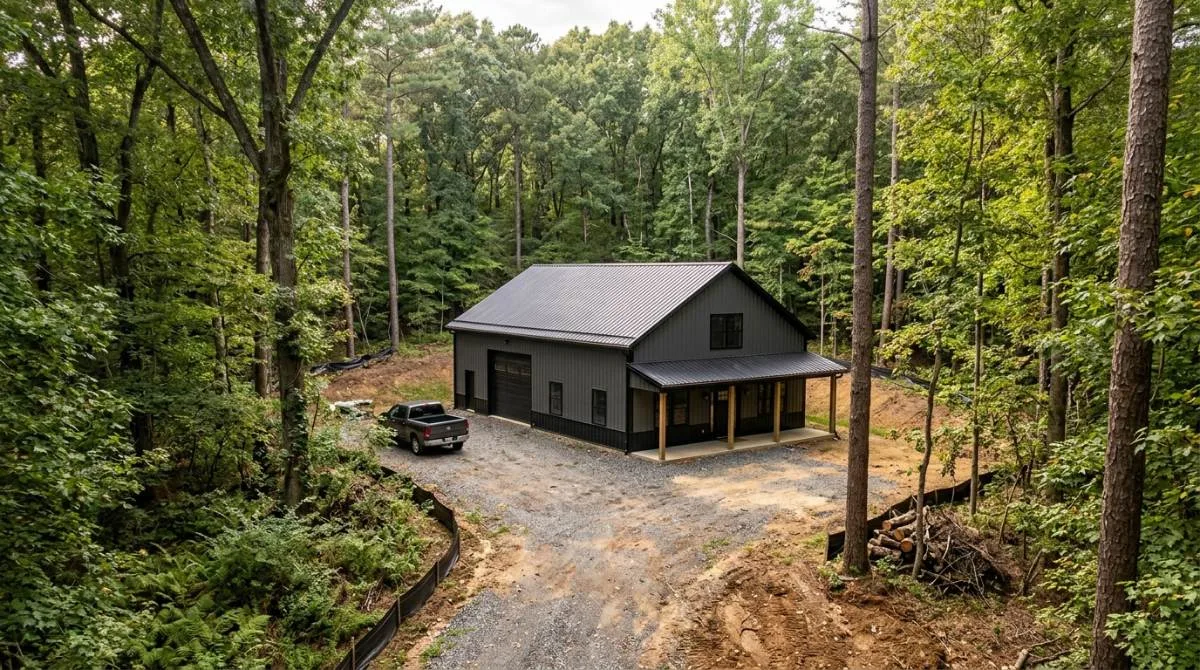
The Forest Conservation Act protects forests during development and can enter subdivision, grading, sediment-control and development review. On wooded land the question is not just acreage but how much forest you may legally clear for the house, driveway, parking, well access, septic and replacement areas, drainage, utility corridors and accessory buildings. Maryland Forest Service guidance notes that planning can involve Forest Stand Delineations, Forest Conservation Plans, retained-forest protection, mitigation and qualified professionals. Wooded land looks great but can be more complicated financially.
Can You Build a Barndominium on Maryland Farmland?
Yes, farmland can be a great setting, but “farmland” does not mean “easy residential construction.” Some properties carry agricultural zoning, conservation easements or development-right limits. The Maryland Agricultural Land Preservation Foundation (MALPF) buys easements that can permanently restrict development rights, so confirm whether a farm has one before assuming you can place a residence anywhere.
Agricultural Use Assessment and Preservation Easements
The Agricultural Use Assessment program assesses qualifying farmland by agricultural use rather than development value. That is valuable to farm owners, but it does not mean a future residence is unrestricted: changing use, adding a home, subdividing or developing preserved land can carry planning, zoning, easement and tax consequences. If an easement exists, read the recorded document to see which residential and agricultural rights remain, since they depend on the property, easement language, county rules and program requirements. A workshop, garage or barn-like look does not make a barndominium an agricultural building.
Maryland Forest Service — Forest Conservation ActForest Conservation Plans, stand delineations and mitigationMALPF — Agricultural Land PreservationAgricultural conservation easements and development restrictionsMaryland SDAT — Agricultural Use AssessmentEligibility and tax treatment of farmlandMaryland Barndominium Cost and Zoning: County Matters
Zoning authority varies by jurisdiction, so one concept can be simple in one county and difficult in another. Before buying, confirm the zoning district, permitted residential uses, minimum lot requirements, density limits, setbacks, height restrictions, accessory-structure rules, farm-related use requirements, subdivision limits, environmental overlays, Critical Area status and forest conservation rules. Maryland has charter counties, code counties, non-charter counties, Baltimore City and municipalities with different statutory frameworks, so the county planning office is one of the first calls to make before buying land.
Maryland Barndominium Cost by Region
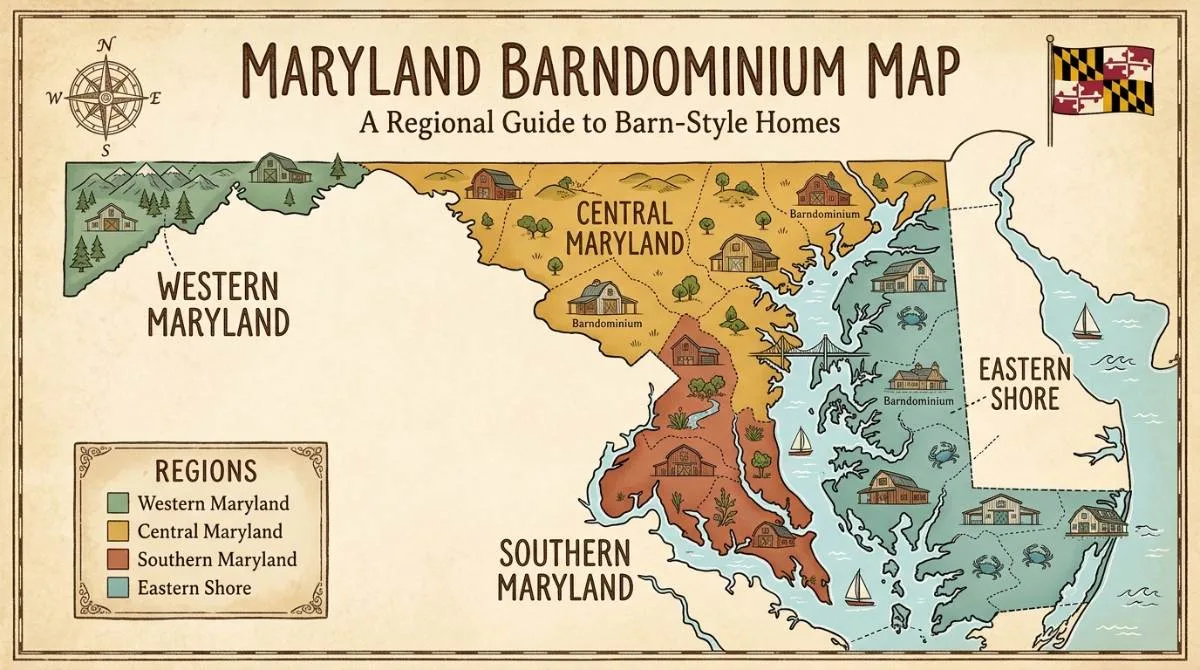
Maryland is too diverse for one statewide price. Rural Western Maryland parcels often price below Central Maryland, but slope, rock and well depth can erase the savings, so treat the statewide range as a starting point for every region.
Western Maryland Barndominium Cost
Garrett, Allegany and Washington counties offer more rural land and an agricultural or recreational setting. Mountain terrain can add steep slopes, excavation, rock, long driveways, winter weather, retaining walls, deeper wells and limited contractor availability. A simple rectangle on gentle ground is far easier than the same house on a steep wooded lot.
Central Maryland Barndominium Cost
Around Baltimore, Howard, Carroll and Frederick, construction and land costs are significantly higher, and land near employment centers carries a premium. The bigger challenge is often finding a parcel where zoning, setbacks, septic, access and environmental limits leave a practical building envelope.
Southern Maryland Barndominium Cost
Calvert, Charles and St. Mary’s mix rural properties with strong development pressure near Washington. Parcels can look rural yet face zoning, woodland or Bay-related restrictions, and anything near tidal water needs extra due diligence.
Eastern Shore Maryland Barndominium Cost
Open farmland and larger parcels are attractive, but watch low-lying terrain, flooding, drainage, high groundwater, septic conditions, coastal hazards, wetlands, Critical Area rules and wind exposure. The building envelope often matters more than the number of acres.
Maryland Barndominium Cost: Wind, Roof, Insulation & Energy
Maryland has humid summers, heavy rain, winter cold, snow and ice, thunderstorms and, on the coast, possible tropical-storm winds. The structure needs an engineered load path from roof through walls and connections into the foundation. A good roof design addresses snow loads where applicable, wind uplift, metal roof attachment, water shedding, ice, gutter and drainage capacity, penetrations, and insulation and condensation control. A cheap roof that leaks or condenses can erase the original savings.
Energy-code requirements make insulation and envelope design central. With a large metal envelope, plan roof and wall insulation, air sealing, thermal-bridging control, quality windows, efficient HVAC, ventilation and moisture management early. Humid summers make moisture control especially important, since good nominal insulation still performs poorly if air leakage and condensation are not controlled. See also: is spray foam mandatory in a barndominium?
Maryland Barndominium Cost: Shop Space & Hidden Costs
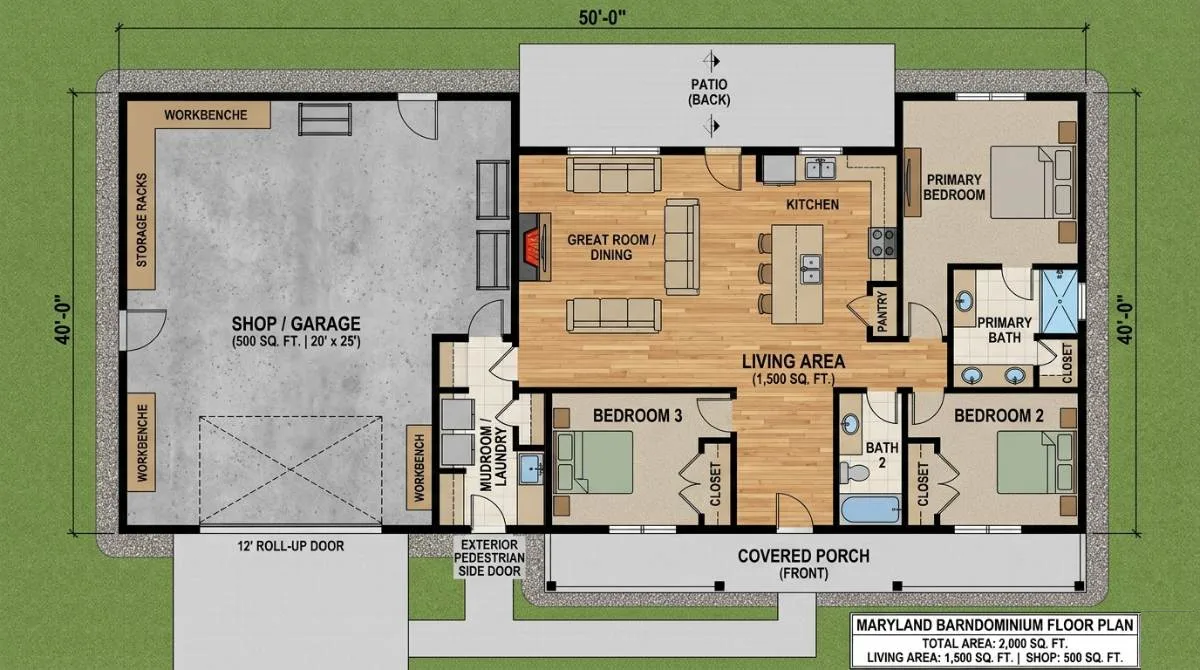
A big attraction is combining living space with a shop, garage or storage. A 2,000 sq ft building could hold 1,500 sq ft of living space and 500 sq ft of shop, or the reverse, and the cost difference is large because finished residential space costs far more than unfinished shop area. Ask whether every square foot needs HVAC, drywall, flooring, plumbing, lighting and residential finishes. Browse barndominium floor plans to see typical living-plus-shop splits.
Maryland Barndominium Hidden Costs
The square-foot estimate is never the full budget. Additional items include land, survey, soil evaluation, geotechnical and structural engineering, architectural design, county permits and zoning approvals, septic evaluation and installation, well drilling and water testing, driveway and culverts, clearing and forest conservation work, grading and retaining walls, stormwater and erosion control, electrical service, propane or other fuel systems, utility trenching, appliances, kitchen and bath upgrades, landscaping, fencing, shop equipment, construction financing, insurance and contingency. On a difficult rural parcel these can be a very large share of the total. Run land numbers through our Land Cost Calculator.
Maryland Barndominium Land Buying Checklist
Order matters when buying land. Work through these steps before finalizing a design:
- Confirm the county and jurisdiction, verify zoning and residential use, confirm the parcel is legally buildable and check setbacks and the building envelope.
- Check floodplain maps, Critical Area status and the Buffer, and wetlands and waterways.
- Check forest conservation requirements and agricultural preservation easements, and review deed restrictions.
- Confirm road access and driveway requirements.
- Complete septic feasibility work and confirm well feasibility or public-water availability.
- Estimate clearing, grading and utility extension costs.
- Only then finalize the barndominium design.
How to Reduce Maryland Barndominium Cost
Savings in Maryland come from reducing complexity, not just choosing cheaper materials.
- Simple shape: a rectangle is easier to frame, roof, insulate, wire and finish.
- Concentrated plumbing: group kitchen, baths, laundry and mechanical areas.
- Careful site choice: good access, suitable soils, an existing driveway and nearby utilities can beat cheap acreage needing major work.
- Lighter shop finishes: the shop does not need residential finish levels.
- Right size: an extra 500–1,000 sq ft raises HVAC, flooring, electrical, roofing, insulation, foundation, site requirements and maintenance.
Maryland Barndominium Cost and Design Ideas
A Maryland barndominium does not have to look like a converted metal building. Popular approaches include a traditional or modern farmhouse exterior, board-and-batten siding with a metal roof, a large front porch and rear screened porch, open kitchen and living room, oversized mudroom, dedicated laundry, attached garage or shop, large pantry, first-floor primary bedroom, loft or second-floor bedrooms, a home office and equipment storage. Covered outdoor space is especially useful in Maryland’s climate for shade and rain protection.
Maryland Barndominium Cost: Financing Considerations
Financing can be harder than for a conventional subdivision home. Lenders may weigh the property, plans, appraisal, builder, borrower, land value, budget and completed value differently, so make sure the lender and appraiser understand a large unfinished shop or agricultural component. Separate the budget into land, site development, foundation, shell, interior construction, mechanical systems, utilities, permits, professional services and contingency to see the real financing need instead of one per-square-foot number. Estimate payments with our Free Home Loan Calculator or check available equity with the Home Equity Calculator.
Maryland Barndominium Cost: 1,500 and 2,500 Sq Ft Examples
A 1,500 sq ft finished Maryland barndominium could fall around $232,500–$345,000 for construction. The low end needs a straightforward design and site; higher costs come from premium finishes, engineering, complex foundations, large openings or difficult conditions.
A 2,500 sq ft finished barndominium would be roughly $387,500–$575,000. At this size, make sure extra square footage improves usefulness; unfinished shop space is often more economical than conditioning every foot.
Maryland Barndominium Cost Planning Example
Take a hypothetical 2,000 sq ft rural Maryland barndominium:
| Component | Planning Approach |
|---|---|
| Living area | Approximately 1,500–1,700 sq ft |
| Shop / garage | Approximately 300–500 sq ft |
| Building design | Simple rectangular footprint |
| Interior | Mid-range residential finish |
| Site | Moderately accessible rural parcel |
| Utilities | Existing or reasonably accessible infrastructure |
The building could land in the planning range above, but a new well, engineered septic, long driveway, major clearing, grading, drainage work or utility extensions can move the total far beyond it.
Maryland Barndominium Cost vs Traditional House
A barndominium shines when you want a large open interior, workshop, garage, equipment storage or flexible plan, but it is not automatically cheaper than a conventional Maryland home. The advantage grows with substantial useful non-residential space and a straightforward structure and finish level, and shrinks with expensive residential finishes, complicated rooflines, large glass walls, multiple bathrooms, extensive porches and difficult site work. Compare with our Barndominium vs House Cost Calculator, the comparison guide and the New Home Construction Cost Calculator. Kit buyers can also see the Kit Cost Calculator and Kits Guide.
Maryland Barndominium Cost: What to Ask Builders
Get a detailed written proposal. Ask whether the price is for shell or complete construction; whether it includes foundation, engineering, permits, site preparation, septic, well, utility connections, windows and exterior doors, kitchen cabinets, appliances and porches; which insulation, HVAC and interior finish level are assumed; whether the shop is finished; who handles county inspections and stormwater and erosion-control requirements; and who pays for unexpected site conditions. Two contractors can quote the same $400,000 and deliver very different projects if scopes differ.
Best Maryland Areas to Research for a Rural Barndominium
There is no single best county; it depends on land availability, commute, agricultural use, privacy, waterfront, mountains, schools, construction access and distance to cities. Western Maryland suits buyers wanting mountains and recreation, but check terrain, winter access, wells, septic and excavation. Frederick and Carroll offer rural surroundings near Central Maryland jobs, with higher land prices and development controls. Southern Maryland (Calvert, Charles, St. Mary’s) needs zoning, woodland and Bay-rule checks. The Eastern Shore offers open farmland but needs special attention to flood risk, wetlands, drainage, groundwater, septic and Critical Area rules. Because Maryland borders several states, neighboring guides make useful comparisons: Pennsylvania and West Virginia sit next to Western Maryland, Delaware touches the Eastern Shore, Virginia lies across the Potomac from Southern Maryland, and New Jersey is a nearby Mid-Atlantic market.
Maryland Barndominium Cost Per Sq Ft: The Bottom Line
For 2026 planning, Maryland barndominium cost can reasonably be modeled around $155–$230 per sq ft finished and $50–$80 per sq ft for a shell, or about $310,000–$460,000 for a 2,000 sq ft building. But do not stop there: the county development system, Critical Area and 100-foot Buffer, septic and well requirements, stormwater rules, Forest Conservation Act, agricultural easements and flood risk can affect the final budget more than small differences in shell price. The key decision may be the land and building envelope, not the floor plan. A parcel with good access, suitable soils, a practical septic area, adequate water, manageable forest, low flood exposure and simple zoning keeps a moderately priced barndominium realistic; a cheap parcel with severe constraints does the opposite.
Compare other states with our Barndominium Cost Per Sq Ft by State guide or read the Barndominium in 2026 guide. You can also browse every state in our Barndominium Cost hub.
Frequently Asked Questions About Maryland Barndominium Cost
What is the average Maryland barndominium cost per square foot?
A reasonable 2026 planning range is approximately $155–$230 per square foot for finished construction, with shell-level estimates around $50–$80 per square foot. Actual pricing varies significantly by county, site, design and finish level.
How much does a 2,000 sq ft barndominium cost in Maryland?
A 2,000-square-foot finished barndominium can be preliminarily modeled at about $310,000–$460,000 for the building construction portion. Site development and property-specific expenses can increase the total.
Is a barndominium cheaper than a house in Maryland?
It can be, particularly when the design combines efficient living space with an unfinished or lightly finished shop. A highly customized barndominium is not automatically cheaper than a conventional home.
Can I build a barndominium on Maryland farmland?
Possibly, but zoning, residential-use rules, agricultural preservation programs, conservation easements, septic requirements and county regulations must be checked first.
Do Maryland barndominiums need building permits?
Plan it as a permitted residential building project. The exact permit package depends on the county, zoning, site conditions, utilities and environmental requirements.
Does Maryland have statewide building codes?
Maryland uses the Maryland Building Performance Standards, which incorporate national model codes with Maryland amendments. Local jurisdictions can also have applicable amendments.
Are Maryland’s 2024 building codes already mandatory in 2026?
State information lists the 2021 IBC, IRC and IECC as the adopted MBPS codes, with a 2026 process underway to move to the 2024 editions with state amendments. Verify the effective code cycle with the local building department.
Do rural Maryland barndominiums need septic systems?
If public sewer is unavailable, an onsite sewage disposal system may be necessary. Maryland’s process involves land evaluation and local approving-authority review before a septic construction permit is issued.
Do I need a well for a rural Maryland barndominium?
If public water is unavailable, a private well may be required. Maryland requires a well construction permit for wells constructed in the state.
Can I build close to the Chesapeake Bay?
Possibly, but properties in the Critical Area face additional restrictions. It generally extends 1,000 feet inland from tidal waters and tidal wetlands, and a minimum 100-foot Buffer commonly applies next to tidal waters, tidal wetlands and tributary streams.
Can forested Maryland land be cleared for a barndominium?
Potentially, but the Forest Conservation Act can apply to development and land disturbance. How much forest can be removed, and what conservation measures are required, depends on the property and project.
What is the biggest mistake when buying Maryland barndominium land?
Buying acreage before confirming the actual building site is suitable. A parcel can look cheap while having problems with zoning, septic, wells, floodplain, wetlands, forest conservation, access or conservation easements.
Maryland Barndominium Cost: Final Checklist
- Confirm county and jurisdiction, zoning, residential use, legal buildability and setbacks
- Check Critical Area status, the 100-foot Buffer, floodplain exposure, wetlands and waterways
- Evaluate septic feasibility and confirm well or public-water availability
- Check Forest Conservation Act requirements, agricultural preservation easements and deed restrictions
- Estimate driveway and access, clearing and grading, and stormwater requirements
- Get a detailed contractor scope separating shell, interior and site-development costs
- Keep a contingency reserve