
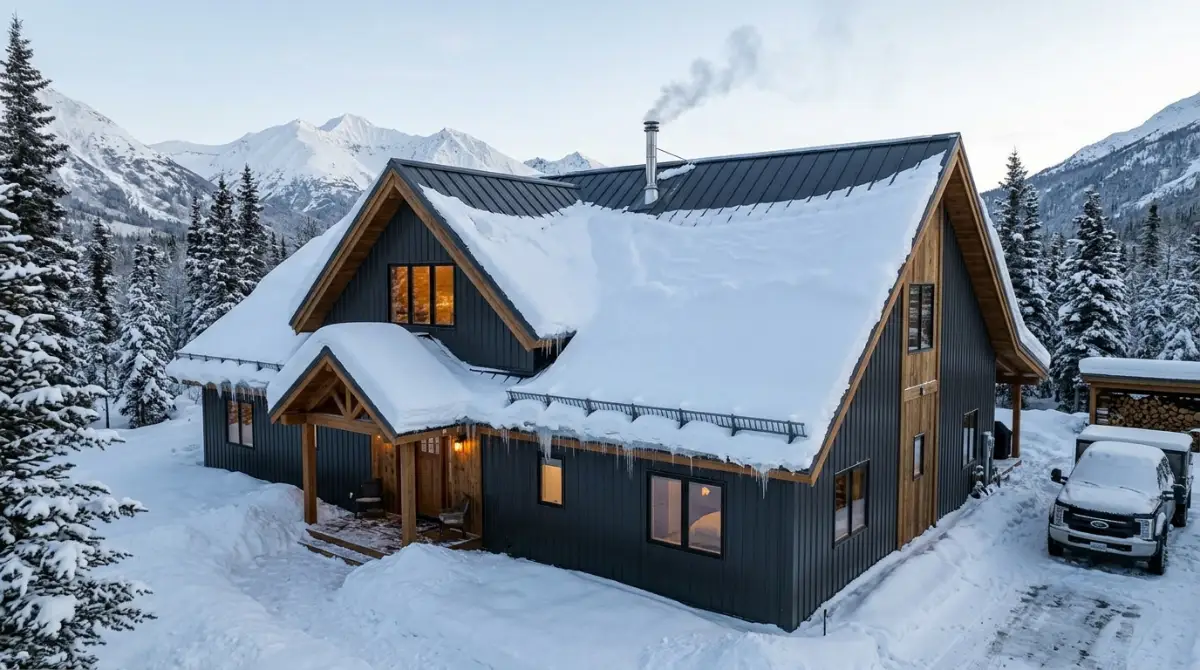
Alaska Barndominium Cost Per Sq Ft (2026)
Planning ranges plus Alaska snow, permafrost, heating, water, septic and remote-land realities — and what shell-price ads leave out.
Alaska Barndominium Cost Per Sq Ft: 2026 Price Range
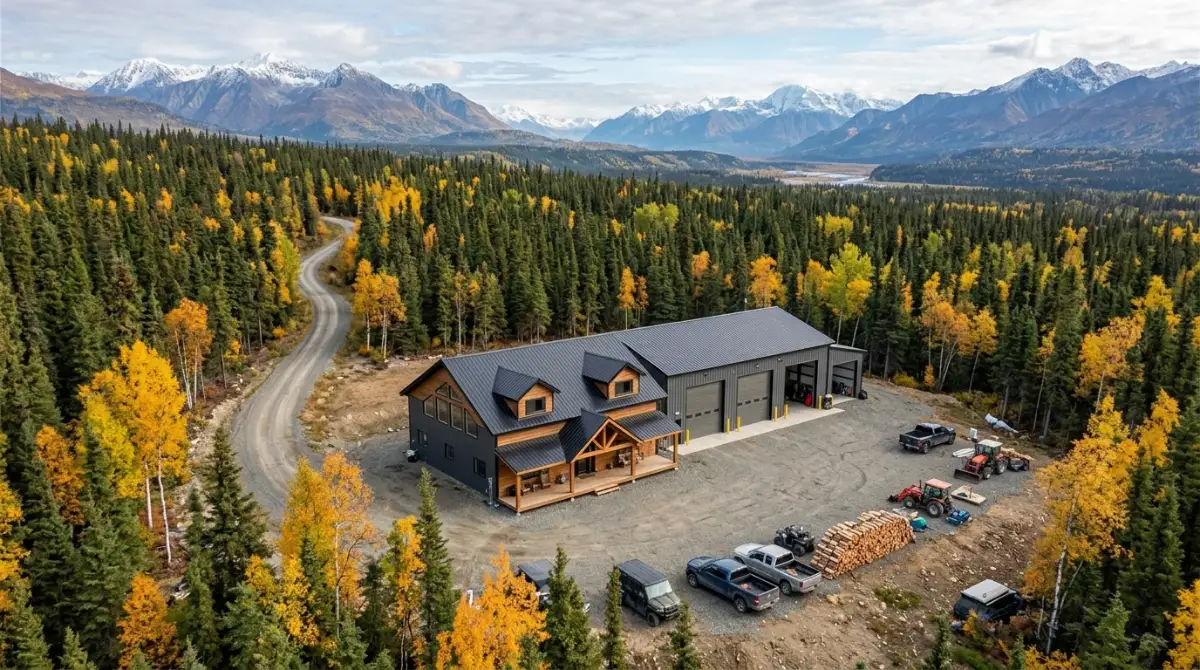
Building a barndominium in Alaska is very different from building one in the Lower 48. The Alaska barndominium cost per sq ft for 2026 is roughly $210–$320 per square foot for a finished home and $70–$120 per square foot for an erected shell. A 2,000-square-foot finished building lands near $420,000–$640,000 before land and site work.
The shell and finished figures describe different scopes. Before comparing quotes, confirm whether the price includes foundation, erection labor, insulation, heating, plumbing, electrical, interior finishes, permits and delivery.
Alaska Barndominium Cost Per Sq Ft by Home Size
This table applies the Alaska barndominium cost per sq ft planning ranges to common building sizes. It is arithmetic, not a prediction for a specific property.
| Living area | Shell | Finished |
|---|---|---|
| 1,200 sqft | $84,000–$144,000 | $252,000–$384,000 |
| 1,500 sqft | $105,000–$180,000 | $315,000–$480,000 |
| 2,000 sqft | $140,000–$240,000 | $420,000–$640,000 |
| 2,400 sqft | $168,000–$288,000 | $504,000–$768,000 |
| 2,500 sqft | $175,000–$300,000 | $525,000–$800,000 |
| 3,000 sqft | $210,000–$360,000 | $630,000–$960,000 |
In remote locations transportation and mobilization can change the total materially. To model your own size and finish, run your numbers in the barndominium cost calculator.
Why Is Alaska Barndominium Cost Per Sq Ft So High?
Alaska’s construction costs reflect climate, geography, labor availability and logistics, which is why the Alaska barndominium cost per sq ft runs above most states. Some projects build efficiently where roads and contractors exist. Others need specialized engineering and heavy preparation before work can start.
1. Freight and material delivery
Steel framing, metal panels, windows, doors, insulation and heating equipment are often made outside Alaska. Delivery cost depends on origin, shipment size, seasonal access and whether the site is reachable by ordinary road transport. A highway-accessible lot is very different from one needing a barge, aircraft, winter trail or several transfers. Ask suppliers to separate material cost from freight, unloading, storage and delivery to the building pad.
2. A short or difficult construction season
Weather affects excavation, concrete, exterior finishing, equipment access and subcontractor scheduling. Delays add cost when crews return to site, equipment stays rented, materials need winter storage or temporary heat is required.
3. Specialized foundations and ground conditions
Alaska is not one ground condition. A site may have competent gravel, compressible soils, seasonally frozen ground, high groundwater or permafrost. Do not assume a slab-on-grade is suitable just because the building is metal. A geotechnical assessment and site-specific foundation design may be necessary.
Alaska Permafrost and Frost Heave: What Should You Know?
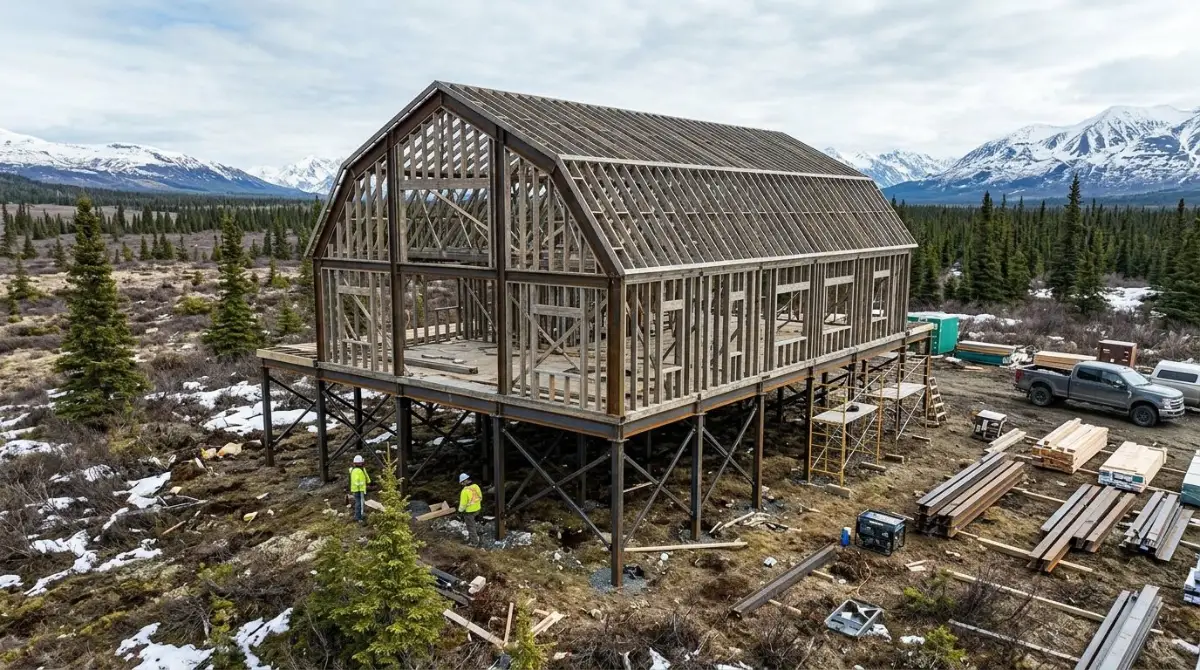
One of the most important questions for any Alaska barndominium is whether the ground contains permafrost or is vulnerable to seasonal frost movement. Permafrost is ground that stays at or below freezing for at least two consecutive years. It does not make building impossible, but it changes foundation design, and the Alaska barndominium cost per sq ft rises with that engineering.
When ice-rich permafrost thaws, the ground can lose strength and settle, causing uneven movement, floor distortion, cracking and damaged utility connections. Heat escaping from a building can itself thaw the ground below. The State’s guidance describes options such as raising the building so cold air circulates beneath it, engineer-designed piles, post-and-pad foundations and foam rafts, plus keeping runoff away from the foundation (Alaska Commerce, Foundations for Building on Permafrost).
- Elevated foundations reduce heat transfer into the ground.
- Piles designed for local soil conditions by an engineer.
- Ground insulation and engineered thermal protection.
- Drainage that manages surface water and snowmelt.
- Monitoring where the design requires it.
These are not interchangeable. The right approach depends on the ground profile, thermal conditions, building loads and local engineering requirements. The Division of Geological & Geophysical Surveys publishes foundation-condition maps for some areas, such as Fairbanks (DGGS), but maps do not replace a site investigation.
Seasonal frost heave and foundation movement
Even without permafrost, freezing and thawing can move shallow foundations, especially with frost-susceptible soils, accumulating water and poor drainage. Before buying land, investigate soil type, groundwater, drainage, freeze depth and foundation suitability. If a site needs imported structural fill, extensive excavation or ground improvement, price it before finalizing the building design.
Alaska Snow Loads, Roof Design and Wind Exposure
Snow is more than a winter chore, and it changes the Alaska barndominium cost per sq ft through roof engineering. It shapes roof structure, geometry, drainage, access and where doors and utilities go. Snow conditions vary by region, elevation, exposure and local weather, so a roof that works in one Alaska community may not suit another.
Designing a barndominium roof for snow
Discuss these points with your designer or structural engineer, because they feed straight into Alaska barndominium cost per sq ft:
- Applicable ground and roof snow loads
- Drifting around roof transitions and taller sections
- Accumulation beside dormers, additions and attached garages
- Roof drainage and melting-snow management
- Connections between roof, walls and foundation
- Safe access for inspection and snow removal
A simple roof form reduces complexity but still has to be engineered for the site. Do not choose pitch or framing from appearance or a generic national design.
Wind exposure and metal-building connections
Wind matters most on open land, coastal sites and ridgelines. The design must cover local wind criteria, roof uplift, wall pressure and the connections that carry loads to the foundation. Include large overhead doors, wide openings and big glazed areas from the start, since adding them after the shell is engineered gets expensive.
Alaska Building Codes and Permits for Barndominiums
Permitting shapes the Alaska barndominium cost per sq ft too. Alaska has no statewide residential building code for homes of three units or fewer. Codes apply only where a municipality or borough adopts and enforces them, and many rural areas have none (Alaska Public Media). Anchorage enforces residential codes inside its code area, but a UAA-led study found outlying Eagle River and Chugiak, and the Matanuska-Susitna Borough, lack them. In the unorganized borough there is often no local building authority at all.
That does not mean “no rules.” Zoning, septic, plumbing, electrical, flood and driveway approvals can still apply, and lenders and insurers often expect engineered, code-based construction anyway. Before ordering a kit, identify the government responsible for the parcel (municipality, borough or another authority) and ask:
- Which building and residential codes, if any, are adopted?
- Is a building permit required for this parcel and structure?
- Are zoning, land-use, driveway or access approvals required?
- What structural design information must be submitted?
- Are energy-code requirements applicable?
- Which inspections are required during construction?
Residential use is not the same as agricultural or storage use
A metal shell does not make living space agricultural or exempt from residential requirements. If the building will have a kitchen, bathrooms or bedrooms, say so before obtaining plans or pricing. Confirm whether the attached shop, garage and living area are treated differently.
Alaska Energy Efficiency: Insulation, Air Sealing and Heating
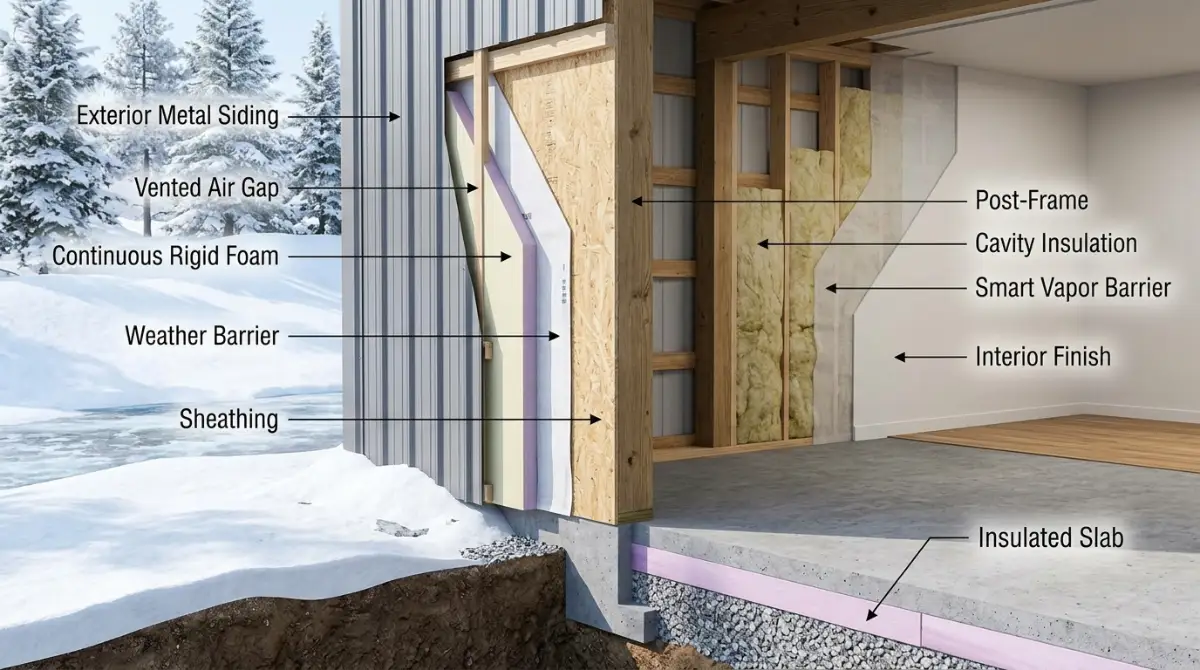
In much of Alaska the building envelope drives comfort and operating cost, so energy design is a core part of the Alaska barndominium cost per sq ft. A metal shell alone does not supply insulation, air tightness or moisture control. Steel conducts heat and can create thermal bridges, and condensation forms when warm, moist indoor air meets cold surfaces inside the wall or roof.
The Alaska Building Energy Efficiency Standard (BEES) is based on the 2018 IECC and ASHRAE 62.2-2016 with Alaska amendments, and it requires at least a 5 Star energy rating. It is binding when Alaska Housing Finance Corporation (AHFC) or other state financial assistance is used (AHFC). Even without AHFC financing, it is a useful benchmark.
- Continuous insulation and control of thermal bridging
- Air sealing at wall, roof, window and door connections
- Vapor control suited to the wall and roof assembly
- Moisture management and ventilation
- Insulated foundations and protected plumbing
- Window performance and careful installation
Choosing a heating system
Options include high-efficiency boilers, forced-air systems, heat pumps and other equipment. The best choice depends on climate, electricity and fuel availability, low-temperature performance, maintenance access and the home’s heat loss. Size equipment from a calculated heat-loss estimate that includes insulation, windows, air leakage, design temperatures and ventilation, not from square footage alone. For remote properties, plan for fuel delivery, backup heat, power interruptions and technician availability.
Alaska Well Costs and Rural Water Supply
Some Alaska properties connect to a community system, while others rely on private wells. Water availability, quality and cost vary a lot and feed straight into the Alaska barndominium cost per sq ft. No state agency permits private water wells in Alaska, though Anchorage and North Pole have local requirements, and outside Anchorage a state general contractor license is what is required to build one (NGWA).
Well contractors must file well logs, pumping tests and water-quality data with the Department of Natural Resources within 45 days of completion, and the public Well Log Tracking System (WELTS) lets you research nearby wells (DNR WELTS). Nearby records help, but they do not guarantee your parcel will match their depth, flow or quality.
- Is a private well feasible, and what local approvals apply?
- What do nearby wells show for depth and yield?
- What water quality testing and treatment will be needed?
- Can the well supply the home plus any shop use?
- How will the well be protected from septic systems and runoff?
- How will pumps, pipes and pressure equipment be protected in winter?
Get a site-specific quote covering drilling, casing, pump, pressure system, testing, trenching and the connection to the house. A drilling-only quote can leave out much of the system.
Alaska Septic Systems and Onsite Wastewater Requirements
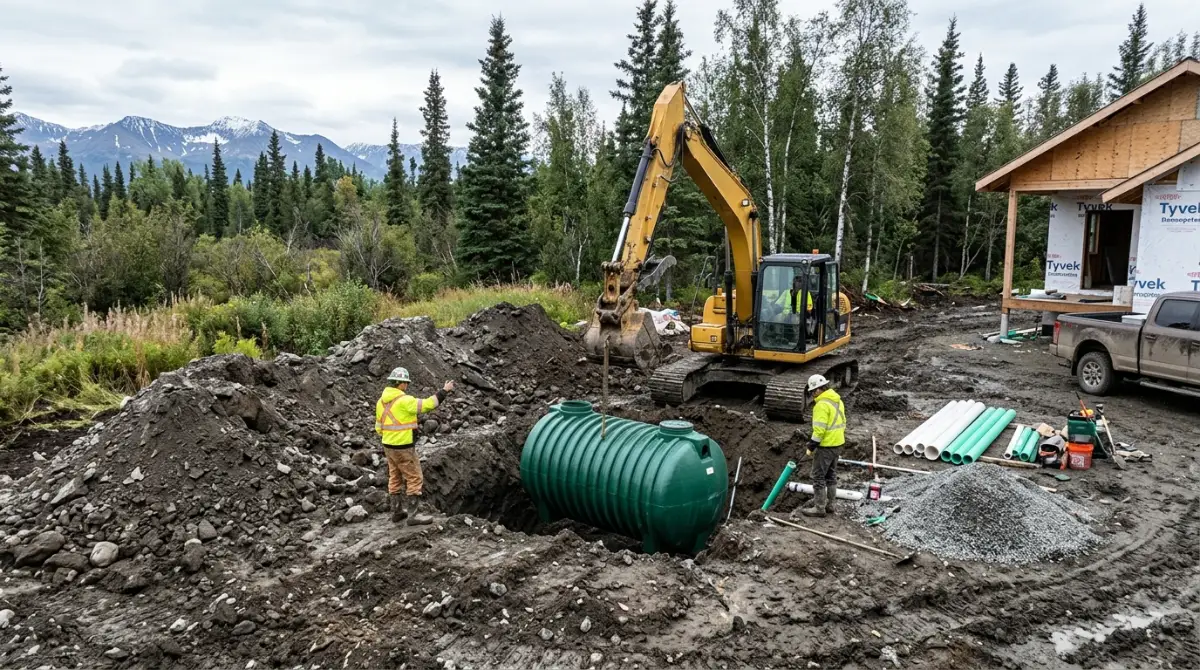
Where public sewer is unavailable, an onsite system is needed, and soils decide whether a lot is practical, which affects the Alaska barndominium cost per sq ft directly. The Department of Environmental Conservation regulates wastewater under 18 AAC 72, with updates effective October 1, 2023 (DEC septic program). A conventional system serving one private residence, with design flow under 1,500 gallons per day, can be installed without prior approval by a certified installer, and an approved homeowner can do the same for an owner-occupied home (18 AAC 72.511).
Difficult sites are different. Where poor soil or high groundwater cannot support a conventional system, an alternative system must be designed by an engineer and approved by DEC before construction. Local authorities such as the Municipality of Anchorage or the City of Valdez may add requirements.
- Soil characteristics and percolation
- Groundwater and slopes
- Separation distances to wells, boundaries and water bodies
- Tank and drainfield location relative to future additions
- Whether an engineered alternative may be needed
Settle this before finalizing the floor plan. A site that cannot hold the system may force a different building location or a costlier engineered solution.
Alaska Flood Risk, Earthquakes and Wildfire Considerations
Alaska has several natural hazards that can raise the Alaska barndominium cost per sq ft, and the relevant risks depend on location. Evaluate them during land selection and design, not after construction starts.
Earthquake risk
Alaska is one of North America’s most seismically active regions, and the lack of enforced residential codes in many areas makes careful engineering even more important. Ask a qualified designer for the seismic design criteria for the site. The structural system, foundation connections, bracing and anchorage must work as a complete system, and a steel frame is not automatically earthquake-proof.
Floodplains and drainage
Low-lying land, river corridors, coastal areas and spots near streams may carry flood restrictions or design requirements. Flood risk can also affect access roads, utilities, septic and insurance. Check flood maps and contact the local floodplain administrator, since a standard building permit may not cover every approval in a flood hazard area.
Wildfire and defensible space
A metal exterior does not make a home fireproof. Roof assemblies, windows, vents, decks, attached structures and nearby vegetation still matter. Consider emergency-vehicle access, defensible space, ember-resistant details and a reliable water supply, and check insurance expectations for the property.
Alaska Land Ownership, Legal Access and Remote Land
Land is its own budget item in the Alaska barndominium cost per sq ft picture. Alaska land can be privately held, state land, borough land or Native corporation land, and each has different rules. Before buying, confirm who owns the parcel and what legal access exists, because a beautiful remote lot without a road, easement or approved route can be hard to build on at any price.
- Confirm ownership and whether the parcel is in an organized borough or the unorganized borough.
- Confirm legal access: recorded easements, section-line or public access easements, and whether a road must be built.
- If buying State land, review the DNR land sale terms, survey and platting requirements (DNR Land Sales).
- Check for borough platting, zoning and subdivision requirements.
- Ask who maintains the road in winter, and how emergency vehicles reach the site.
State land disposals in the unorganized borough involve extra steps, including a traditional use finding under AS 38.05.830, so timelines can be longer than a private sale.
Alaska Barndominium Cost Per Sq Ft by Region
A statewide average cannot describe every community, so treat any single Alaska barndominium cost per sq ft number as a starting point. These cards describe the main pressures rather than official regional price schedules.
Anchorage & Mat-Su Valley
A broader market and road connections. Anchorage enforces codes in its code area, while Mat-Su and outlying areas do not enforce residential codes. Compare total building plus site cost, not just parcel price.
Fairbanks & Interior
Cold-weather performance, foundations, heating and seasonal logistics matter. Permafrost and frost movement may apply at some sites, assessed parcel by parcel.
Kenai & Southcentral
Coastal, forested and open sites differ. Evaluate drainage, snow, wind exposure, access and community services, and get well and septic feasibility early.
Southeast Alaska
Rainfall, drainage, terrain and logistics dominate. A sloped or hard-to-reach parcel can need heavy site work even for a small footprint.
Remote & off-road
Delivery, equipment, workforce accommodation, fuel and weather delays can outweigh the nominal price per square foot. Confirm delivery and local crews before choosing a kit.
How Much Does a 2,000 Sq Ft Barndominium Cost in Alaska?
Using the Alaska barndominium cost per sq ft planning range, a 2,000-square-foot finished building is approximately $420,000–$640,000. That is not a complete land-and-construction budget. Prepare separate estimates for:
- Land purchase, if you do not own it
- Survey, site evaluation and design
- Clearing, excavation, drainage and foundation prep
- Materials, freight, erection and labor
- Insulation, heating, ventilation and electrical
- Water supply or community connection
- Septic installation or sewer connection
- Driveway, access and utility extensions
- Permits, inspections, engineering and fees
- Contingency for site conditions and delays
Use written estimates from local professionals. A remote property can cost far more than a serviced parcel near an established road.
Alaska Site Costs: Benchmarks and What Needs a Quote
Site costs are where an Alaska budget most often breaks, and they sit outside the quoted Alaska barndominium cost per sq ft. No reliable public Alaska-specific price list exists for these items, so the table pairs national baselines for scale with the items that must be priced locally.
| Item | Reference or approach | Alaska note |
|---|---|---|
| Concrete slab | About $6–$14/sqft nationally | Frost, permafrost and fill can add cost |
| Basement foundation | About $35–$50+/sqft nationally | Often unsuitable on frozen or wet ground |
| Kit materials plus assembly | About $30–$50/sqft nationally | Add freight and remote labor |
| Freight and unloading | Written supplier quote | Varies by origin, route and season |
| Well and water system | Local driller quote | Depth, casing, pump and winter protection |
| Septic system | Certified installer or engineer quote | Soils, groundwater and alternative designs |
| Driveway and access | Local excavator quote | Length, drainage and seasonal access |
| Power extension | Utility quote | Distance to the nearest line |
Barndominium Design Ideas That Make Sense for Alaska
A successful Alaska barndominium is designed around how it will be used and maintained, not just how it looks. For layouts, see the best barndominium floor plans and match the plan to your Alaska barndominium cost per sq ft budget.
- Keep the shape practical: a simple footprint eases foundation, roof, insulation and air-barrier coordination. Complex roof intersections and big cantilevers add cost and risk.
- Plan the shop for winter: consider how people and vehicles move through snow and cold, plus doors, ventilation, fire separation and heat management.
- Protect plumbing and mechanicals: keep vulnerable pipes in conditioned or protected spaces with maintenance access, and plan for outages.
- Include storage and entry space: a practical mudroom keeps wet gear, boots and dirt out of the living area.
To check whether rooms are big enough before you pay for the square footage, use the room and furniture fit visualizer.
How to Compare Alaska Barndominium Builder Quotes
Give each builder the same plans and specifications, or one will look cheaper simply because it leaves things out. Ask every Alaska barndominium builder what their cost per sq ft includes. Ask each builder to clarify:
- Is the quote for a kit, erected shell, dried-in shell or finished residence?
- Are the foundation and site preparation included?
- Which insulation, air-sealing and heating specifications are included?
- Does structural engineering cover the actual building location?
- Who handles permits, inspections and documentation?
- Are freight, unloading, storage and remote mobilization included?
- Which water, septic, electrical and access costs are excluded?
- How are allowances, change orders, delays and substitutions handled?
- What warranty covers the structure, installation and completed home?
Ask for a written exclusions list. In Alaska, knowing what a quote leaves out matters as much as the headline price.
Can You Save Money by Building an Alaska Barndominium?
Savings come from reducing complexity and avoiding expensive mistakes, not from the cheapest shell package. Lowering your Alaska barndominium cost per sq ft works best with these steps:
- Choose the site carefully. A serviced, accessible parcel can cut utility and transport costs.
- Use a straightforward floor plan. An open-concept floor plan means fewer interior walls to frame and finish.
- Design for the real climate. Correct insulation and air sealing avoid costly comfort and moisture problems.
- Coordinate the foundation early. Investigate ground conditions before finalizing the building package.
- Combine deliveries. Coordinate materials and equipment to reduce repeated transport.
- Keep the shop size intentional. Heated workshop space adds construction and operating cost.
- Compare complete proposals with the same scope and exclusions, and keep a contingency.
Do not save money by skipping structural engineering, foundation suitability, fire safety, energy performance or wastewater requirements. Fixing those later costs far more. For more ideas, read our guide to planning a cheap barndominium.
Alaska Barndominium Financing and Insurance
Lenders will look beyond the Alaska barndominium cost per sq ft. Financing a barndominium takes more preparation than a conventional home, especially when the property is remote or mixes living and workshop space. By statute, AHFC finances a home only when it meets the Alaska Minimum Construction Standards and BEES and is built by a general contractor with a residential endorsement, with owner-builder exceptions possible (AHFC). Before you commit, estimate your monthly payment with a free home loan calculator, and if you are weighing options, the rent vs. buy home calculator can help.
- Will the lender finance this building type and construction on rural land?
- Must the contractor meet specific requirements or hold a residential endorsement?
- How do construction draws work, and what completion documents are needed?
- Will an insurer cover the property given its location, access, heating system, flood and wildfire exposure?
Confirm insurance before construction begins instead of assuming a standard homeowners policy fits every rural property.
Alaska Barndominium vs. Traditional House Cost
A barndominium is not automatically cheaper than a conventional house in Alaska, and the Alaska barndominium cost per sq ft can match stick-built costs. Freight, ground conditions and climate-driven requirements can erase expected savings from the building style, and the finished living area still needs the same systems as any home. Compare two complete projects, including site development. The barndominium vs. house cost calculator compares both on the same square footage, and the new home construction cost calculator gives a stick-built figure. If you are considering a kit, the barndominium kit cost calculator and the barndo material cost estimator help price the shell.
Alaska Barndominium Land-Buying Checklist
Before purchasing a parcel, work through this checklist, because land conditions change the Alaska barndominium cost per sq ft more than the shell does. A parcel is not affordable based on its purchase price alone. The relevant figure is the combined cost of acquiring the land, making it buildable, connecting services and completing the home.
- Confirm ownership, legal access and year-round or seasonal road conditions
- Identify the local authority and verify zoning and building requirements
- Confirm residential occupancy is allowed
- Investigate soil, groundwater, permafrost and foundation conditions
- Check snow, wind, seismic, flood and wildfire exposure
- Determine whether public utilities are available
- Establish well feasibility and water quality, and confirm septic feasibility
- Get realistic freight and delivery estimates
- Check access for trucks, cranes and excavators
- Estimate heating fuel or electricity costs and backup systems
- Obtain preliminary quotes from builders familiar with the region
Alaska Barndominium Cost Per Sq Ft: Frequently Asked Questions
How much does a barndominium cost per square foot in Alaska in 2026?
This guide’s Alaska barndominium cost per sq ft planning range is $210–$320 finished and $70–$120 for a shell. Published figures vary widely and often exclude land, freight and site work, so get local quotes.
How much does a 2,000 sq ft barndominium cost in Alaska?
At $210–$320 per square foot, about $420,000–$640,000 for the building, before land, freight, foundation, utilities, well, septic and permits.
Is it cheaper to build a barndominium in Alaska than a traditional house?
Not necessarily. Freight, ground conditions and climate-related requirements can reduce or eliminate expected savings from the building style.
Does Alaska have a statewide building code for homes?
No. There is no statewide residential code for homes of three units or fewer. Codes apply only where a municipality or borough adopts them.
Can you build a barndominium on permafrost in Alaska?
Possibly, with a foundation engineered for the actual ground. Permafrost can settle if it thaws, so a geotechnical investigation is often needed.
Do Alaska barndominiums need special snow-load engineering?
The roof and structure must meet the criteria for the specific location. Snow loads and drifting vary, so use local design criteria, not a generic statewide assumption.
Can I use septic on rural Alaska land?
Often, if soils, groundwater and setbacks allow. Conventional systems can go in through a certified installer or approved homeowner, while difficult sites need an engineered system approved by DEC.
Do I need a private well?
Not always. Some properties have community water. If you drill, no state agency permits private wells, but contractors must file well logs with DNR within 45 days.
Is a metal barndominium warm enough for an Alaska winter?
It can be, if the envelope and heating system are properly designed. A metal shell by itself is not a complete thermal system.
What is the cheapest place in Alaska to build a barndominium?
There is no reliable statewide answer without comparing specific parcels and scopes. A cheap lot can be offset by freight, access, foundation and utility costs.
Does Alaska have the same permit requirements everywhere?
No. Requirements vary by jurisdiction. Confirm building, zoning, energy and wastewater rules with the authority for your property.
Final Thoughts: Planning an Alaska Barndominium
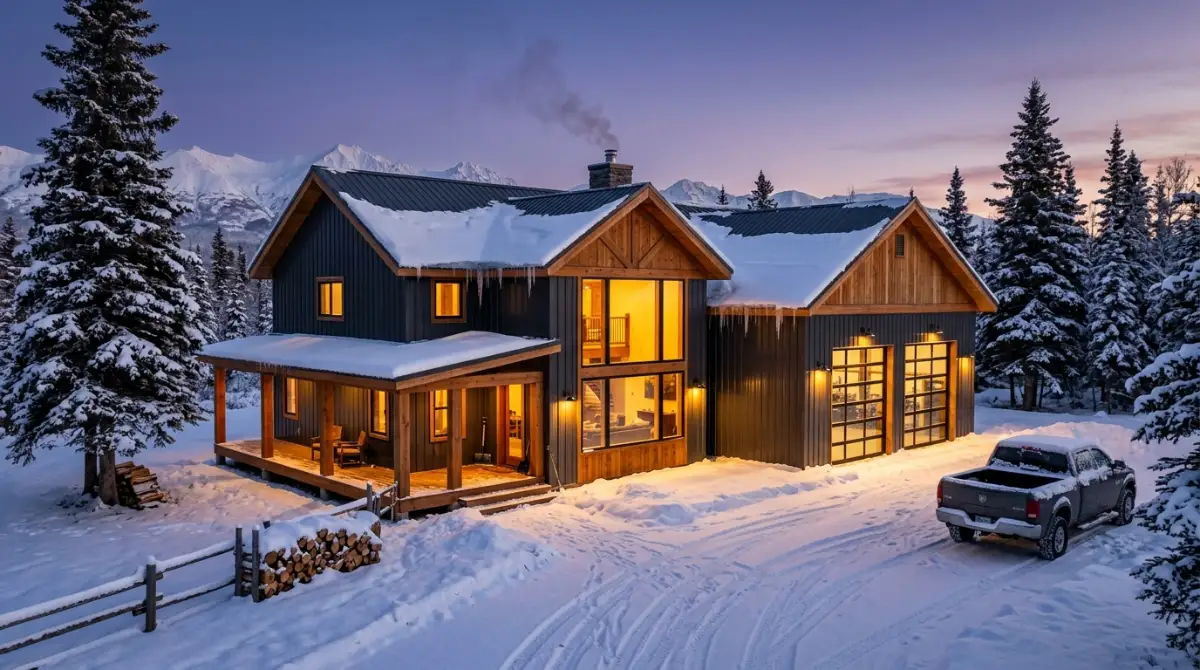
Building a barndominium in Alaska can give you a combined home and workshop, but it must be designed for its actual location. The Alaska barndominium cost per sq ft is useful for an initial budget, yet it cannot account for ground conditions, access, freight, utilities or engineering. This guide’s planning range is roughly $210–$320 finished and $70–$120 for a shell, so a 2,000-square-foot finished building falls near $420,000–$640,000, before land and site work.
For a successful project, investigate the land before buying a building package, confirm the local rules, evaluate the foundation and water systems, and obtain detailed quotes from professionals who know the area. The most dependable budget is built from the complete scope, not the lowest advertised shell price. To compare other states, visit Barndominium Cost Per Sq Ft by State. Weighing the Pacific Northwest instead? See Washington barndominium costs and Oregon barndominium costs, or for another cold, remote market, Montana barndominium costs. Every state guide is listed in the barndominium cost hub.
Sources
Regulatory and ground-condition points come from the Alaska agency and rule pages below. Check each for the latest version before you rely on it.
- AHFC: Building Energy Efficiency Standard (BEES)
- AHFC: Building professionals and financing requirements
- Alaska DEC: Onsite wastewater (septic) program
- 18 AAC 72.511: Conventional systems not requiring plan approval (statute text)
- Alaska DNR: Well Log Tracking System (WELTS)
- Alaska Commerce: Foundations for Building on Permafrost
- Alaska DGGS: Foundation conditions map, Fairbanks D-2 SW
- Alaska DNR: Land Sales
- Alaska Public Media: Statewide residential building codes
- NGWA: Alaska domestic water well information
Cost figures: comparisons cite HomeGuide, BarndoBuilderList and Toolsweek (private publishers). The Alaska per-sqft ranges, regional notes and budget examples are planning estimates, not government data or bids.