
A 2026 Regional Cost Guide
Barndominium Cost
Per Sqft in Georgia (GA)
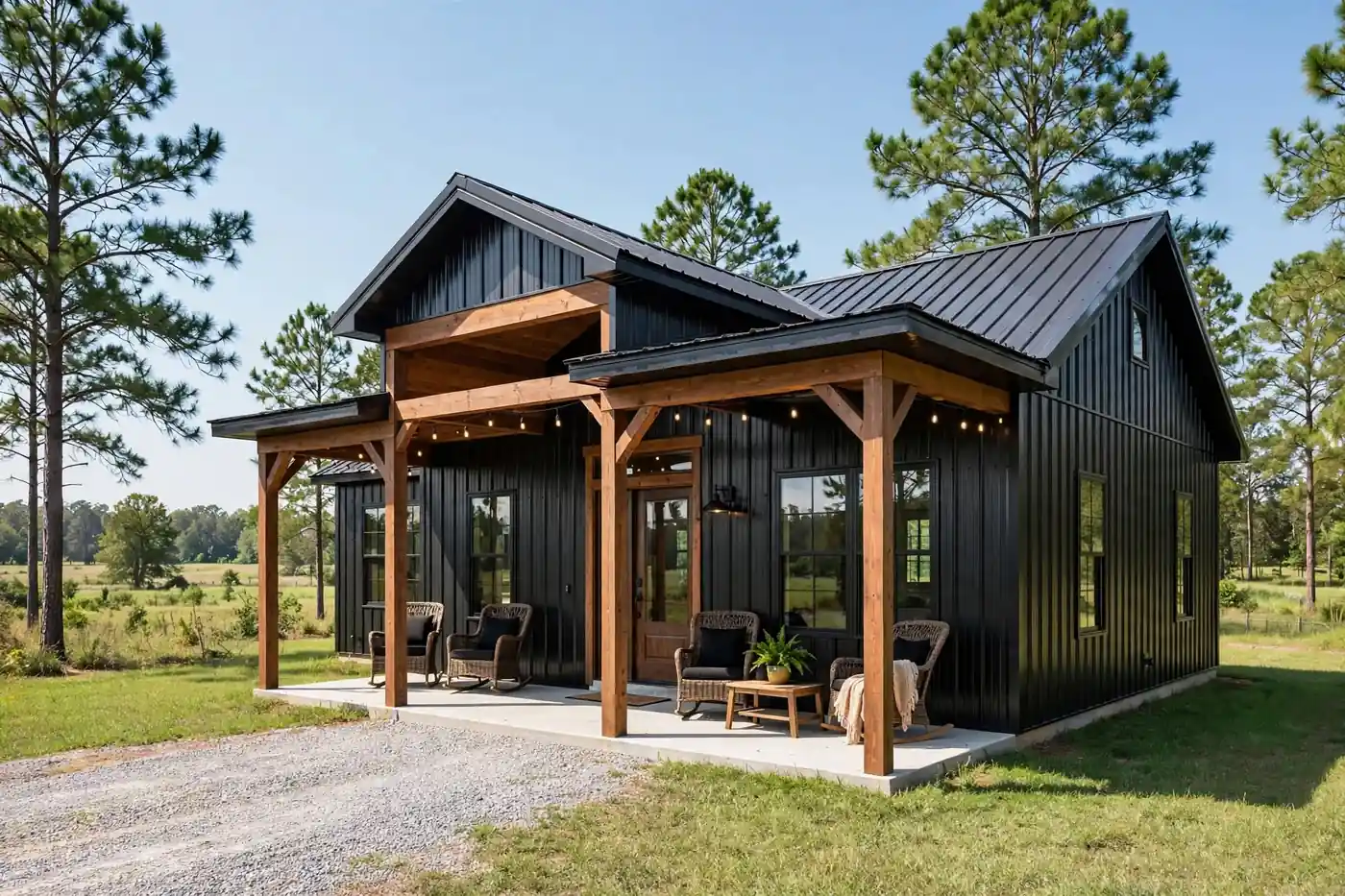
If you’re pricing out a barndominium build in Georgia, here’s a practical place to start — planning ranges by region, size, and finish level, plus the shell-vs-finished trap and coastal insurance costs most estimates leave out.
This guide uses $95–$150 per square foot as a mid-range planning estimate for a finished Georgia barndominium, with basic builds starting around $70–$95 and premium custom projects reaching $160–$225 or more. That puts a typical 2,000 sqft home at roughly $190,000–$300,000 before land and major site-specific costs.
There isn’t one fixed statewide number. Online estimates vary widely because some prices describe a bare shell or kit while others describe a fully finished residence. Your actual cost depends on building size, county, site conditions, foundation, utilities, interior finishes, contractor, and whether you manage any of the project yourself.
This guide breaks the barndominium cost per sqft in Georgia down by region, explains what’s typically included in a per-square-foot price, flags the hidden costs that most estimates skip, and covers financing and insurance. For a broader look at layouts and finish choices, our Barndominium in 2026: Plans, Cost & Finishing guide is a useful companion read.
Cost by Size (2026 Quick Reference)
The table below applies this guide’s barndominium cost per sqft in Georgia planning ranges to common sizes. These are budgeting figures, not contractor quotes.
| Living Space | Basic ($70–95/sqft) | Mid-Range ($95–150/sqft) | Premium ($160–225/sqft) |
|---|---|---|---|
| 1,200 sqft | $84,000–$114,000 | $114,000–$180,000 | $192,000–$270,000 |
| 1,500 sqft | $105,000–$142,500 | $142,500–$225,000 | $240,000–$337,500 |
| 2,000 sqft | $140,000–$190,000 | $190,000–$300,000 | $320,000–$450,000 |
| 2,500 sqft | $175,000–$237,500 | $237,500–$375,000 | $400,000–$562,500 |
| 3,000 sqft | $210,000–$285,000 | $285,000–$450,000 | $480,000–$675,000 |
| 4,000 sqft | $280,000–$380,000 | $380,000–$600,000 | $640,000–$900,000 |
A three-bedroom barndominium commonly falls around 1,700–2,300 sqft depending on the floor plan, which places it around $161,500–$345,000 at the mid-range estimate above. Bedroom count isn’t usually the main cost driver — total square footage, bathroom count, roof complexity, and finish quality matter more.
Run your own numbers with our Barndominium Cost Calculator, or check what a comparable material package alone would run using the Barndo Material Cost Estimator.
Free · Takes 60 seconds
Turn These Ranges Into a Real Number
These planning ranges are a solid starting point — the exact number for your build depends on your property, finish level, and builder. Answer a few quick questions and get matched with local, vetted barndominium builders who can give you an actual quote for your exact size, budget, and location — free, with zero obligation.
100% free — no credit card needed
What’s Included in the Price?
When comparing the barndominium cost per sqft in Georgia across different builders, always confirm what’s actually in scope. A finished residential estimate typically includes the steel or post-frame structural system, metal roof and siding, concrete foundation or slab, insulation, interior framing, drywall, electrical, plumbing, HVAC, windows, interior doors, kitchen cabinets and countertops, bathroom fixtures, flooring, and basic lighting.
There’s no universal definition of “finished,” though. Some builders exclude appliances, porches, garages, upgraded windows, or landscaping. Always ask for an itemized scope of work before comparing bids.
Shell Cost vs. Finished Barndominium Cost
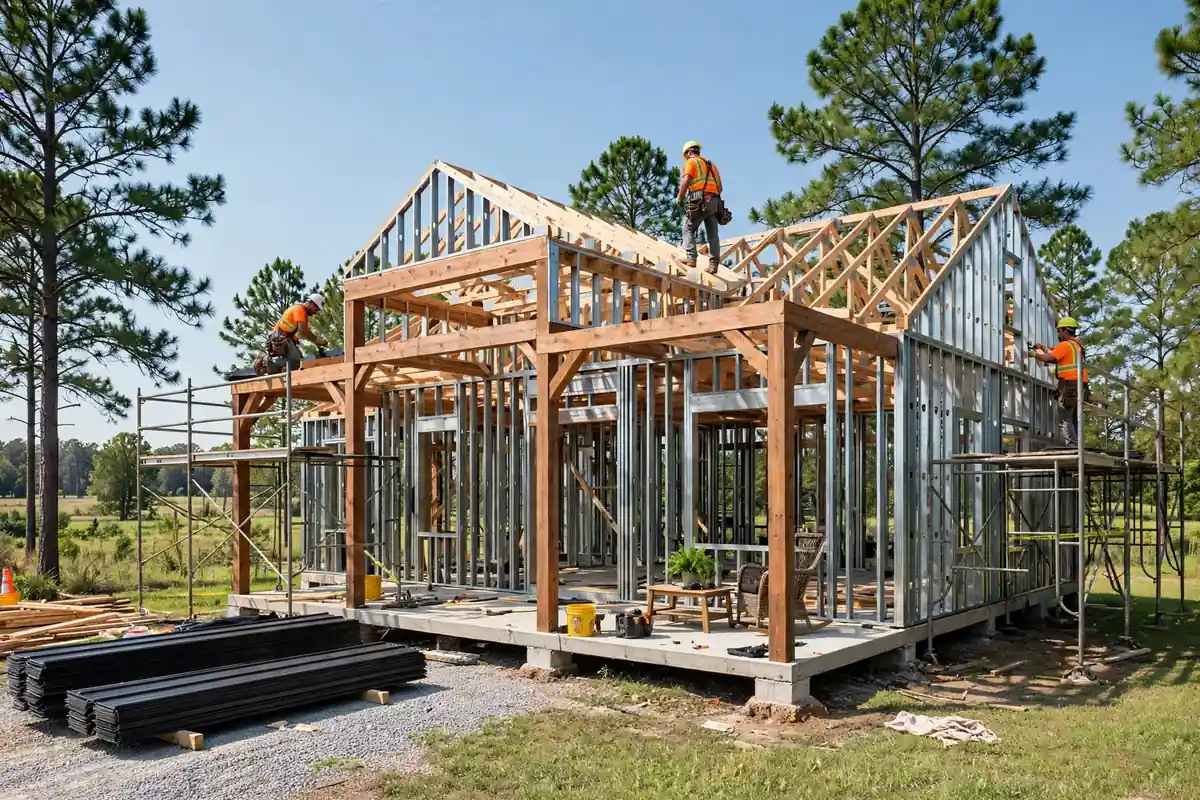
One of the biggest reasons the barndominium cost per sqft in Georgia looks inconsistent from one estimate to the next is the gap between a shell and a finished home. A shell — roughly $40–$70+ per square foot — is mainly the structural frame, roof, exterior metal, doors, and windows, often with no interior plumbing, electrical, HVAC, cabinets, bathrooms, or flooring.
A finished barndominium has to function as a complete residence once insulation, interior walls, electrical, plumbing, HVAC, kitchen, bathrooms, flooring, and trim are added — which is why the finished price can run two to three times higher per square foot than a shell. If you see a Georgia barndominium advertised at $50–$70 per square foot, find out exactly what that figure includes before comparing it against a $130-per-square-foot finished-home estimate.
Why Costs Vary by Region
Construction prices aren’t identical across Georgia, so the barndominium cost per sqft in Georgia depends heavily on where you build. Labor availability, land development, terrain, utility access, and local construction markets all influence the final price.
Atlanta Metro and North Georgia — Fulton, Gwinnett, Cobb, DeKalb, Forsyth Counties
The Atlanta metro and the rapidly growing communities north of it generally carry higher construction and land costs than most rural parts of the state. For planning purposes, a finished barndominium in or around these markets may fall around $110–$175+ per square foot, depending on the property and finish level. A cheap building site here doesn’t guarantee a cheap project — suburban development requirements and higher labor costs can quickly add up.
Central Georgia — Bibb, Houston, Peach, Monroe Counties
The area around Macon and surrounding rural communities can offer a more moderate construction environment than metro Atlanta. A practical planning range is approximately $90–$145 per square foot for a finished build, though individual projects can fall outside that range.
Augusta and East-Central Georgia — Richmond, Columbia Counties
The Augusta area and surrounding rural counties can provide relatively moderate costs outside the most developed pockets, with approximately $90–$145 per square foot a reasonable starting range for a mid-range finished project.
South Georgia — Lowndes, Thomas, Colquitt Counties
Rural South Georgia can offer lower land and labor costs than the Atlanta region, but rural properties often need extra spending on wells, septic systems, driveways, and electrical service. A basic-to-mid-range project might land around $80–$135 per square foot before those site-specific costs.
Coastal Georgia — Chatham, Glynn, Bryan, Camden, Liberty, McIntosh Counties
Coastal Georgia, including the Savannah and Brunswick areas and offshore islands like Tybee, St. Simons, Jekyll, and Sea Island, carries greater wind and flood exposure than inland Georgia. A coastal project should be engineered for the wind loads that apply to the specific site rather than a generic kit specification, and flood-zone status can affect foundation design and elevation. As a planning estimate, a finished coastal build may fall around $120–$200 per square foot or more, depending heavily on the site, foundation, and wind requirements. See the Insurance section below for what this means for ongoing coverage costs.
North Georgia Mountains and Foothills — Gilmer, Fannin, Union, White, Rabun Counties
Mountain properties can look inexpensive on paper but get complicated fast when the lot has steep slopes, difficult access, extensive rock, or drainage challenges. A building that would be straightforward on a flat rural lot can require considerably more grading, retaining structures, and driveway construction on a sloped mountain site — always price the whole site, not just the building.
Why Georgia Barndominium Prices Vary So Much
Two 2,000-square-foot barndominiums can end up at completely different final prices, which is exactly why the barndominium cost per sqft in Georgia is best treated as a range, not a fixed number. The biggest factors are usually finish level, building design, and site conditions.
Finish level can swing the project by tens of thousands of dollars: basic cabinets and standard flooring keep costs toward the lower end, while custom cabinetry, stone countertops, and premium flooring push it toward the premium range. Building design matters almost as much — a simple rectangular footprint is more efficient than a complicated layout with multiple rooflines, dormers, and large porches. Shop or garage space under the same roof isn’t equivalent to finished living space, since it doesn’t need the same interior finish work, so a 2,000 sqft home with a 1,000 sqft shop attached will generally have a lower blended cost per square foot than a fully finished 3,000 sqft residence. And site conditions — a cleared, flat lot with utilities at the road versus a wooded, remote property needing a well, septic system, and a long driveway — can be one of the easiest costs to underestimate.
Before running numbers through a calculator, decide whether garage or shop space should be priced separately from finished living space, since blending the two can distort your per-square-foot math.
Real Cost Examples: 2026 Builds
These illustrative examples apply the barndominium cost per sqft in Georgia ranges above to common Georgia scenarios. Treat them as a starting point, not a quote.
Kits vs. Full-Service Builders
How you build also changes your barndominium cost per sqft in Georgia. Georgia buyers generally choose between a kit plus local contractors or a full-service builder. Buying a prefabricated package and hiring subcontractors yourself can give more control over materials and potentially lower overhead, but it puts scheduling, trade coordination, and financing planning on you. A full-service builder typically costs more but reduces the project-management burden.
Whichever route you take, confirm the contractor has actual experience finishing residential barndominiums — erecting agricultural pole barns is a different skill set than completing kitchens, bathrooms, HVAC, and electrical systems to residential code. Before comparing kit prices, run the numbers through our Barndominium Kit Cost Calculator to see how a kit-plus-finish budget compares with a turnkey quote.
Georgia Building Codes and Barndominiums
Code compliance doesn’t usually change the barndominium cost per sqft in Georgia dramatically, but skipping it can cost far more later. Georgia uses a statewide minimum construction-code framework administered by the Georgia Department of Community Affairs (DCA), with local jurisdictions responsible for enforcement. Mandatory codes apply to all construction statewide whether or not a local government separately enforces them, while permissive codes only apply where a local government has adopted them. You can review the current codes through the Georgia DCA Construction Codes program.
Before buying a property, check with the applicable city or county authority about zoning, setbacks, residential use, permits, inspections, foundation requirements, and septic requirements. Don’t assume a structure qualifies for an agricultural exemption simply because it looks like a barn — a building intended as a residence has to meet residential requirements.
Climate and Soil Factors
Georgia’s warm, humid climate makes moisture management and proper insulation especially important for metal building assemblies — the cheapest insulation option isn’t always the cheapest choice over the life of the building. Our guide on whether spray foam insulation is mandatory for a barndominium walks through when it’s required versus optional in a build like this.
Georgia also experiences severe thunderstorms, strong winds, and occasional tornadoes, so structural design should meet the requirements that apply to the specific property rather than a generic kit spec — ask the builder or kit supplier what design loads the package is engineered for. Some areas of Georgia contain clay-heavy or otherwise challenging soils that can affect grading, foundation design, and septic suitability, and North Georgia mountain properties can need more excavation and drainage work than a flat rural lot. A site evaluation before finalizing the foundation design helps catch problems early.
Financing
Financing changes the real, total cost of ownership beyond the barndominium cost per sqft in Georgia figure alone. Financing a barndominium can require more planning than financing a conventional existing home, particularly on rural properties with limited comparable sales. Potential routes include construction-to-permanent loans, local banks, credit unions, portfolio lenders, and specialized construction lenders. USDA Rural Development financing may also be available for qualifying properties and borrowers through the USDA Rural Development Guaranteed Loan Program.
Before signing a construction contract, confirm with the lender whether it specifically finances barndominiums and what its requirements are for the builder, appraisal, plans, foundation, and construction timeline. Our Free Home Loan Calculator can help you estimate monthly payments across different rate and down-payment scenarios before you talk to a lender.
Insurance Costs to Budget For
Insurance is an ongoing ownership cost that should be considered before purchasing land, not after construction begins, since it adds to your effective barndominium cost per sqft in Georgia over time. Premiums depend on the property’s location, replacement cost, construction characteristics, flood exposure, wind exposure, deductible, and insurer.
Coastal Georgia — Chatham, Glynn, Bryan, Camden, Liberty, and McIntosh counties, plus the offshore islands — requires the most attention to wind and flood exposure. If windstorm and hail coverage isn’t available through the voluntary market, the Georgia Underwriting Association (GUA) operates the state’s FAIR Plan as an insurer of last resort for eligible coastal properties, subject to its own construction and eligibility standards.
Flood insurance is separate from standard homeowners coverage and may be required by a lender when the property sits in a designated high-risk flood zone. Check the property’s mapped flood status through the FEMA Flood Map Service Center before purchasing coastal or river-adjacent land, even if flood coverage isn’t strictly required.
Inland Georgia generally has fewer coastal windstorm considerations, but severe thunderstorms, hail, and tornado exposure can still affect premiums depending on the property and construction value.
A practical approach is to request an insurance quote before closing on the land — two properties that look similar on paper can have very different flood, wind, and insurance characteristics.
How to Reduce Your Georgia Barndominium Cost
If you’re trying to bring down your barndominium cost per sqft in Georgia, focus on design efficiency rather than simply chasing the cheapest materials: use a simple rectangular footprint, keep the roofline straightforward, group bathrooms and plumbing fixtures together, choose durable mid-range finishes, and price shop space separately from living space when estimating. Compare at least three detailed contractor proposals, get site-work estimates before buying land, and keep a contingency reserve for surprises. Our dedicated guide on planning an affordable barndominium goes deeper on cost-cutting strategies without sacrificing durability.
Popular Georgia Barndominium Floor Plans
Floor plan choice is one of the biggest levers on your barndominium cost per sqft in Georgia. A 1,500–1,800 sqft ranch layout with two or three bedrooms and an open kitchen/living area is a common, efficient starting point. A 2,000 sqft three-bedroom design can comfortably fit two bathrooms, an open living area, laundry, and storage. A 2,000 sqft home plus a 1,000 sqft shop is a particularly popular combination for rural Georgia properties, since the residential portion gets the finish budget while the shop stays simple. Large Southern-style builds with covered porches, vaulted ceilings, and outdoor kitchens can look spectacular but push well past the standard planning range.
Browse layout ideas in our open concept floor plans collection or our best barndominium floor plans roundup, then test furniture placement in each room with the Room & Furniture Fit Visualizer before finalizing your layout.
Free · Takes 60 seconds
Turn These Ranges Into a Real Number
These planning ranges are a solid starting point — the exact number for your build depends on your property, finish level, and builder. Answer a few quick questions and get matched with local, vetted barndominium builders who can give you an actual quote for your exact size, budget, and location — free, with zero obligation.
100% free — no credit card needed
Local Resources
These resources can help you research a Georgia property and confirm your own barndominium cost per sqft in Georgia before finalizing your design or construction budget:
Georgia Department of Community Affairs — Construction CodesCurrent state minimum construction codes and how they’re enforced locally. Georgia Underwriting Association (GUA)Georgia’s FAIR Plan for windstorm and hail coverage in coastal counties and offshore islands. FEMA Flood Map Service CenterCheck the property’s mapped flood-zone information before purchasing coastal or river-adjacent land. USDA Rural Development Guaranteed Loan ProgramCheck whether a specific rural property may qualify for USDA financing.Compare Georgia Barndominium Costs to Nearby States
Planning near a state border, or just want a wider price picture? See how nearby states compare.
Frequently Asked Questions
How much does a barndominium cost per square foot in Georgia?
A reasonable 2026 planning range is approximately $95–$150 per square foot for a mid-range finished barndominium in Georgia. Basic projects may start around $70–$95 per square foot, while premium custom builds can reach $160–$225 or more. These are planning ranges, not official statewide averages.
How much does a 2,000 sq ft barndominium cost in Georgia?
A 2,000-square-foot finished barndominium could cost approximately $190,000–$300,000 at a mid-range finish level. Basic construction could fall around $140,000–$190,000, while premium projects could reach $320,000–$450,000 before land and major site costs.
What is the cheapest way to build a barndominium in Georgia?
The most economical approach is usually a simple rectangular design, an efficient floor plan, practical finishes, and a relatively easy building site. Managing subcontractors yourself can potentially reduce contractor overhead, but it requires significant time and construction-management experience.
Are barndominiums cheaper in rural Georgia?
They can be, especially where land and construction costs are lower. However, rural properties may require wells, septic systems, long driveways, electrical extensions, clearing, and grading — costs that can offset some of the savings on the building itself.
Do I need a permit to build a barndominium in Georgia?
Residential construction generally has to comply with Georgia’s state minimum construction codes and local permitting requirements. The exact process depends on the jurisdiction and property. Always confirm zoning, permits, inspections, and setbacks with the city or county authority covering your parcel before construction begins.
Does Atlanta cost more than rural Georgia for a barndominium?
It can. Atlanta and rapidly growing North Georgia markets generally have higher labor, land, and development costs than many rural areas. However, rural properties can have higher site-development costs when wells, septic systems, long driveways, clearing, or utility extensions are required.
Is coastal Georgia more expensive to build and insure?
Often, yes. Chatham, Glynn, Bryan, Camden, Liberty, and McIntosh counties, along with the offshore islands, carry greater wind and flood exposure than inland Georgia. Projects there may need additional structural engineering, elevation, and windstorm or flood insurance, which can push the planning range toward $120–$200 per square foot or more depending on the site and design.
Is a barndominium a good investment in Georgia?
That depends heavily on location, construction quality, financing, local demand, and resale comparables. A well-designed barndominium can appeal to buyers looking for large garages, workshops, and open floor plans, but resale value can vary more than for conventional homes in some markets.
Getting an Accurate Estimate
Statewide averages are useful for early planning, but they’re not a substitute for a site-specific estimate. Your actual barndominium cost per sqft in Georgia depends on your county, lot conditions, utility access, foundation requirements, floor plan, building size, finish level, and whether the property has coastal wind or flood exposure.
Start by estimating your finished living space separately from garage or shop space, then account for land, well or water connection, septic, electrical service, driveway, grading, permits, and insurance. For a personalized number, use our free Barndominium Cost Calculator. Still deciding between a barndominium and a conventional build? Our Barndominium vs House Cost Calculator compares both side by side — or read the broader barndominium vs. house comparison guide first. The New Home Construction Cost Calculator can price out a traditional build for comparison.
Once you have a preliminary budget, get at least three detailed quotes from Georgia contractors and confirm each one covers the same scope of work. At the same time, confirm zoning, permitting, inspections, floodplain requirements, and utility availability with the authority responsible for your exact property.