
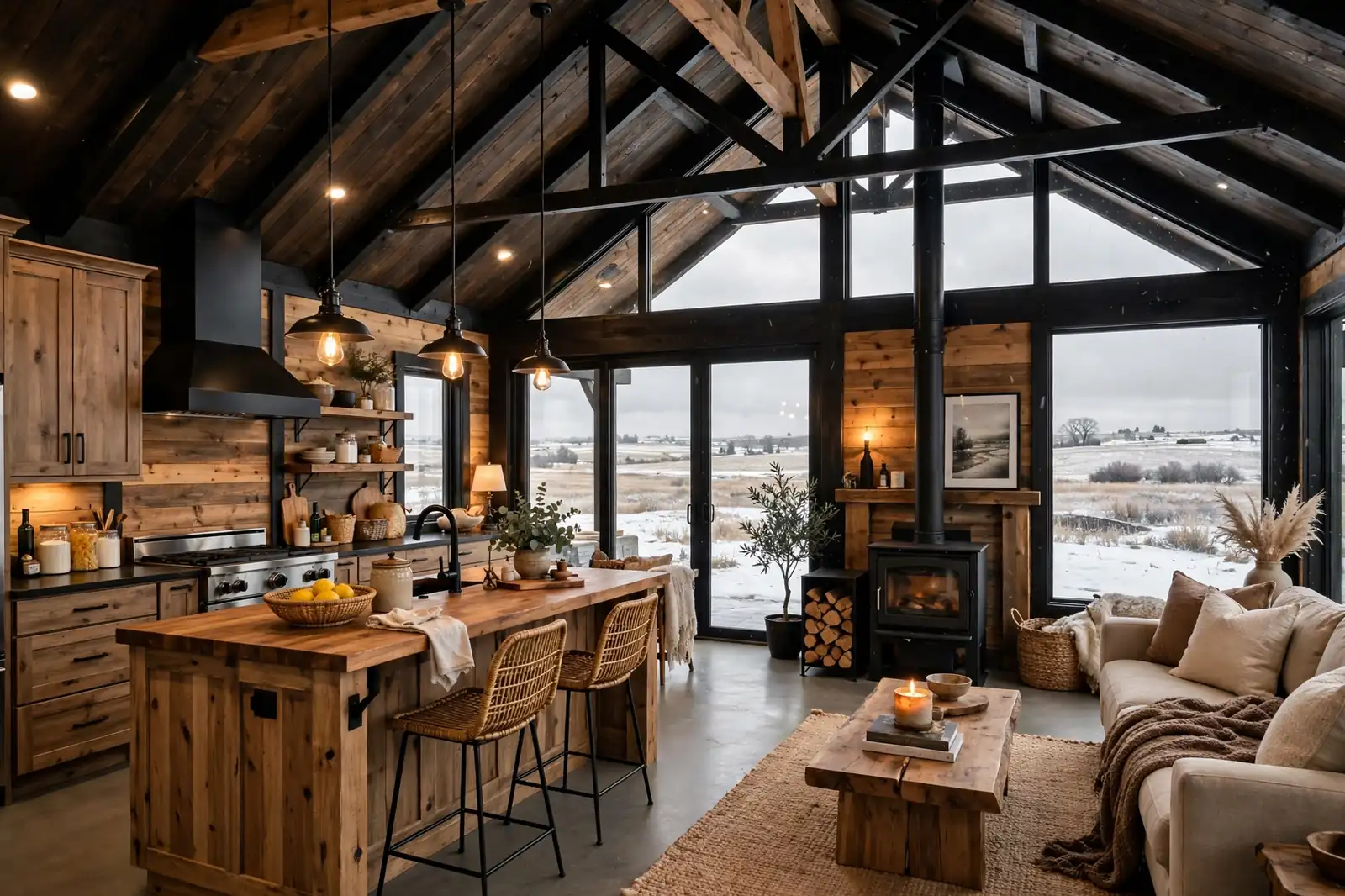
Barndominium Cost Per Sqft in North Dakota 2026
Real 2026 numbers by region, why cold-climate builds run $76 to $195+ per square foot, snow-load and building-code requirements, and what North Dakota’s Peace Garden State climate actually adds to your budget.
If you’re researching barndominium cost per sqft in North Dakota, a national barndominium article won’t tell you much about what it actually costs to build in the Peace Garden State. Long, cold winters, snow loads, strong prairie winds, deep frost depths, rural utilities, private wells, and onsite wastewater systems all shape the final number here more than they would in a Southern state.
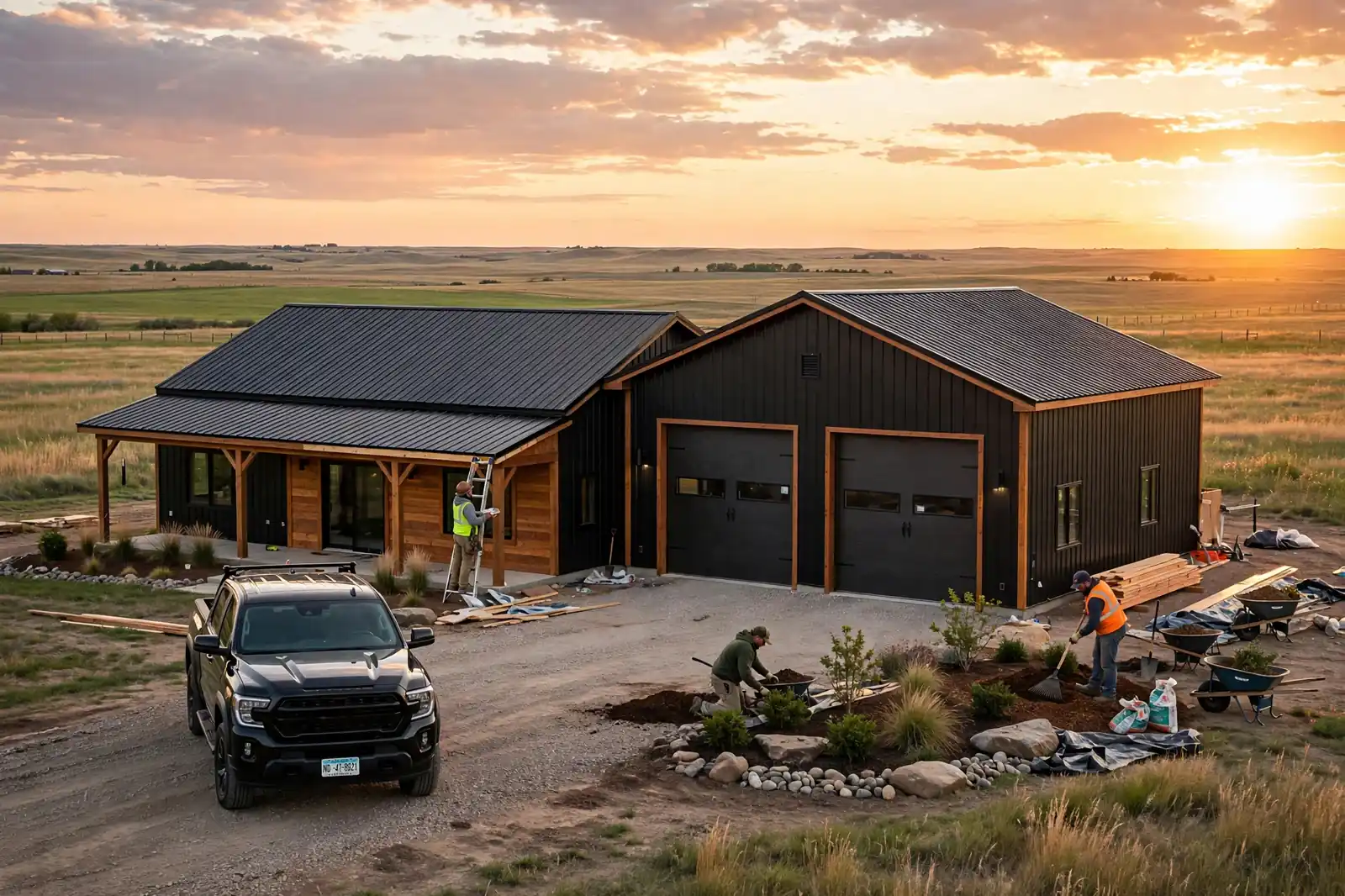
Current published market estimates put a finished North Dakota barndominium at roughly $76–$195+ per square foot, with self-managed and basic-finish builds toward the lower end and full-service turnkey premium builds toward the top. Shell-only construction runs considerably less. There’s also a real difference between building near Fargo, Bismarck, Grand Forks, Minot, or Dickinson and building on remote agricultural acreage — the structure may be similar, but land development costs can be completely different.
On this page
What Does a Barndominium Cost Per Sqft in North Dakota in 2026?
For 2026 planning purposes, a useful North Dakota range is approximately $76–$195+ per square foot for a finished barndominium. These are planning ranges, not guaranteed prices — a particular project can land outside this range depending on design, foundation, site, utilities, finishes, contractor, and local jurisdiction.
| Build Type | Barndominium Cost Per Sqft in North Dakota | What’s Included |
|---|---|---|
| Shell only | $30–$65 | Framing, roof structure and covering, exterior metal siding, basic doors — substantial interior work remains. |
| Basic / self-managed | $76–$130 | Functional completed residence with simpler selections, often owner-managed subcontractors. |
| Mid-range finished | $130–$175 | More complete residential finishes and mechanical systems. Most common tier for full-service builds. |
| Premium / custom | $175–$195+ | Higher-end finishes, custom design, or more difficult sites (deep frost, remote utilities, complex rooflines). |
The $76–$130 basic/self-managed tier reflects real North Dakota-specific market data that a generic national average misses — acting as your own GC or using a barndo-experienced local post-frame crew can meaningfully undercut a full-service turnkey quote in this state.
Want a number specific to your build instead of a range? Use our free Barndominium Cost Calculator to model your size, finish level, and add-ons.
North Dakota Barndominium Cost by Size (2026 Quick Reference)
Multiply your finished living-space square footage by your expected cost-per-square-foot tier. These are planning estimates, not a live pricing database — confirm with local quotes.
| Living Space | Basic ($76–$130/sqft) | Mid-Range ($130–$175/sqft) | Premium ($175–$195+/sqft) |
|---|---|---|---|
| 1,200 sqft | $91,200–$156,000 | $156,000–$210,000 | $210,000–$234,000+ |
| 1,500 sqft | $114,000–$195,000 | $195,000–$262,500 | $262,500–$292,500+ |
| 2,000 sqft | $152,000–$260,000 | $260,000–$350,000 | $350,000–$390,000+ |
| 2,500 sqft | $190,000–$325,000 | $325,000–$437,500 | $437,500–$487,500+ |
| 3,000 sqft | $228,000–$390,000 | $390,000–$525,000 | $525,000–$585,000+ |
| 4,000 sqft | $304,000–$520,000 | $520,000–$700,000 | $700,000–$780,000+ |
| 5,000 sqft | $380,000–$650,000 | $650,000–$875,000 | $875,000–$975,000+ |
Figures are for finished living area only and do not include land, well, septic, driveway, utility extensions, or major site-development costs. If your building includes a large unfinished shop, price that space separately — it shouldn’t carry the same per-sqft rate as finished residential space.
Barndominium Cost Per Sqft in North Dakota by Region
North Dakota doesn’t have a single construction market. Labor availability, land prices, development pressure, and site conditions vary by region. The ranges below are planning estimates based on regional market patterns and site-development factors — North Dakota doesn’t publish a single official per-region barndominium dataset, so treat these as a starting point for local quotes, not a fixed price list.
Fargo & Red River Valley
~$140–$195/sqftFlat terrain with real floodplain and drainage considerations that can add foundation and site costs. Stronger contractor availability than remote counties.
Bismarck & Central ND
~$130–$185/sqftAlong the Missouri River; a major construction and government center. Rural acreage nearby still needs water, septic, and floodplain evaluation.
Minot & North-Central
~$135–$190/sqftSome of the state’s most severe winter conditions — heating, insulation, and roof design carry extra weight in the budget here.
Dickinson & Western ND / Bakken
~$135–$200/sqftMore remote sites, longer utility runs, and a labor market shaped by oil-development activity in Williston and Watford City. Lower land cost, higher site-development cost.
Why North Dakota Barndominium Costs Differ From Southern States
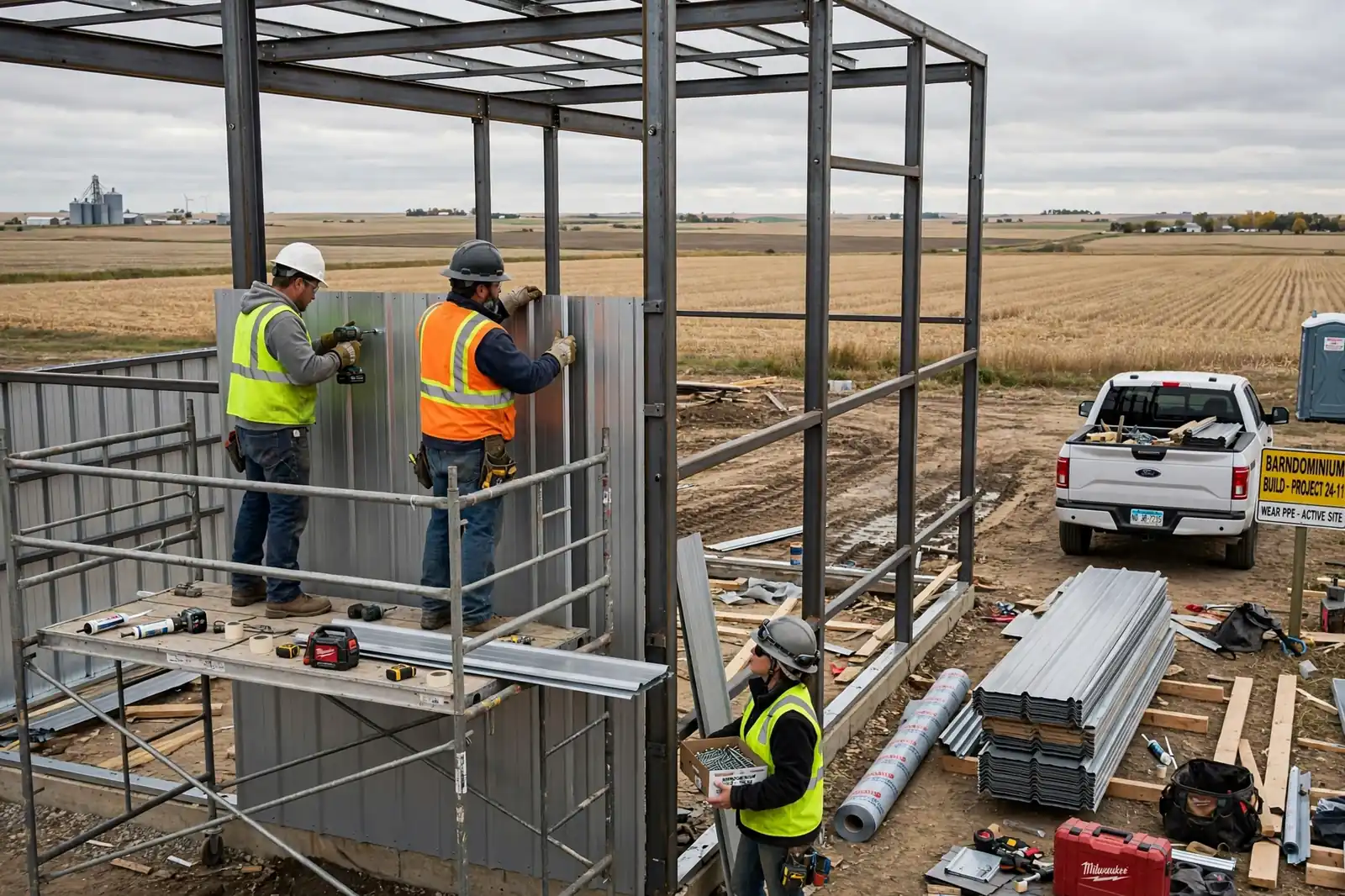
North Dakota’s construction environment is dominated by cold-weather considerations that don’t apply to the same degree in states like Louisiana, Alabama, or Florida. National Weather Service records show historical lows below -40°F in several major communities, with a statewide record of -60°F at Parshall in 1936. That doesn’t mean your barndominium will see those temperatures every winter — it does mean the building envelope needs to be designed for a genuinely severe cold-weather climate, and that shows up directly in barndominium cost per sqft in North Dakota.
Snow & Wind Alert
North Dakota’s state building code sets ground snow loads by county, ranging from 30 to 70 psf — not a single statewide number. Open prairie without windbreaks also means wind loads matter as much as snow, especially for large shop doors and open floor plans with wide roof spans.
Ask your builder or engineer what snow-load criteria and wind design apply to your specific county before signing a contract — a generic “Midwest-rated” kit spec isn’t a substitute for site-specific engineering.
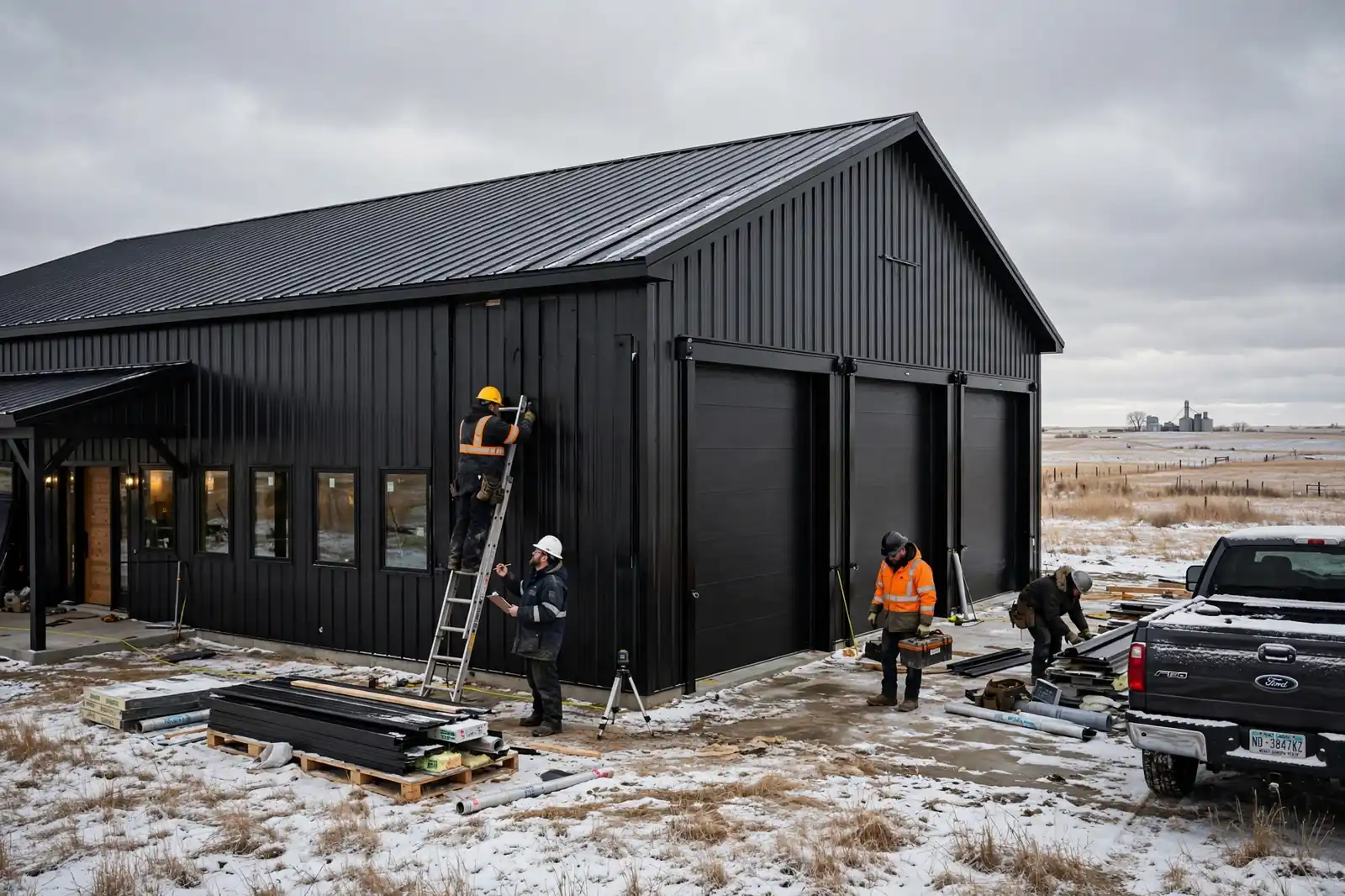
Frost depth is the other big cold-climate cost driver: North Dakota’s state amendment sets minimum footing depth at 60 inches below grade, deeper than most model code tables assume. A generic warm-climate foundation design should never be copied into a North Dakota build. Insulation and air sealing matter more here too — cutting insulation to save money upfront tends to create higher heating costs and comfort problems for the life of the home.
North Dakota’s 2026 Building Code and Permits
North Dakota’s new State Building Code took effect January 1, 2026, built on the 2024 International Building Code, Residential Code, Mechanical Code, Fuel Gas Code, Energy Conservation Code, and Existing Building Code, with North Dakota-specific amendments (including the 60-inch frost-depth rule and county-level snow-load table).
Critically, the state code is enforced by local jurisdictions that elect to adopt and enforce it — cities, townships, and counties can adopt the state code and apply local amendments, and fully chartered home-rule cities have additional authority. Agricultural buildings used exclusively for farm purposes are exempt from the state building code. Don’t assume a rule that applies in Fargo automatically applies to an unincorporated rural property a few miles away — identify the governing jurisdiction before finalizing your design, and confirm permit requirements directly rather than relying on an online claim that “rural North Dakota doesn’t require permits.”
North Dakota also has a specific contractor-licensing threshold worth knowing before you sign anything: the North Dakota Secretary of State requires anyone doing construction work where the job’s cost, value, or price exceeds $4,000 to hold a state contractor license — one of the lowest thresholds in the country. Licenses run Class D (up to $100,000 per job) through Class A (over $500,000), so for a large barndominium, check that your contractor’s license class actually covers the project size before signing.
Well, Septic, and Rural Utility Costs
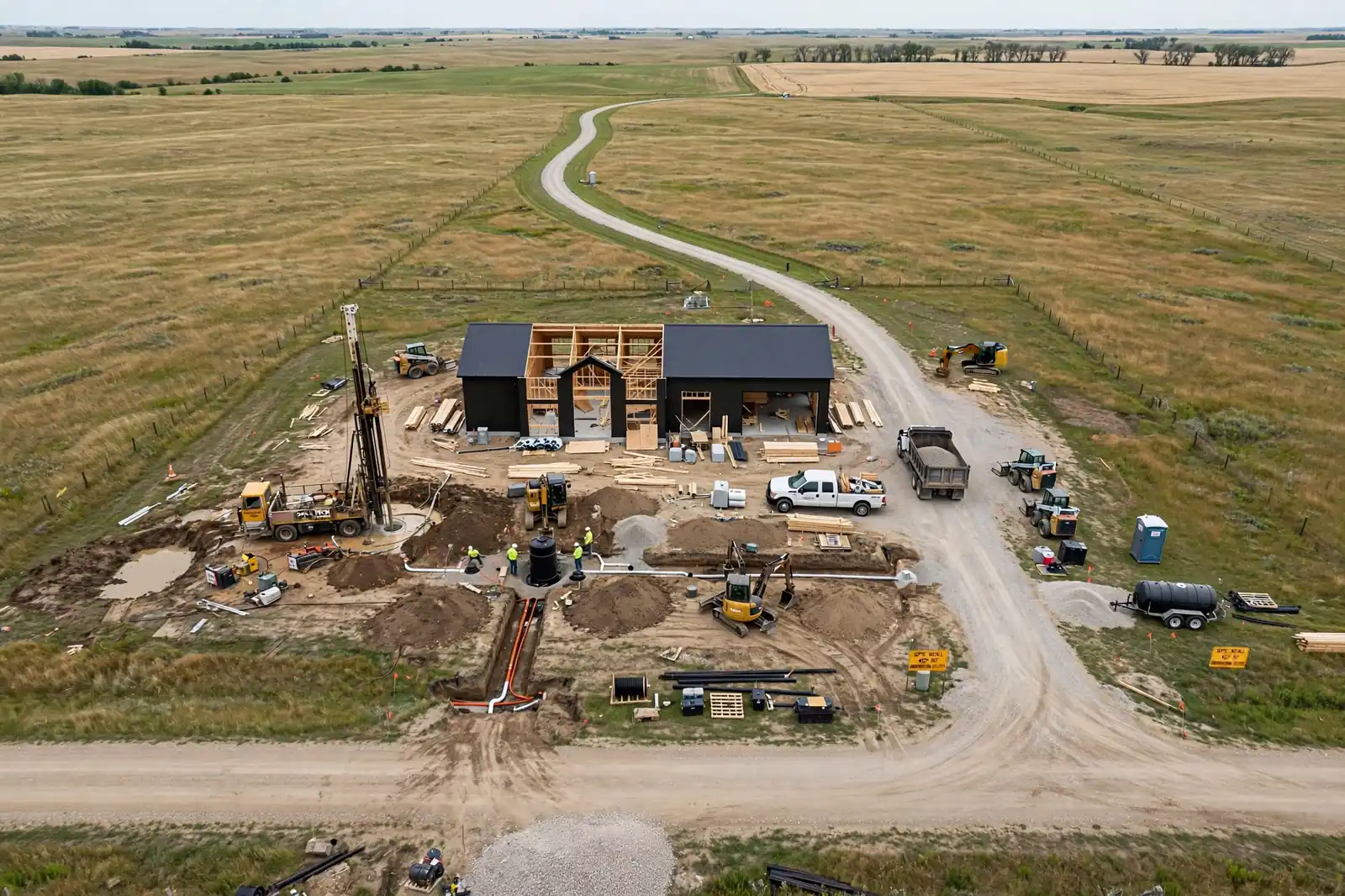
The advertised cost per square foot usually doesn’t tell the whole story on rural North Dakota land. A flat parcel with power, water, and sewer already available can be dramatically cheaper to develop than a remote property requiring a long driveway, private well, septic system, and extensive excavation.
If public water isn’t available, you’ll likely need a private well. North Dakota regulates water-well construction and pump installation, and covered work must be performed by a contractor licensed by the state’s Department of Water Resources. Well construction is regulated — private well water quality generally isn’t, which is worth remembering: a newly drilled well being properly constructed doesn’t automatically mean the water is safe to drink without separate testing.
Rural properties without public sewer may need an onsite wastewater system. North Dakota’s Department of Environmental Quality oversees installer licensing, while a permit from the local public health unit is required before work begins. Septic feasibility should be checked before purchasing rural land, not after the floor plan is finalized — soil, groundwater, lot size, slope, and setbacks all factor into what system a site can actually support.
North Dakota also has real floodplain exposure — not just along the coasts. The Missouri, Red, and Souris River systems create mapped Special Flood Hazard Areas, and a floodplain development permit is required from the local Floodplain Administrator before work begins in an SFHA. This can affect foundation design, finished-floor elevation, and whether a basement makes sense on a given parcel — check FEMA flood mapping and North Dakota’s Risk Assessment Map Service before committing to land, especially in the Red River Valley.
Farm Property Tax Exemption and Construction Sales Tax
Many North Dakota barndominium buyers start by looking at farm or ranch acreage, which raises a tax question worth understanding early. North Dakota’s Farm Residence Exemption isn’t automatic for every rural home — it requires the residence to sit on 10 or more contiguous acres of agricultural land and be occupied by a qualifying farmer whose gross farm income is at least 66% of total annual income in one of the two preceding years. Buying acreage purely to build a barndominium, without meeting the farmer-occupancy test, doesn’t qualify for this exemption — check with your county director of tax equalization before assuming it applies.
Construction materials are also subject to North Dakota’s state sales tax rate of 5%, plus any applicable local tax, and contractors generally owe sales or use tax on materials they incorporate into the build. Ask your builder exactly how material tax is handled in your contract — don’t assume a quoted price automatically includes every applicable tax.
North Dakota vs Neighboring States
North Dakota shares cold winters, snow, prairie wind, and large rural areas with South Dakota and Minnesota, and severe-winter rural construction with Montana — but the comparison isn’t as simple as “$X per sqft in ND versus $Y next door.” South Dakota’s construction market runs similarly, though local land markets and code enforcement differ by county. Minnesota’s larger population and denser suburban development mean utility distance and rural permitting matter less there than in North Dakota’s vast unincorporated areas. Montana shares severe winters but adds mountain and elevation-driven structural costs that don’t apply to North Dakota’s prairie terrain. The practical takeaway: price your North Dakota project against its own site and jurisdiction, not a neighboring state’s average.
Hidden Costs Barndominium Buyers Often Miss in North Dakota
- Deep frost-depth foundations — the state’s 60-inch footing requirement adds real foundation cost versus a warmer-climate design.
- County-specific snow-load engineering — 30–70 psf depending on location; large open-span roofs cost more to engineer.
- Long utility runs — remote parcels may need significant trenching and electrical infrastructure.
- Private well and septic — drilling and system requirements vary by site.
- Winter construction scheduling — cold-weather concrete, temporary heat, and weather protection can affect timeline and cost.
- Insulated overhead doors — a poorly insulated shop door can become the weakest point in the building envelope.
- Construction sales/use tax — confirm how it’s handled in your contract rather than assuming it’s baked into the quoted price.
Get your barndominium cost per sqft in North Dakota estimate
Plug in your size, finish level, and add-ons for a number tuned to your build.
Open the Barndominium Cost Calculator →Financing a Barndominium in North Dakota
Financing a barndominium can be more complicated than financing an existing conventional house. Lenders typically want construction plans, detailed specifications, a construction budget, contractor information, an appraisal, and a draw schedule. For a rural North Dakota project specifically, expect the lender to also want to understand well, septic, road access, and completed property value before approving a construction-to-permanent loan. Ask about the lender’s specific requirements before signing a construction contract — not every national bank has experience underwriting post-frame or barndominium construction, but local North Dakota credit unions in agricultural regions often do.
See our Barndominium vs House comparison for a full breakdown of financing, resale, and long-term cost differences, and our Barndominium Kits Guide if you’re weighing a prefab kit against a full-service builder.
North Dakota Barndominium Pre-Construction Checklist
Before signing a construction contract, confirm: governing jurisdiction and zoning, residential-use permission, building-code and permit requirements, floodplain status, well and septic feasibility, electrical service distance, driveway access, snow-load and wind-load design for your county, insulation specification, heating system, shop specification, construction sales/use tax handling, contractor license class, and a realistic schedule that accounts for North Dakota’s winter construction season.
Frequently Asked Questions
How much does a barndominium cost per square foot in North Dakota?
Current published 2026 market estimates put a finished North Dakota barndominium at roughly $76–$195+ per square foot, with self-managed and basic-finish builds toward the lower end and full-service turnkey premium builds toward the top. Shell-only construction can run $30–$65 per square foot.
How much does a 3-bedroom barndominium cost in North Dakota?
A 3-bedroom North Dakota barndominium typically runs 1,800–2,200 square feet. At mid-range finish ($130–$175 per square foot), that’s roughly $234,000–$385,000 for the build, before land, well, septic, and site prep.
How much does a 2,000 sq ft barndominium cost in North Dakota?
A rough building-only planning range is approximately $200,000–$390,000+ using $100–$195+ per square foot depending on finish level. Land, well, septic, driveway, utilities, site work, and permits can be additional.
Are barndominiums cheaper to build in North Dakota?
They can be, especially when the project combines finished living space with an unfinished shop or garage. However, winter construction, insulation, heating, snow loads, foundations, and rural utilities can significantly affect the final cost.
What is North Dakota’s building code in 2026?
North Dakota’s State Building Code, effective January 1, 2026, is based on the 2024 IBC, IRC, IMC, IFGC, IECC, and IEBC with state amendments. Local jurisdictions that elect to adopt and enforce building codes are responsible for enforcement and may make permitted local amendments.
Do I need a building permit for a North Dakota barndominium?
Permit requirements depend on the governing jurisdiction. Determine which city, county, or township authority controls the property and ask specifically about a single-family residence combined with garage or shop space.
Do rural North Dakota barndominiums need septic?
If public sewer is unavailable, an onsite wastewater system may be necessary. North Dakota’s Department of Environmental Quality regulates installer licensing, while local public health units issue applicable permits.
Does North Dakota have a farm residence property-tax exemption?
Yes. North Dakota’s Farm Residence Exemption requires the residence to sit on 10 or more contiguous acres of agricultural land and be occupied by a qualifying farmer whose gross farm income is at least 66% of total annual income in one of the two preceding years. It is not automatically available to every rural barndominium.
Resources to Plan Your North Dakota Build
- Barndominium Cost Guide 2026 — the full national hidden-costs breakdown
- Barndominium vs. House — side-by-side cost, financing, and resale comparison
- Barndominium Kits Guide — what’s typically included in kit pricing vs. billed separately
- Barndominium Cost Per Sqft by State — compare North Dakota with other states
- North Dakota Secretary of State — Contractor Licensing
- North Dakota Division of Community Services — Building Codes
Barndominium cost per sqft in North Dakota data above is based on 2026 construction market research and publicly available builder estimates. Figures are planning estimates, not contractor bids — always get three local quotes before committing to a budget. Land cost is not included in any figure above.