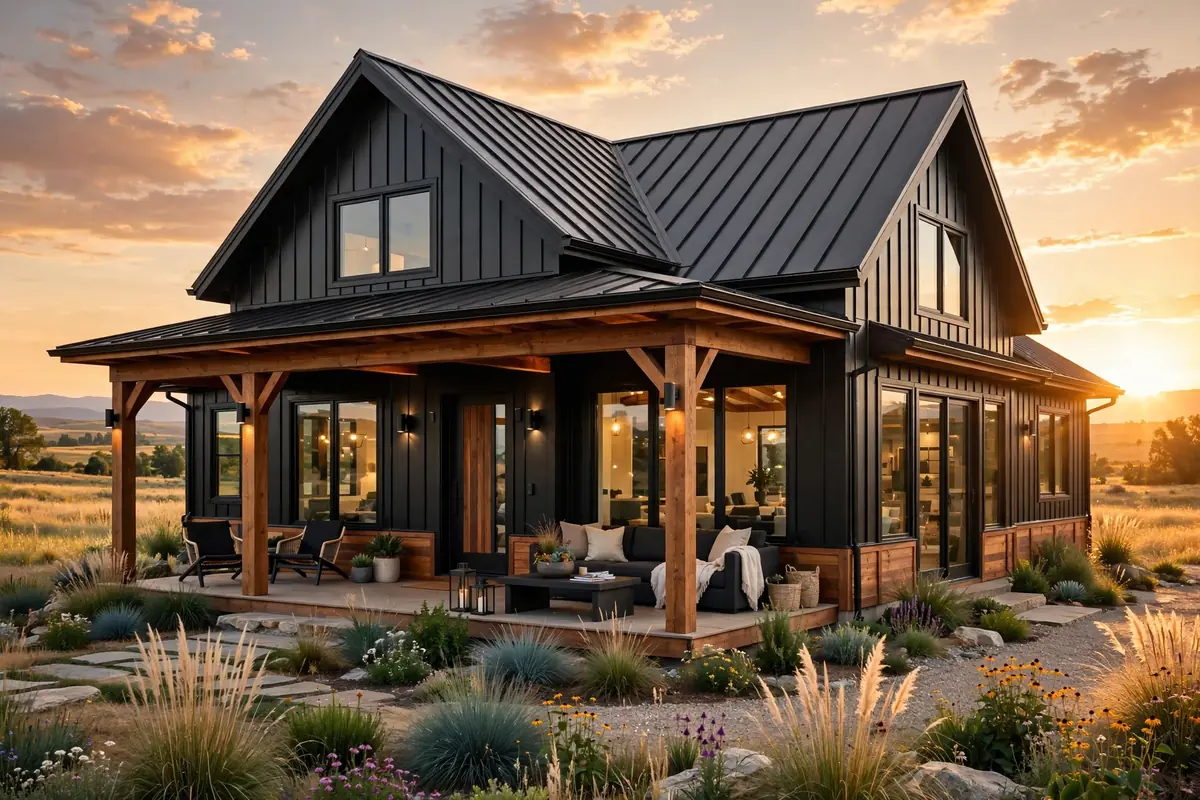
Everything from real costs and reputable kit companies to DIY assembly tips and the pitfalls most guides leave out.
What Is a Barndominium Kit?
A barndominium kit is a pre-engineered building package that includes everything you need to construct the exterior shell of a home. Think of it as a giant, heavy-duty building set — all the structural pieces arrive pre-cut, pre-drilled, and ready to bolt together on your land.
But is a barndominium the right choice for you? Before you buy a kit, check out our full comparison of barndominiums vs. traditional houses to see which one fits your budget and lifestyle.
Most standard kits include:
- Steel framing (red-iron I-beams or post-frame components)
- Metal roof panels and wall siding
- Trim, closures, and all fasteners
- Stamped engineering plans (required for permits)
- Door and window cutout openings
Premium kits from some manufacturers may also bundle roll-up garage doors, insulation packages, or interior wall framing.
Important: Most barndominium kits cover the shell only. Interior finishing — insulation, drywall, plumbing, electrical, cabinets, flooring — is sold separately and typically costs more than the kit itself.
For a complete breakdown of why closed-cell spray foam is mandatory for metal barndominiums, including health and safety considerations, read our Spray Foam Insulation Guide.
Why Barndominium Kits Are Booming
The barndominium market has exploded over the past few years, and interest keeps climbing. Here’s why American homeowners are choosing this path in record numbers:
- Lower upfront costs — Traditional stick-built homes average $150-$250/sq ft. A barndo kit shell runs as little as $20-$50/sq ft.
- Faster construction — The shell can go up in days or weeks with a professional crew, not months.
- Durability — Steel resists termites, rot, mold, and fire better than wood framing.
- Design freedom — No load-bearing interior walls means completely open floor plans.
- Low maintenance — Metal exteriors don’t need repainting every few years.
- Rural land compatibility — Perfect for larger lots, farms, and rural properties where traditional contractors are scarce.
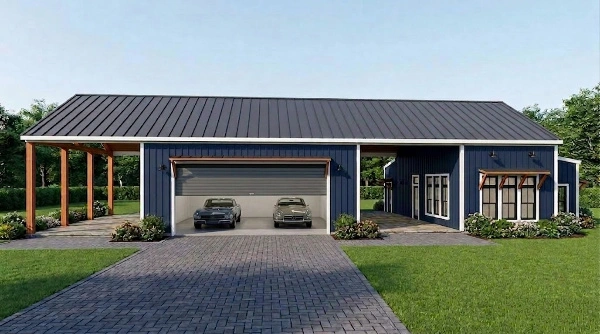
Hidden Costs First-Time Buyers Miss
This is the section most guides skip. Too many buyers see a kit listed at $30,000 and assume that’s their total budget. It’s not even close. Here’s what a complete 2,000 sq ft build actually costs in 2026:
| Cost Component | Typical Range | Notes |
|---|---|---|
| Kit (shell only) | $40,000 – $100,000 | Steel framing, roof, siding, trim |
| Concrete slab | $15,000 – $30,000 | 4–6 inch reinforced slab |
| Assembly labor | $10,000 – $25,000 | Or DIY to save significantly |
| Spray foam insulation | $8,000 – $15,000 | Recommended for metal buildings |
| Plumbing & electrical | $20,000 – $40,000 | Rough-in + fixtures |
| Interior finishes | $30,000 – $70,000 | Drywall, flooring, cabinets, paint |
| Permits & fees | $2,000 – $8,000 | Varies wildly by county |
| Total turnkey | $125,000 – $288,000 | Complete livable home |
The kit itself is typically only 20–30% of your total finished cost. Always budget for the full picture before committing.
For a complete overview of barndominium costs, framing types, and finishing steps, read our Ultimate Barndominium Guide.
Want a number tied to your own kit quote instead of a general range? Run it through our Barndominium Kit Cost Calculator to see how the rest of your build stacks up against what the kit alone costs.
Free · Takes 60 seconds
Turn These Ranges Into a Real Number
These planning ranges are a solid starting point — the exact number for your build depends on your property, finish level, and builder. Answer a few quick questions and get matched with local, vetted barndominium builders who can give you an actual quote for your exact size, budget, and location — free, with zero obligation.
100% free — no credit card needed
Real Cost Examples by State
Where you build has a massive impact on your final cost, especially when budgeting for barndominium kits. While the kit price itself is often fixed, labor rates, permit fees, land prices, and contractor availability vary dramatically across the US. To give you a clearer picture, here’s what a finished 2,000 sq ft home built from a quality barndominium kit realistically costs in popular barndo states:
| State | Finished Cost (2,000 sq ft) | Key Notes |
|---|---|---|
| Texas | $130,000 – $220,000 | Most builder competition = lowest labor costs. Barndo-friendly permitting. |
| Oklahoma | $125,000 – $210,000 | Very affordable. Rural land plentiful. Few zoning restrictions. See our full Oklahoma cost breakdown. |
| Montana | $160,000 – $270,000 | Short build season. Higher insulation requirements due to climate. |
| Tennessee | $140,000 – $230,000 | Growing market. Moderate labor costs. Some HOA restrictions in suburbs. |
| Florida | $155,000 – $260,000 | Hurricane code compliance adds cost. Excellent for year-round builds. |
| Colorado | $175,000 – $310,000 | High labor costs. Snow load engineering required. Stunning results. |
| Missouri | $130,000 – $215,000 | Affordable land and labor. Rural-friendly zoning in most counties. |
| Georgia | $145,000 – $240,000 | Growing barndo market. Moderate costs. Watch for HOA rules near Atlanta. |
The biggest savings opportunity is Texas and Oklahoma, where barndominium builders are abundant and experienced. If you have flexibility on location, these states offer the lowest total cost of ownership. Oklahoma in particular is worth a closer look — our Oklahoma cost-per-square-foot guide breaks the numbers down by region within the state.
The kit is only 20–30% of your total finished cost. Before you choose a kit company, get a complete picture of your budget — including site prep, utilities, insulation, and finishing. Use our interactive cost calculator to avoid surprises and compare different build scenarios.
Barndominium Kit Companies to Know
Not all kit manufacturers are created equal. Here’s a frank breakdown of several established US companies based on product quality, customer support, pricing transparency, and who they’re actually best suited for. This list isn’t exhaustive or ranked — treat it as a starting point for your own research and quote-gathering.
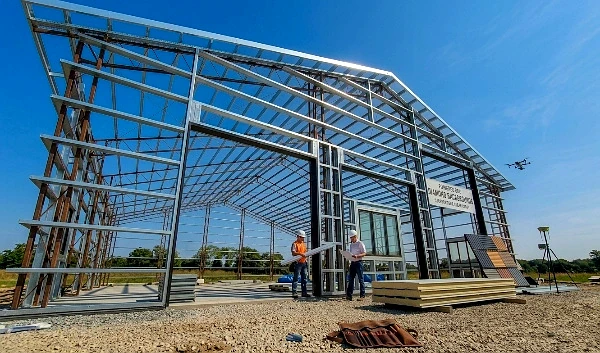
Worldwide Steel Buildings — Best for DIY Assembly
If you want to do it yourself, Worldwide Steel Buildings is a solid benchmark. Kits arrive in clearly labeled, ready-to-assemble sections. Main framing, secondary framing, roofing, siding, closures, fasteners, trim, and stamped plans are all included. They market their kits as buildable by “the average person,” though prior construction experience is still strongly recommended.
Mueller, Inc. — Best for TX / OK / NM / AZ / LA / AR
Mueller is a Texas institution with decades of experience serving the southern US. That means local sales reps, established crews, and genuine accountability. If you’re in their service area, Mueller’s regional presence is a real advantage — you won’t be dealing with a company two states away when something needs fixing.
Visit muellerinc.com
Morton Buildings — Premium Post-Frame
Morton has been in the post-frame building business longer than most of their competitors have existed. Their quality control, warranty coverage, and nationwide builder network make them worth serious consideration if budget isn’t your primary constraint.
Visit mortonbuildings.com
DC Structures — Hybrid Wood-Steel Designs
DC Structures blends timber framing with steel components for a rustic-luxury aesthetic that’s popular in mountain and farmhouse settings. Their western red cedar options, custom cupolas, and wrap-around porch packages are unlike anything steel-only companies offer. Expect to pay a premium — and expect a striking result.
Visit dcstructures.com
Best Barns — Strong Customer Support
Best Barns earns consistently strong reviews for one simple reason: they stand behind their product. Owners frequently report that when parts arrive damaged, replacements ship quickly. For first-time builders who value peace of mind, that responsiveness matters.
Visit bestbarns.com
Hansen Buildings — Transparent Pricing
Hansen publishes sample kit pricing directly on their website rather than requiring a quote form for every size — useful if you want a rough sense of cost before talking to a rep. Note that Hansen uses post-frame wood construction, not steel, which is worth factoring into your comparison.
Visit hansenpolebuildings.com
DIY vs. Professional Assembly
One of the most consequential decisions you’ll make is who builds your shell. Here’s an honest comparison:
| Factor | DIY Assembly | Professional Assembly |
|---|---|---|
| Cost savings | Save 30–50% on labor | Pay market rate for expertise |
| Time commitment | Several weekends to months | 1–3 weeks for the shell |
| Skill required | Moderate to high construction experience | None — they handle everything |
| Risk | Mistakes cost time and money | Liability and warranty coverage |
| Best for | Experienced DIYers with flexible schedules | Most first-time homeowners |
The Smart Hybrid Approach
Many experienced barndominium owners take a hybrid approach: hire professionals for the steel shell (the technically demanding part) and DIY the interior finishing (the fun part). This gives you professional speed and structural quality where it matters most, while keeping you involved in the design choices and cutting labor costs by 20–30%.
Pros and Cons of Barndominium Kits
Pros
- 20–40% cheaper per sq ft than stick-built construction
- Shell goes up in days or weeks, not months
- Steel resists termites, rot, mold, and fire
- Many insurers offer discounts for steel-framed homes
- No load-bearing interior walls = complete design freedom
- Continuous insulation layers boost energy efficiency
- Ideal for large rural lots and working farms
Cons
- Shell customization is more limited than full custom builds
- Assembly requires real construction knowledge
- Traditional banks may not recognize kit homes as standard residences — financing takes more work
- Many buyers seriously underestimate finishing and site prep costs
- Metal buildings can block cell and Wi-Fi signals without boosters (Faraday cage effect)
- Open floor plans need carefully sized HVAC systems
7-Step Guide to Buying Your Barndominium Kit
Step 1: Check Local Zoning and Permits
Before spending a dollar on a kit, call your county planning department. Some counties restrict metal primary residences or require minimum square footage. HOA communities may ban metal exteriors entirely. Ask about height limits, setback requirements, foundation specs, and any HOA rules.
Your barndominium must also comply with the International Residential Code (IRC), which sets the minimum standards for safety, structural integrity, and energy efficiency. For official information and the latest updates, visit the International Code Council (ICC) official website.
This step has ended more barndo projects than anything else — do it first.
Step 2: Prepare Your Land
Your kit needs somewhere to go. Budget for land clearing and grading ($2,000–$10,000), driveway construction ($1,500–$5,000), well and septic for off-grid sites ($10,000–$30,000), and utility hookups ($5,000–$25,000). These costs are often invisible in the excitement of kit shopping.
Step 3: Choose Your Kit
Select a company and either pick a pre-designed plan or work with their design team on a custom layout. Most companies offer free quotes — get at least three before deciding. Compare what’s included, not just the headline price.
Step 4: Understand What’s Actually Included
Kits vary dramatically. Always request a detailed material list and ask: What gauge steel? Are windows and doors included? Is trim and flashing included? Are fasteners and sealants included? Are the engineering plans stamped for permits? What’s the warranty? The answers determine whether two similar-priced kits are actually comparable.
Step 5: Pour Your Foundation
Your slab must be poured before the kit arrives. Most steel kits require a reinforced concrete slab with anchor bolts placed precisely to match the kit’s specifications. Get the exact bolt placement plans from your kit company before your concrete contractor pours — mistakes here are very expensive to fix.
Step 6: Assemble or Hire a Builder
Decide on DIY vs professional assembly using the comparison above. If hiring, specifically look for contractors with metal building experience — not just general contractors. Ask to see photos of previous metal builds. A general contractor learning on your project is a risk you don’t need.
Step 7: Finish the Interior
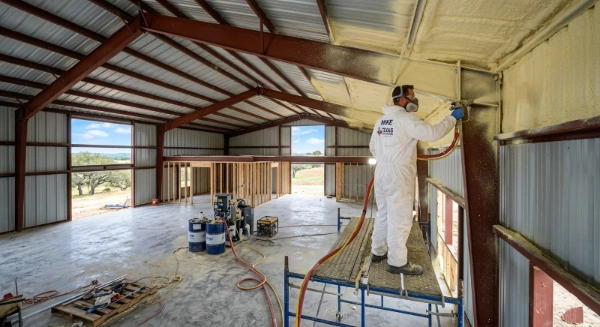
This is where your barndominium becomes a home: insulation, drywall, flooring, kitchen, bathrooms, HVAC, electrical, and plumbing. Closed-cell spray foam insulation is strongly recommended for all metal builds — it helps prevent condensation, reduces rust risk, cuts down on rain noise, and improves energy efficiency. Fiberglass batts tend to leave gaps and absorb moisture in metal structures.
Finding a Qualified Local Builder Near You
Choosing the right kit company is only half the battle. You also need a local builder with real metal building experience. Here’s how to find and vet one in your area:
- Ask your kit company first. Most manufacturers maintain lists of certified or recommended contractors in your state. This is your best starting point.
- Search the Metal Building Contractors and Erectors Association (MBCEA). Their member directory lists certified professionals by state.
- Search Facebook Groups. Groups like “Barndominium Life” and state-specific barndo groups have thousands of active members. Ask for local contractor recommendations — you’ll get honest, unfiltered opinions from people who’ve already been through the process.
- Verify with these three questions: Can I see photos of your last 3 metal building projects? Have you worked with this kit brand before? Can I speak to one of your past clients? Any hesitation is a red flag.
- Get quotes from at least 3 contractors. Labor costs for shell assembly vary significantly by region — especially between rural and suburban areas.
In Texas and Oklahoma, experienced barndo builders are easier to find and more competitively priced than in most of the country. If you’re building in the Southeast or Mountain West, expect to do more vetting and potentially wait longer for qualified crews.
Free · Takes 60 seconds
Turn These Ranges Into a Real Number
These planning ranges are a solid starting point — the exact number for your build depends on your property, finish level, and builder. Answer a few quick questions and get matched with local, vetted barndominium builders who can give you an actual quote for your exact size, budget, and location — free, with zero obligation.
100% free — no credit card needed
Frequently Asked Questions
Are barndominium kits cheaper than traditional homes?
The shell is typically 20–40% cheaper per square foot than stick framing. However, finishing costs are roughly similar. A fully complete barndominium usually runs $120–$150/sq ft, compared to $200+ for a custom stick-built home. The savings are real — but most come from the structure, not the interior.
Can I get a mortgage for a barndominium kit?
Yes, but it takes more effort than a conventional home loan. Your best options are USDA loans (for rural properties), FHA loans on qualifying structures, local credit unions, and portfolio lenders who keep loans in-house. In barndo-heavy states like Texas and Oklahoma, local lenders are far more experienced with these builds.
How long does it take to build from a kit?
A professional crew can have the shell up in 1–3 weeks. The full build — including interior finishing — typically takes 4–9 months depending on how much you DIY, contractor availability in your area, and permit processing times.
Do I really need spray foam insulation?
For a metal barndominium: strongly recommended. Closed-cell spray foam seals the metal envelope, helps prevent condensation (which can cause rust from the inside), and significantly reduces rain noise on a metal roof. Fiberglass batts tend to leave gaps and absorb moisture, so most builders avoid relying on them as the primary insulation in a metal building.
Can I build a barndominium kit myself?
If you have genuine moderate-to-high construction experience, yes. Be honest with yourself — this is not a weekend project for a beginner. The framing work involves heavy steel components, crane or telehandler equipment, and precise structural connections. The interior work is much more DIY-friendly.
What’s the difference between post-frame and steel-frame kits?
Post-frame construction uses large wood columns set on concrete piers, with girts and purlins framing the walls and roof. Steel-frame construction uses red-iron I-beams bolted together. Post-frame is often easier to DIY and can have lower material costs. Steel-frame is more durable against high winds, pests, and fire. Both can produce excellent barndominiums.
How much does a barndominium kit actually cost?
A basic shell kit starts around $20,000–$90,000 depending on size. A complete turnkey build ranges from $125,000 to $350,000 or more. Location matters enormously — see the state-by-state breakdown above for realistic numbers in your area.
Final Checklist: Before You Buy a Barndominium Kit
- Confirmed local zoning allows metal primary residences
- Verified HOA rules (if applicable)
- Contacted county building department about permits
- Ordered a soil test for foundation design
- Budgeted for site prep (clearing, grading, driveway)
- Budgeted for utilities (well, septic, power connection)
- Received detailed quotes from 3+ kit companies
- Read the fine print: confirmed exactly what IS and IS NOT included
- Interviewed 2–3 local contractors with metal building experience
- Arranged financing (USDA loan, credit union, or portfolio lender)
- Set aside a contingency fund of at least 15% for surprises
- Watched at least 3–4 YouTube videos from real barndo builders
Don’t forget the last line item: getting your belongings into the finished house. Our Moving Cost Calculator gives you a realistic estimate so it doesn’t catch you off guard after months of construction budgeting.
This guide was researched and written for US homeowners planning to build in 2026. Costs, company availability, and regulations vary by location and change over time. Always consult local professionals — including a licensed contractor, your county building department, and a financial advisor — before beginning construction.