
Arizona · 2026 Cost Guide
Arizona Barndominium Cost Per Sq Ft (2026): AZ Heat, Water, Building Codes & Rural Land Guide
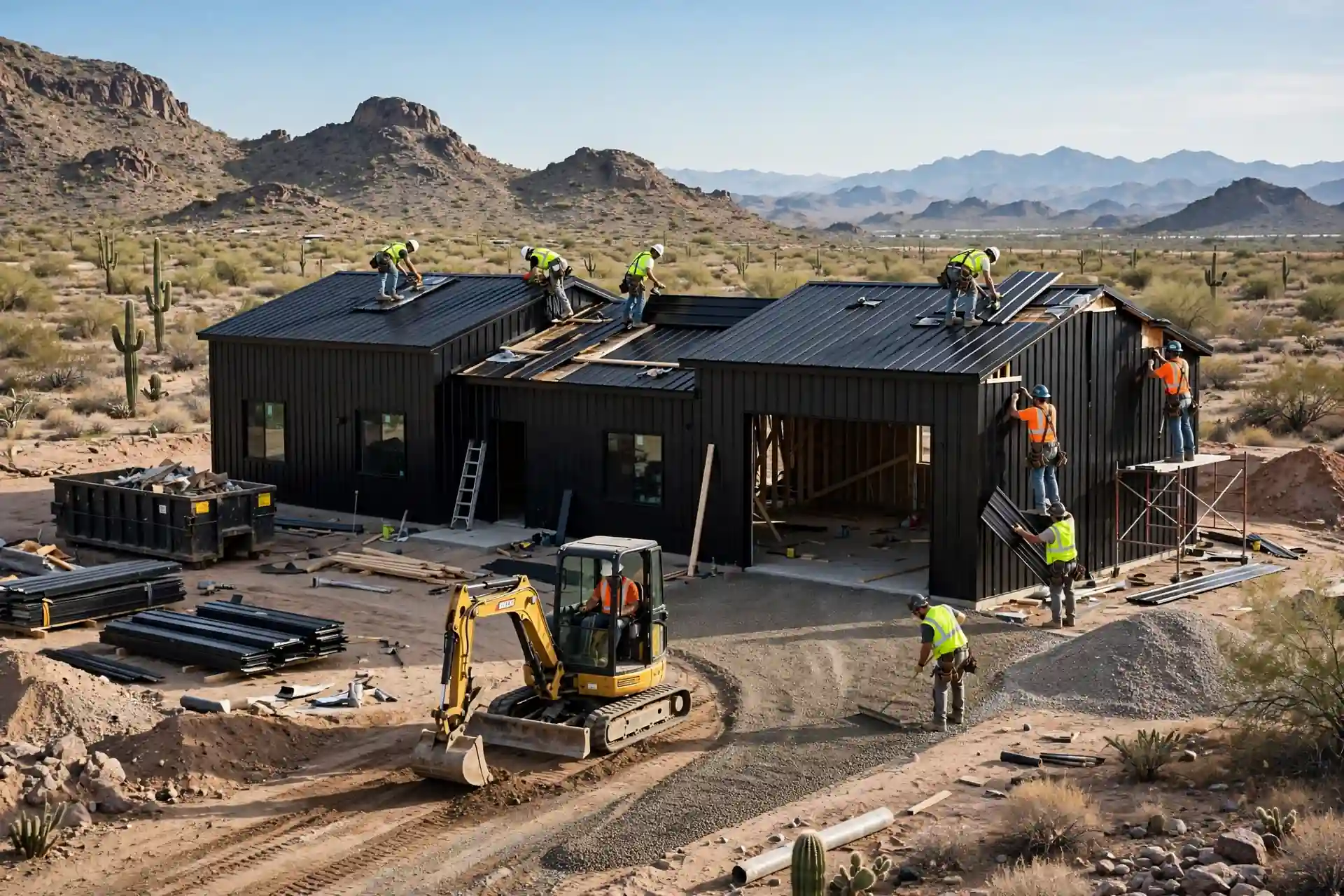
If you are researching Arizona barndominium cost per sq ft, the price of the metal shell is only one part of the real construction budget. In Arizona, a barndominium project can be heavily influenced by extreme summer heat, cooling requirements, water availability, well regulations, septic systems, monsoon flooding, wildfire exposure, rural access, elevation and local building codes.
Arizona, often called the Grand Canyon State, is also one of the most geographically diverse states in the country. A barndominium near Phoenix is not necessarily going to have the same construction requirements or operating costs as one near Flagstaff, Prescott, Tucson or a rural property in southern AZ.
This guide focuses specifically on Arizona barndominium construction in 2026, including realistic planning costs, shell-versus-finished pricing, rural land considerations, water supply, wells, septic systems, building permits, heat management, insulation, wildfire considerations and the differences between metropolitan and rural construction.
How Much Does a Barndominium Cost Per Square Foot in Arizona in 2026?
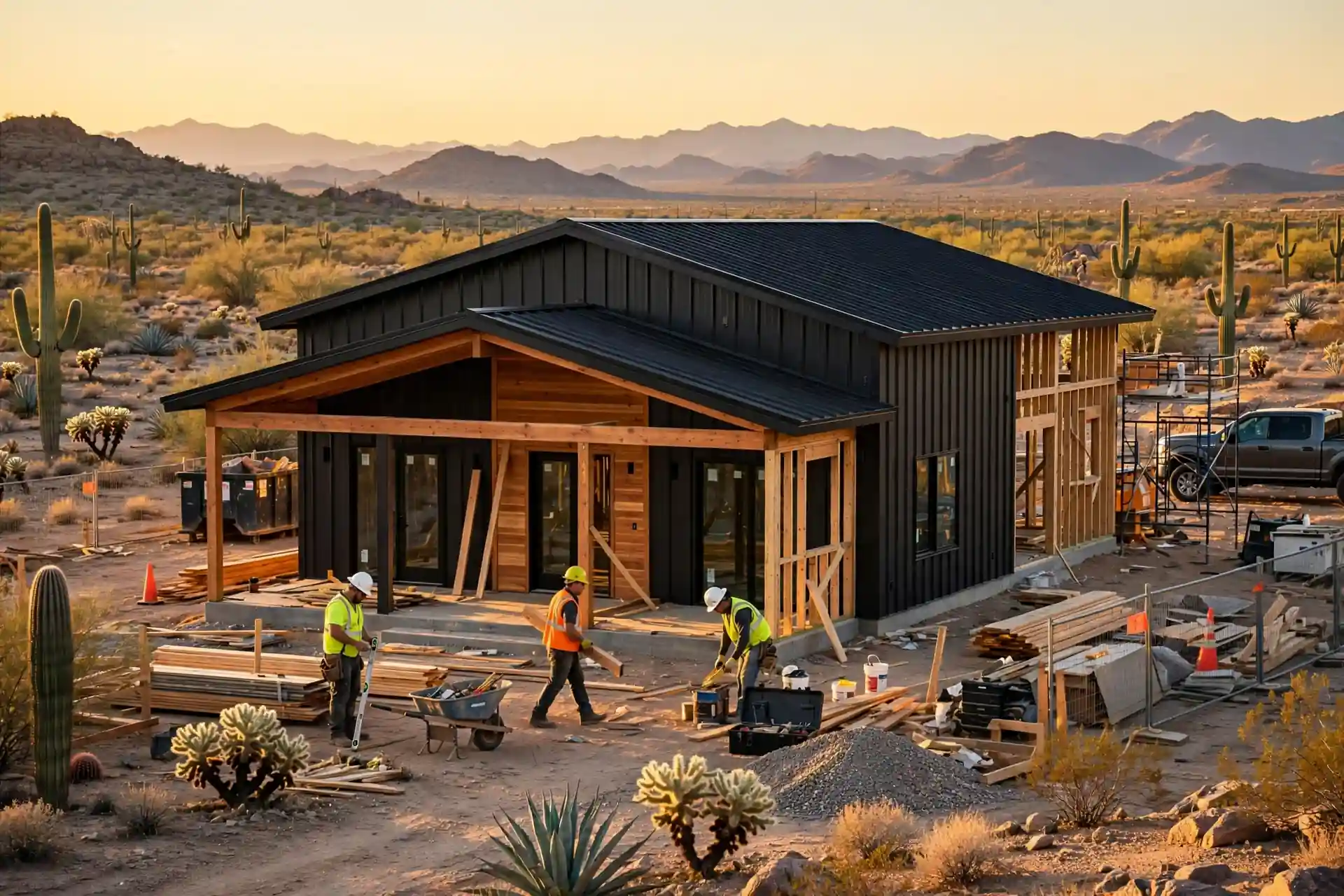
A current 2026 planning range for an Arizona barndominium is approximately $145–$215 per square foot for a finished turnkey build.
An erected shell can be around $45–$75 per square foot, depending on the building package, structural design, erection work and what is included in the quote.
| Arizona Barndominium Type | 2026 Planning Range | General Scope |
|---|---|---|
| Shell | $45–$75/sq ft | Structural building package/erection; major residential finish work excluded |
| Basic finished | About $145–$165/sq ft | Functional residential build with practical finishes |
| Mid-range finished | About $165–$190/sq ft | More complete finishes and upgraded systems |
| Premium/custom | About $190–$215+/sq ft | Custom layouts, upgraded finishes and higher-end features |
These are planning ranges, not guaranteed contractor bids. The actual price can move outside these ranges depending on the property, location, design, site work, utilities and finish level.
Arizona Barndominium Cost Per Sq Ft: What the Price Actually Includes
A common mistake when researching barndominiums is comparing a shell price with a finished-home price.
A shell can include some combination of the structural frame, roof, metal siding, openings and erection work. A completed residence requires considerably more. Our Barndo Material Cost Estimator shows how material choices alone can move the total.
The finished home may require:
- Foundation and concrete
- Structural steel or post-frame structure
- Roofing
- Exterior siding
- Windows
- Exterior doors
- Insulation
- Interior framing
- Drywall or other interior finishes
- Electrical wiring
- Electrical panel
- Plumbing
- Water heater
- HVAC
- Kitchen
- Bathrooms
- Flooring
- Cabinetry
- Lighting
- Fixtures
- Appliances
This is why an advertised $50 per square foot shell should never be compared directly with a $170 per square foot finished-home quote.
How Much Does a 2,000 Sq Ft Barndominium Cost in Arizona?
A 2,000-square-foot Arizona barndominium is a useful benchmark for estimating a typical medium-sized project.
| Build Level | Approximate Rate | 2,000 Sq Ft Example |
|---|---|---|
| Basic finished | $145–$165/sq ft | $290,000–$330,000 |
| Mid-range | $165–$190/sq ft | $330,000–$380,000 |
| Premium/custom | $190–$215+ | $380,000–$430,000+ |
These numbers are building-cost examples only. Land, driveway, well, septic, utility connections, grading, engineering, permits and other site-development expenses may be additional.
How Much Does a 2,400 Sq Ft Barndominium Cost in Arizona?
A 40-by-60 building contains approximately 2,400 square feet and is a useful size for a combination home and workshop.
| Build Level | Planning Rate | 2,400 Sq Ft Example |
|---|---|---|
| Basic | $145–$165/sq ft | $348,000–$396,000 |
| Mid-range | $165–$190/sq ft | $396,000–$456,000 |
| Premium | $190–$215+ | $456,000–$516,000+ |
Not every 2,400-square-foot building will cost the same. A building with 1,800 square feet of finished living area and a 600-square-foot shop will have a different blended construction cost from a 2,400-square-foot fully finished residence.
Arizona Barndominium Cost Calculator: Estimate Your AZ Build
One simple way to start an Arizona barndominium budget is to multiply the planned finished square footage by a realistic construction rate.
For example:
2,000 sq ft × $175/sq ft = $350,000 preliminary building estimate
That is a starting construction estimate, not necessarily the complete cost of building on Arizona acreage.
A rural project could also require:
- Land
- Survey
- Engineering
- Grading
- Driveway
- Private well
- Septic system
- Electrical service extension
- Water storage or pumping equipment where appropriate
- Drainage improvements
- Floodplain-related work
- Wildfire-related site improvements
- Permits
Use our Barndominium Cost Calculator to create a preliminary construction estimate before comparing actual Arizona builder quotes, and our Land Cost Calculator to set a realistic land budget alongside it.
Why Arizona Barndominium Costs Are Different From Other States
Arizona’s construction environment has several characteristics that make a state-specific barndominium budget important.
- Extreme summer heat
- High cooling demand
- Strong solar exposure
- Limited water resources in many areas
- Groundwater regulation
- Active Management Areas
- Rural well requirements
- Private septic systems
- Monsoon storms
- Flash-flood risk
- Wildfire risk
- Large elevation differences
- Different local building codes
- Large differences between metro and rural land
That combination makes Arizona very different from a generic Midwest barndominium market.
Arizona Barndominium Heat and Cooling Costs
One of the most important Arizona-specific issues is not the initial steel shell price. It is how the completed building handles heat.
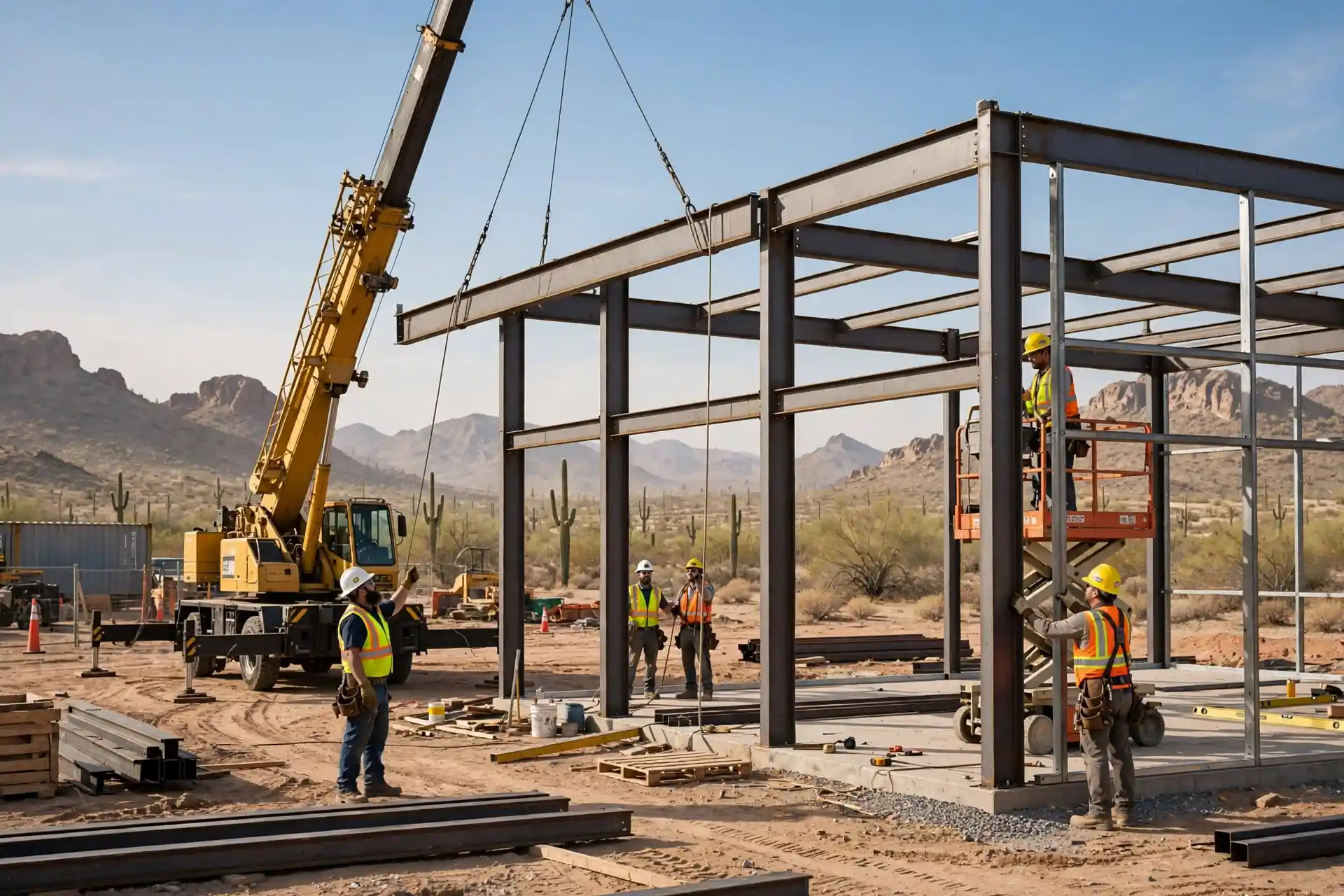
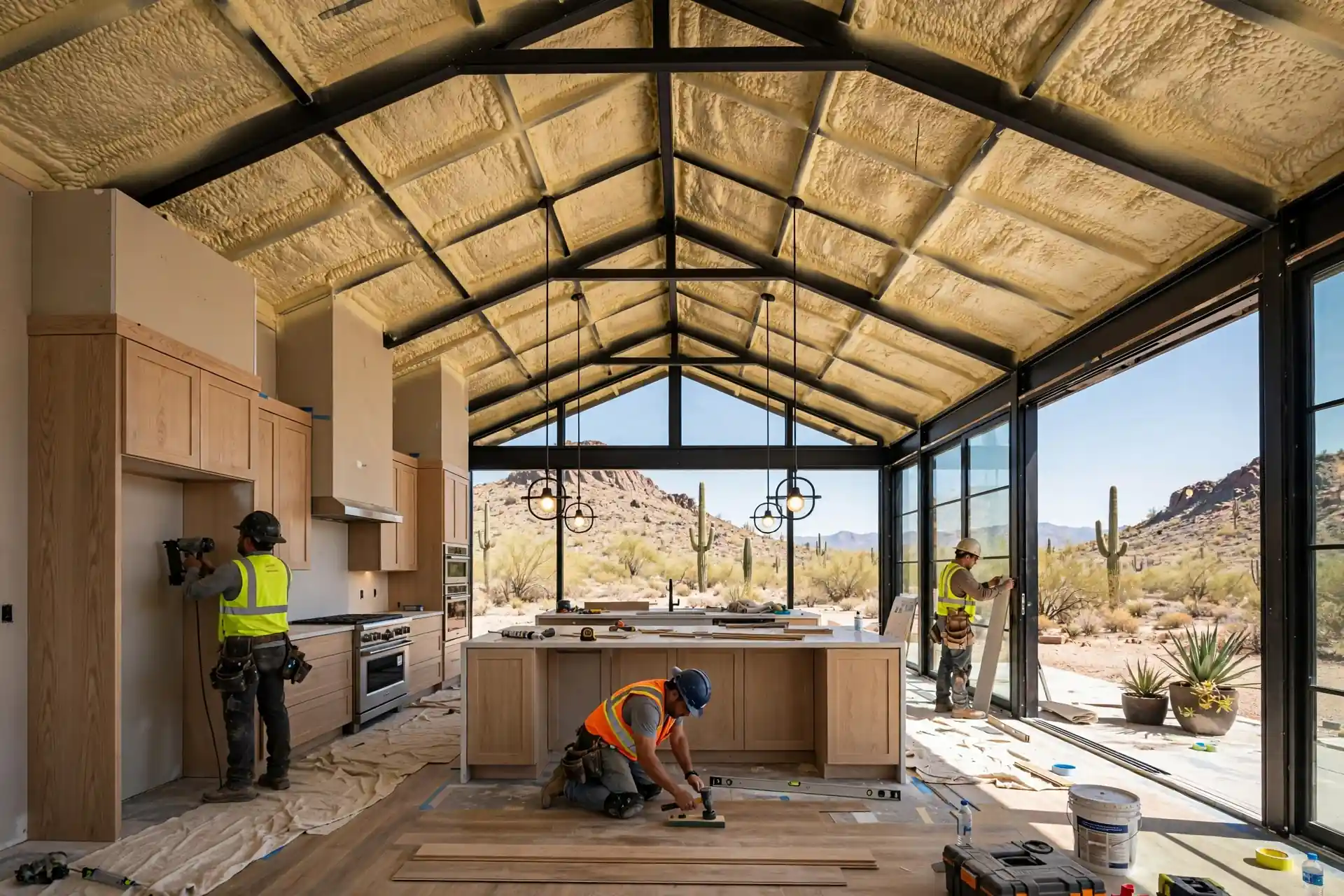
Many areas of Arizona experience extremely hot summer conditions. A large metal building with inadequate insulation can gain heat rapidly and place a substantial load on the air-conditioning system.
For an Arizona barndominium, the building envelope should therefore be treated as a major design component.
Important considerations include:
- Roof insulation
- Wall insulation
- Air sealing
- Thermal bridging
- Window orientation
- Low-solar-gain glazing
- Exterior shading
- Roof reflectivity
- HVAC sizing
- Attic or roof ventilation strategy
- Air distribution
Arizona Barndominium Insulation: Why the Metal Shell Needs More Than a Basic Finish
Metal buildings can become very hot when exposed to direct Arizona sun. Simply adding a minimal insulation layer after the shell is erected may not produce the thermal performance a homeowner expects. See our guide on whether spray foam insulation is mandatory for a barndominium for what that step can add to the budget.
Possible insulation approaches include:
- Closed-cell spray foam
- Open-cell spray foam where appropriate
- Rigid insulation
- Fiberglass systems
- Mineral wool in selected assemblies
- Hybrid insulation systems
- Insulated metal panels
The correct assembly depends on the structural system, climate zone, energy-code requirements, moisture control and HVAC design.
Does an Arizona Barndominium Need Air Conditioning?
For most occupied residential buildings in Arizona’s hot regions, mechanical cooling is a major design consideration.
Potential HVAC approaches include:
- High-efficiency central air conditioning
- Heat pumps
- Mini-split systems
- Variable-speed systems
- Zoned HVAC
- Evaporative cooling in suitable climates
- Hybrid systems
Evaporative cooling can be useful in dry climates, but it is not equally suitable for every Arizona location or every part of the year. HVAC selection should be based on the specific climate, humidity, building envelope and comfort requirements.
Arizona Barndominium Solar Panels and Energy Costs
Arizona’s high solar exposure makes solar energy an obvious consideration for some homeowners.
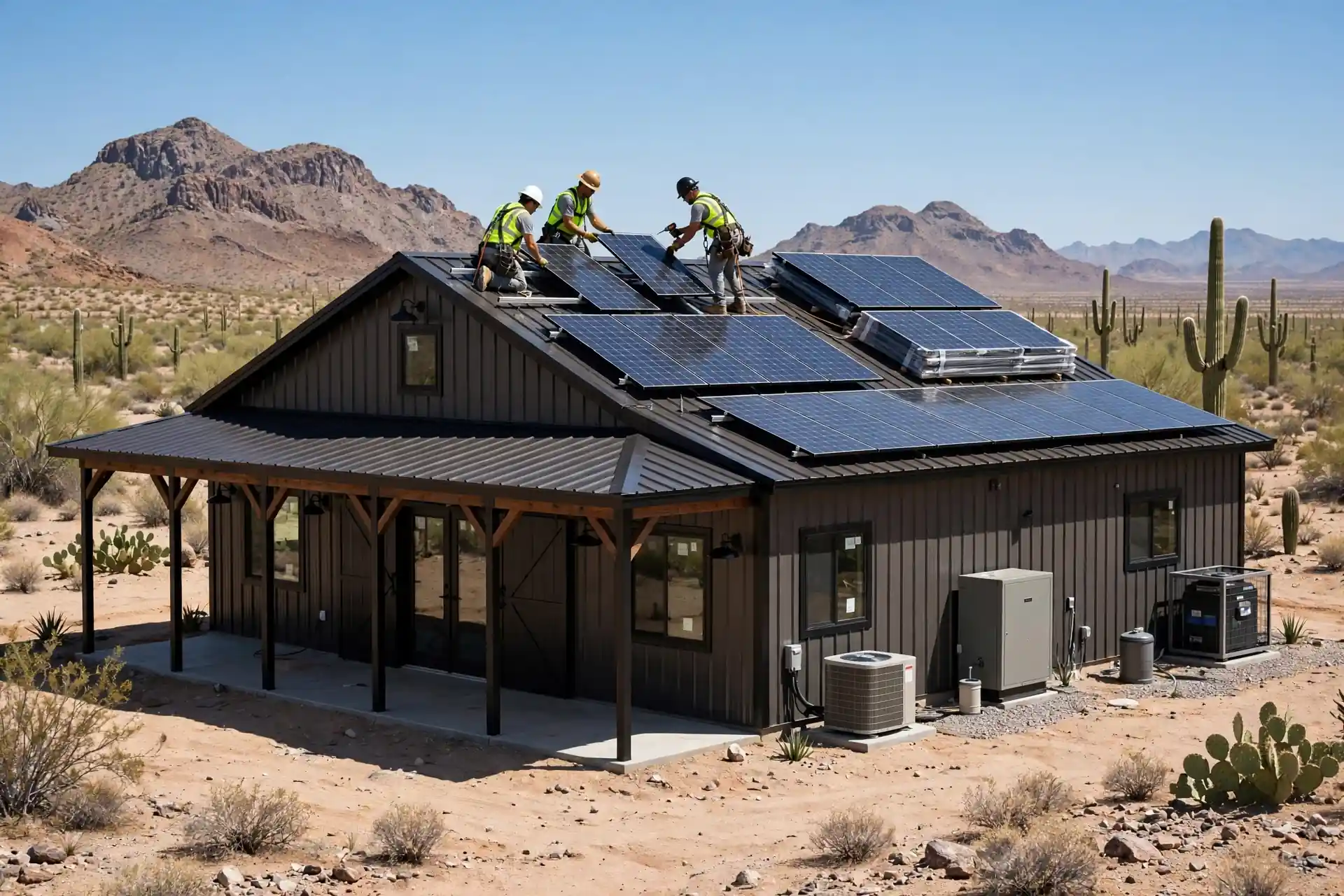
A barndominium’s large roof area can potentially provide substantial space for photovoltaic panels, depending on roof orientation, shading, structural design, utility rules and the owner’s energy goals.
Solar should be treated as a separate investment decision rather than automatically assuming that every Arizona barndominium needs a specific solar system.
When planning a roof, however, it can be useful to consider future solar-panel placement before finalizing structural and electrical layouts.
Arizona Barndominium Building Codes in 2026
Arizona is particularly important to research at the local level because building-code adoption and amendments can vary by jurisdiction.
For example, the City of Phoenix adopted its 2024 Phoenix Building Construction Code, effective August 1, 2025, including the 2024 IRC, IBC, IECC and other referenced codes with local amendments.
Pima County’s current building-code resources identify 2024 building codes and the 2023 National Electrical Code effective January 1, 2026, along with local amendments.
Coconino County’s current codes, effective June 2, 2026, include the 2024 IRC and IBC, while its energy-code adoption differs from Phoenix and other jurisdictions.
This demonstrates why an Arizona barndominium article should not simply say “Arizona uses the 2024 building code.” The exact jurisdiction matters.
Arizona Barndominium Building Codes: Phoenix vs Rural Counties
A barndominium near Phoenix is not necessarily subject to the same permitting process as a rural property in Cochise County, Coconino County or another county.
For example, Cochise County currently identifies the 2024 IRC, IBC, IMC, IFGC, IPC and IFC among its adopted codes, along with local requirements.
Coconino County also adopted 2024 construction codes in 2026.
Therefore, before ordering an Arizona barndominium package, identify the exact authority having jurisdiction for the property.
Arizona Barndominium Permits: What You Need to Know
Permitting is location-specific.
For example, the City of Phoenix states that construction permits are required for new homes and many residential construction projects.
Rural counties may have different administrative processes and zoning requirements.
Before construction, determine:
- Which city or county has jurisdiction
- Whether the property is incorporated or unincorporated
- Which building code applies
- Which residential code applies
- What zoning district applies
- Whether a building permit is required
- Whether a septic permit is required
- Whether a floodplain permit is required
- Whether additional fire requirements apply
- Whether special site-plan review is required
Arizona Rural Barndominium Zoning
Rural Arizona land can look attractive because large parcels may provide plenty of room for a home, shop, garage and outdoor space.
But rural does not mean unregulated.
Cochise County, for example, assigns zoning designations to unincorporated property and uses zoning districts to regulate permitted housing types, minimum lot sizes and development standards.
Some rural districts allow residential uses on large acreage, while other districts can have different minimum lot sizes and restrictions.
Before buying an Arizona acreage parcel, confirm the actual zoning for the specific parcel rather than relying on the property’s listing description.
Can You Build a Barndominium on Acreage in Arizona?
In many areas, residential construction on acreage is possible, but the specific parcel must be evaluated for zoning, access, water, wastewater and building requirements.
Acreage is not automatically equivalent to a buildable homesite.
Before purchasing land, investigate:
- Zoning district
- Minimum lot size
- Permitted residential use
- Setbacks
- Road access
- Driveway requirements
- Floodplain
- Well feasibility
- Septic feasibility
- Electricity availability
- Wildfire exposure
- Grading requirements
Arizona Water Supply: One of the Most Important Barndominium Issues
Water deserves its own section in any serious Arizona barndominium guide.
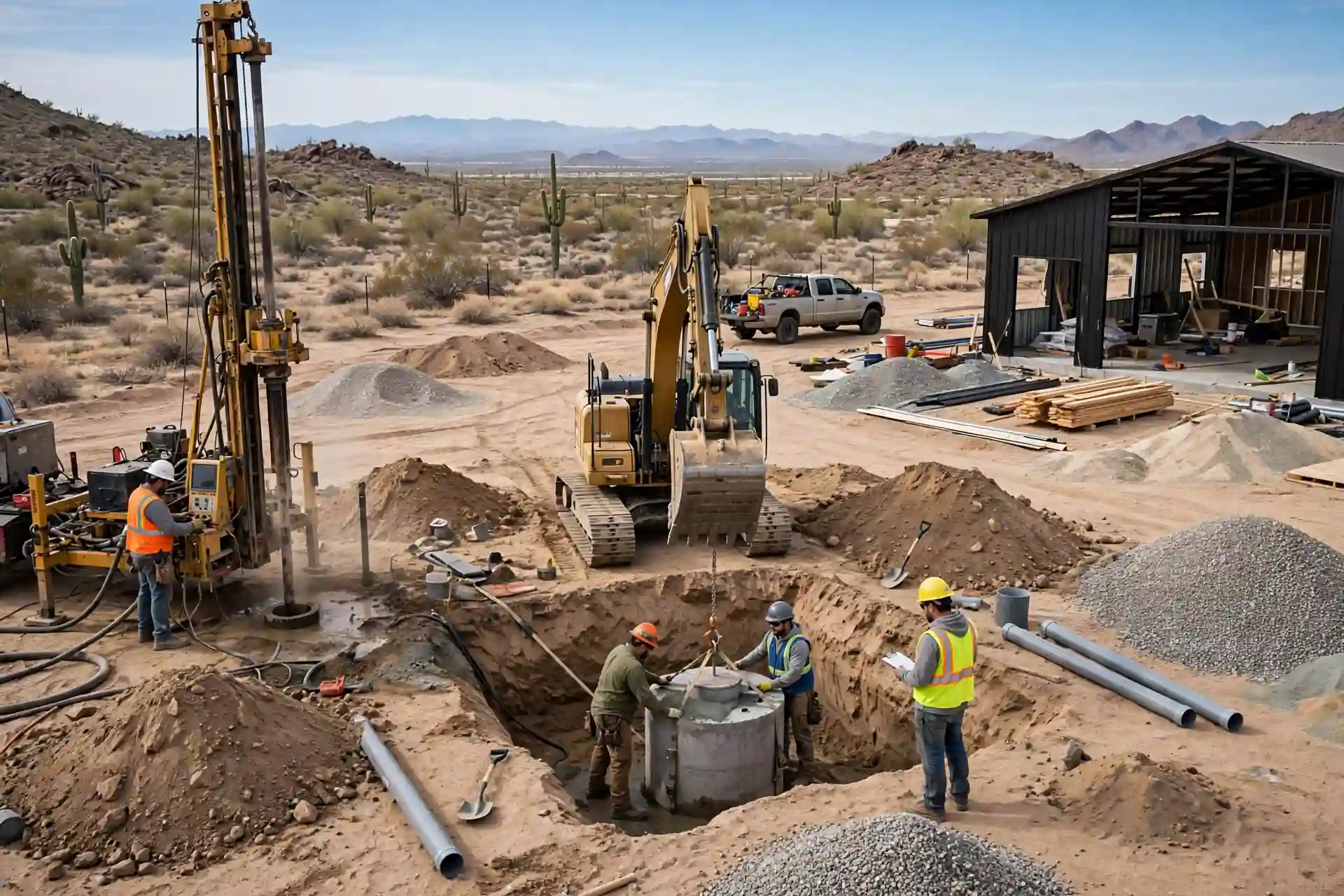
Arizona Department of Water Resources regulates groundwater wells, and Arizona has several Active Management Areas where groundwater is subject to additional management requirements.
ADWR identifies Active Management Areas including Phoenix, Pinal, Prescott, Tucson, Santa Cruz, Douglas, Willcox and Ranegras Plain in its current information.
The exact water situation therefore depends heavily on where the property is located.
Arizona Barndominium Well Requirements
If your Arizona property does not have access to a public water system, a private well may be considered.
Arizona Department of Water Resources states that a Notice of Intent to Drill must be filed before drilling a new well or deepening or modifying an existing well, and the work must be performed by a licensed well-drilling contractor.
ADWR also distinguishes between exempt and non-exempt wells. An exempt well generally has a pumping capacity of 35 gallons per minute or less and can be used for certain domestic purposes.
However, groundwater rules can be more complicated inside Active Management Areas.
That means “there is plenty of land, so I can drill a well” is not a sufficient assumption for an Arizona barndominium project.
Arizona Active Management Areas and Barndominium Water Supply
Arizona’s Active Management Areas, commonly called AMAs, are areas where groundwater is subject to additional regulation.
This is particularly relevant to properties around major population centers and other groundwater-management areas.
ADWR’s Assured and Adequate Water Supply programs evaluate water availability over a 100-year planning period under their respective programs.
For subdivisions within applicable Active Management Areas, assured-water-supply requirements can become particularly important.
A person buying an individual rural parcel should therefore investigate the specific water situation before assuming that a future well will be straightforward.
Arizona Barndominium Water Rights vs Having a Well
Owning land and having a well are not the same thing as having an unlimited water supply.
Arizona’s groundwater system is regulated under state law, and water availability can vary significantly by basin and location.
Before buying rural land, determine:
- Is there a public water provider?
- Is a private well feasible?
- Is the parcel inside an AMA?
- What well rules apply?
- Is an existing well already on the property?
- What is the well’s production history?
- Is the well legally documented?
- Are there water-quality concerns?
- Will additional storage or pumping equipment be required?
Arizona Barndominium Septic System Cost and Requirements
Many rural Arizona properties rely on onsite wastewater treatment systems, commonly called septic systems.
Arizona Department of Environmental Quality states that it has authority for onsite wastewater treatment facilities and has delegated permitting authority to Arizona’s counties.
That means the county where your property is located can be the agency through which the septic permit is handled.
Potential septic-related costs include:
- Site investigation
- Soil evaluation
- System design
- Permit
- Tank
- Disposal field
- Distribution components
- Pump equipment where necessary
- Excavation
- Site restoration
Arizona’s dry climate does not mean every parcel is automatically suitable for a basic septic system.
Arizona Well and Septic Placement for a Rural Barndominium
On rural Arizona land, the house, well and septic system should be considered together during site planning.
The preferred location for the barndominium may not be the best location for the well.
The best driveway location may conflict with the wastewater disposal area.
A wash or drainage path may limit the usable building site.
Therefore, before finalizing the house location, map:
- House
- Shop
- Driveway
- Well
- Septic system
- Electrical service
- Propane or other fuel storage
- Drainage routes
- Flood-prone areas
Arizona Monsoon Storms and Barndominium Drainage
Arizona’s desert climate does not mean that water management can be ignored.
Monsoon storms can produce intense rainfall over short periods, creating runoff, erosion and flash-flood hazards.
The Arizona Emergency Information Network specifically identifies monsoon-season hazards and encourages residents to understand local risks.
For a rural barndominium, site planning should consider:
- Natural drainage paths
- Washes
- Finished-floor elevation
- Driveway drainage
- Roof runoff
- Site grading
- Erosion control
- Floodplain status
Arizona Barndominium Floodplain Requirements
A desert property should never be assumed to be flood-safe simply because it receives relatively little annual rainfall.
Short-duration heavy storms can create significant runoff.
Arizona counties can have floodplain permitting requirements. Cochise County, for example, states that development within designated floodplains may require a Floodplain Use Permit, including certain grading and other property changes.
The county also notes that agricultural properties are not automatically exempt from floodplain requirements.
Check the floodplain status before purchasing the land and before choosing the building pad.
Arizona Barndominium Wildfire Risk
Wildfire is another Arizona-specific consideration, particularly for properties near desert vegetation, grassland, forest and wildland-urban interface areas.
The Arizona Emergency Information Network describes the state’s hot, dry climate as creating a year-round wildfire concern.
For a rural barndominium, wildfire planning can affect:
- Site selection
- Vegetation management
- Access roads
- Emergency vehicle access
- Exterior materials
- Roof design
- Defensible space
- Water availability
Local requirements can vary by jurisdiction and wildfire-risk area.
Arizona Barndominium Fire Code and Rural Access
Arizona’s Office of the State Fire Marshal currently operates under the 2024 International Fire Code for applicable state-level reviews.
However, residential structures under five units can fall outside certain state fire-code review requirements where local fire codes are not adopted, so the exact applicability depends on the project and jurisdiction.
Fire-department access can become particularly important on remote acreage.
A long narrow driveway may look inexpensive during land purchase but create additional requirements for emergency access, turning areas or road improvements depending on the local jurisdiction.
Arizona Barndominium Foundation Requirements
Foundation design should be based on the actual site and structural design rather than selecting a foundation from a generic barndominium package.
Arizona sites can vary from relatively flat desert lots to steep mountainous terrain.
Potential foundation cost factors include:
- Soil conditions
- Expansive soils
- Rock excavation
- Slopes
- Drainage
- Site grading
- Frost conditions at higher elevations
- Structural loads
- Shop equipment
- Large overhead doors
In higher-elevation Arizona communities, winter and freeze conditions can also become more important than they are in low-desert locations.
Arizona Barndominium Cost: Phoenix vs Tucson vs Northern Arizona
Arizona should be divided into several broad construction environments rather than treated as one uniform market.
Phoenix Metropolitan Area
Phoenix-area projects are strongly influenced by extreme summer heat, cooling requirements, urban or suburban permitting, land availability and utility connections.
A rural property on the edge of the metropolitan area can have a very different development profile from a serviced residential lot inside Phoenix.
Tucson and Southern Arizona
Tucson and surrounding areas combine desert heat with a different elevation and landscape from Phoenix.
Rural properties around southern AZ can introduce well, septic, access and drainage considerations.
Prescott and Central Highlands
Higher-elevation areas such as the Prescott region can have cooler winters than the Phoenix desert, making heating and insulation more important than a purely low-desert design would suggest.
Flagstaff and Northern Arizona
Flagstaff and other high-elevation areas are a completely different climate from Phoenix.
Snow, freezing temperatures, heating demand and winter construction conditions can become significant factors.
This is one of the clearest reasons an Arizona barndominium article should not assume that every AZ property needs the same building envelope or mechanical system.
Arizona Barndominium Cost on Rural Acreage
Buying acreage can provide space for a larger shop, garage, RV storage, animals or outdoor activities.
But rural construction introduces costs that are often absent from suburban projects. Comparing against a conventional build is worthwhile too: our Barndominium vs House Cost Calculator prices both options at the same size and finish level.
| Rural Development Item | Why It Matters |
|---|---|
| Driveway | Long access roads can require grading, gravel and drainage |
| Well | May be necessary where public water is unavailable |
| Septic | Often necessary outside sewer service areas |
| Power | Distance from existing utility infrastructure matters |
| Grading | Desert terrain can still require substantial site work |
| Flood control | Washes and drainage paths can affect the building site |
| Fire access | Remote properties may have additional access considerations |
| Water planning | Groundwater rules vary by location |
Arizona Barndominium Shell Cost Per Square Foot
Current 2026 market estimates place an Arizona barndominium shell around $45–$75 per square foot.
But a shell quote can vary according to:
- Building dimensions
- Roof design
- Structural system
- Steel specifications
- Wind design
- Doors and windows
- Roofing
- Exterior siding
- Porches
- Overhead doors
- Foundation scope
- Erection labor
- Site accessibility
Always request an itemized scope of work before comparing shell quotes. Our Barndominium Kit Cost Calculator and Barndominium Kits Guide explain what suppliers commonly include or exclude.
Why a $50 Per Sq Ft Shell Is Not a $50 Per Sq Ft Arizona Home
Suppose a 2,000-square-foot shell is quoted at $50 per square foot.
The shell would be approximately $100,000.
But the finished home could still need:
- Foundation
- Insulation
- HVAC
- Electrical
- Plumbing
- Interior walls
- Drywall
- Flooring
- Kitchen
- Bathrooms
- Cabinets
- Lighting
- Windows and doors
- Appliances
In Arizona, HVAC and insulation deserve particular attention because the thermal environment can be much more demanding than a generic shell-price advertisement suggests.
Arizona Barndominium With a Shop
The ability to combine a residence and workshop under one roof is one of the main attractions of a barndominium. Browsing popular barndominium floor plans shows how living-plus-shop layouts are typically split.
For example, a 2,400-square-foot structure could contain:
- 1,600 square feet of finished living space
- 800 square feet of shop/garage space
That should not automatically be priced as 2,400 square feet of fully finished residential construction.
The shop may need concrete, electrical circuits, insulation, lighting and large doors but may not require the same cabinetry, flooring and plumbing as the living area.
How Much Does a 30×40 Barndominium Cost in Arizona?
A 30-by-40 building contains approximately 1,200 square feet.
| Build Level | Planning Rate | 1,200 Sq Ft Example |
|---|---|---|
| Basic | $145–$165/sq ft | $174,000–$198,000 |
| Mid-range | $165–$190/sq ft | $198,000–$228,000 |
| Premium | $190–$215+ | $228,000–$258,000+ |
These examples represent building-cost planning only and exclude land and many site-development expenses.
Arizona Barndominium Cost Factors That Are Easy to Miss
Cooling Capacity
A large open-plan metal building can place significant demand on the cooling system if the thermal envelope is poorly designed.
Roof Insulation
The roof receives intense solar exposure, especially in low-desert areas. Roof insulation should be considered during the original design.
Windows
Large areas of glass can increase solar heat gain. Window orientation, glazing and exterior shading can therefore affect cooling demand.
Driveway
Rural Arizona parcels can require long access roads, especially where homesites are set back from public roads.
Well
A private well involves permitting, drilling and pumping considerations and can be affected by local groundwater rules.
Septic
Rural properties may require an onsite wastewater treatment system.
Flood Drainage
Desert washes and monsoon runoff can make drainage a major site-planning issue.
Wildfire
Properties near vegetation or wildland areas may need additional fire-access and site-planning considerations.
Elevation
Arizona’s higher elevations can have substantially different heating and snow conditions from the low desert.
Arizona Barndominium Land-Buying & Due-Diligence Checklist
Before purchasing AZ acreage for a barndominium, confirm all of the following:
- Parcel number
- Parcel zoning
- Permitted residential use
- Minimum lot size
- Setbacks
- Building height restrictions
- Road access
- Driveway requirements
- Floodplain status
- Wash and drainage paths
- Well feasibility
- Water rights and groundwater conditions
- AMA status
- Septic feasibility
- Electrical availability
- Internet availability
- Wildfire exposure
- Conservation easements and restrictions
- Utility easements
- Soil and rock conditions
- Topography
Arizona Barndominium Hidden Costs
| Potential Cost | Why It Matters |
|---|---|
| Land survey | Needed for accurate site planning and boundaries |
| Engineering | Structural and site-specific design may be required |
| Grading | Building pad and drainage preparation |
| Driveway | Long rural access can become expensive |
| Well | May be required outside public water service |
| Septic | May be required outside public sewer service |
| Power extension | Distance from existing electrical infrastructure matters |
| Drainage | Monsoon runoff can require site planning |
| Floodplain requirements | Can affect building location and elevation |
| Wildfire improvements | May affect access and site preparation |
| HVAC | Major system in hot Arizona climates |
| Insulation | Important for controlling solar heat gain |
| Solar | Optional system that can require additional investment |
How to Save Money Building a Barndominium in Arizona
Choose the Building Site Before Finalizing the Design
A cheap parcel is not necessarily a cheap building site. Check water, wastewater, access, drainage and utilities before committing to the property.
Keep the Floor Plan Efficient
A simple rectangular building with a compact plumbing layout can reduce unnecessary construction complexity.
Design the Thermal Envelope Early
Do not wait until after the shell is ordered to decide how the building will be insulated and cooled.
Control Window Area
Large windows can provide excellent views but can also increase solar heat gain. Window size and orientation should be considered together.
Plan the Shop From Day One
If you want a large workshop, include it in the original design rather than trying to add it later.
Compare Complete Quotes
Make sure builders are quoting the same scope. One contractor’s “finished” price can contain items that another contractor excludes.
Arizona Barndominium Cost by Climate and Elevation
Arizona should not be treated as a single climate.
| Arizona Area Type | Major Construction Considerations |
|---|---|
| Low desert | Extreme heat, cooling, solar exposure, monsoon runoff |
| Southern Arizona | Heat, rural acreage, water, wells, septic and monsoon conditions |
| Central highlands | Cooler temperatures, heating, terrain and winter conditions |
| Northern highlands | Snow, freezing temperatures, heating and winter construction |
| Mountain/wildland areas | Terrain, wildfire exposure, access, snow and drainage |
Arizona Barndominium vs New Mexico and Texas
Arizona shares some characteristics with neighboring southwestern states, but the construction environment is not identical.
| Factor | Arizona | New Mexico | Texas |
|---|---|---|---|
| Hot/dry climate | Major consideration | Important in many areas | Varies substantially by region |
| Water availability | Major planning issue | Important | Region-dependent |
| Private wells | Common rural consideration | Common rural consideration | Common rural consideration |
| Septic | Common outside sewer areas | Common outside sewer areas | Common outside sewer areas |
| Extreme summer heat | Major factor | Important | Major factor in many regions |
| Monsoon/flash flooding | Important | Important in some areas | Region-dependent |
The comparison illustrates why a state-specific cost guide is more useful than applying one national barndominium price to every property.
Arizona Barndominium Financing and Construction Budgeting
Financing a barndominium can be more complicated than financing a conventional production home because the project may involve land, a custom building, a shop and rural infrastructure.
Before choosing a design, ask the lender:
- Does the lender finance barndominiums?
- Does the lender treat the building as a conventional residence?
- Is the shop area included in the appraised residential value?
- Can land and construction be financed together?
- Is a construction-to-permanent loan available?
- What plans and specifications are required?
- Are licensed contractors required?
- What inspections are required before draws?
- What contingency percentage is required?
Do not assume every mortgage lender treats a barndominium the same way. To see a realistic monthly payment before committing to a loan amount, run the numbers through our Free Home Loan Calculator, and if you already own property, our Home Equity Calculator can estimate how much equity may be available.
Questions to Ask an Arizona Barndominium Builder
- Is the quote for a shell or a finished home?
- Is the foundation included?
- Is concrete included?
- Are insulation costs included?
- What HVAC system is included?
- What energy-code requirements are included?
- Are windows included?
- Are overhead shop doors included?
- Who handles engineering?
- Who obtains the building permit?
- Are permit fees included?
- Is site grading included?
- Is drainage work included?
- Are well and septic included?
- Is the driveway included?
- Is electrical service included?
- Are appliances included?
- What is the construction payment schedule?
- What happens if material prices change?
- What warranty is included?
Arizona Barndominium Cost Example: 2,000 Sq Ft Rural Build
Consider a hypothetical 2,000-square-foot rural Arizona barndominium.
| Budget Category | Planning Approach |
|---|---|
| Building construction | $290,000–$430,000+ |
| Foundation/site preparation | Project-specific |
| Well | Project-specific |
| Septic | Project-specific |
| Driveway | Project-specific |
| Electrical connection | Project-specific |
| Survey/engineering | Project-specific |
| Flood/drainage work | Project-specific |
| Wildfire-related improvements | Project-specific |
| Land | Excluded |
This is why a complete Arizona project budget should be built in layers rather than relying on one advertised price per square foot.
Arizona Barndominium Cost Per Sq Ft: The Bottom Line
For 2026 planning purposes, approximately $145–$215 per square foot is a useful published Arizona turnkey range, while an erected shell may be around $45–$75 per square foot.
But the real Arizona barndominium budget depends heavily on the property.
The most important questions are:
- Where in AZ is the property?
- Is it low desert or high elevation?
- What local building code applies?
- What zoning district applies?
- Is public water available?
- Can a private well legally and practically serve the property?
- Is the property inside an Active Management Area?
- Is septic feasible?
- Is the property affected by a floodplain or wash?
- What are the wildfire conditions?
- How much grading is required?
- How far is the building from utilities?
- What cooling and insulation system will be needed?
Those questions can have a greater effect on the total project budget than a small difference in the advertised shell price.
Arizona Barndominium Cost Per Sq Ft FAQs
How much does a barndominium cost per square foot in Arizona?
A current 2026 planning range is approximately $145–$215 per square foot for a finished turnkey Arizona barndominium. An erected shell may be around $45–$75 per square foot depending on scope.
How much does a 2,000 sq ft barndominium cost in Arizona?
A 2,000-square-foot Arizona barndominium can be approximately $290,000–$430,000+ based on current planning ranges, before land and many site-development costs.
How much does a barndominium shell cost in Arizona?
Current 2026 market estimates place an Arizona shell around $45–$75 per square foot. The exact scope of the shell quote must be checked before comparing builders.
Is it cheaper to build a barndominium in rural Arizona?
Rural land can have different land prices, but rural construction may require a private well, septic system, long driveway, electrical extension, grading and additional drainage or fire-access work.
Can I build a barndominium on Arizona acreage?
Potentially, but the parcel must be checked for zoning, residential use, setbacks, water availability, septic feasibility, access, floodplain conditions and other local requirements.
Do Arizona barndominiums need building permits?
Building permit requirements depend on the applicable local jurisdiction and project. Cities and counties can have their own adopted codes and amendments, so confirm requirements before construction.
Does Arizona have one statewide building code?
Arizona construction requirements are significantly affected by local jurisdictional code adoption and amendments. Phoenix, Pima County, Coconino County and other jurisdictions can have different adopted codes and local amendments.
Do rural Arizona barndominiums need a well?
If public water is unavailable, a private well may be necessary. Arizona Department of Water Resources requires a Notice of Intent before drilling a new well and regulates groundwater wells under state rules.
Does Arizona have groundwater restrictions?
Yes. Arizona has Active Management Areas where groundwater is subject to additional management requirements. The exact rules depend on the property’s location and type of water use.
Do Arizona barndominiums need septic?
If public sewer is unavailable, an onsite wastewater treatment system may be necessary. Arizona ADEQ has delegated much of the onsite wastewater permitting process to the state’s counties.
Are Arizona barndominiums good in extreme heat?
A properly designed barndominium can be suitable for Arizona’s climate, but insulation, air sealing, window selection, shading and HVAC capacity are particularly important in hot regions.
Do Arizona barndominiums need solar panels?
Solar is not automatically required for every barndominium. However, Arizona’s strong solar resource makes photovoltaic systems worth considering depending on the property’s electrical needs, roof design and utility situation.
What is the biggest hidden cost of an Arizona rural barndominium?
There is no single hidden cost that applies to every property. Water supply, septic, driveway, power extension, grading, drainage and site-specific conditions can each materially affect a rural project’s budget.
Is Phoenix or northern Arizona better for a barndominium?
These areas have different construction environments rather than one universal cost or design profile. Phoenix has extreme low-desert heat and cooling considerations, while northern Arizona can introduce snow, freezing temperatures and much higher heating requirements.
Final Arizona Barndominium Budget Checklist
- Land
- Survey
- Zoning review
- Building plans
- Structural engineering
- Building permit
- Foundation
- Steel shell
- Roofing
- Siding
- Windows
- Doors
- Insulation
- HVAC
- Electrical
- Plumbing
- Kitchen
- Bathrooms
- Flooring
- Interior finishes
- Shop/garage
- Well
- Septic
- Driveway
- Power extension
- Drainage
- Floodplain requirements
- Wildfire-related site work
- Landscaping
- Construction contingency
An Arizona barndominium can be an efficient way to combine a home, garage and workshop, but the project should be priced as a complete development rather than simply multiplying the floor area by a low shell price.
The most important Arizona-specific issues are water, local codes, extreme heat, cooling, insulation, rural access, septic, flood drainage and wildfire exposure. These factors can change the total cost substantially from one parcel to another.
Start with our Barndominium Cost Calculator, then verify the property-specific requirements with the applicable Arizona city or county before committing to a building design or construction contract. For broader planning, see our Barndominium in 2026: Plans, Cost & Finishing guide.
Official Arizona Resources
Arizona Department of Water Resources (ADWR)well rules, Notice of Intent to Drill, Active Management Areas and assured water supply Arizona Department of Environmental Quality (ADEQ)onsite wastewater (septic) program and county delegation City of PhoenixPhoenix Building Construction Code and residential permits Pima Countyadopted building codes and local amendments Coconino Countyadopted construction codes and community development Cochise Countyzoning districts, adopted codes and floodplain permits Arizona Emergency Information Networkmonsoon and wildfire hazard informationRelated guide: Compare Arizona with the other states on our Barndominium Cost Per Sqft by State guide.