
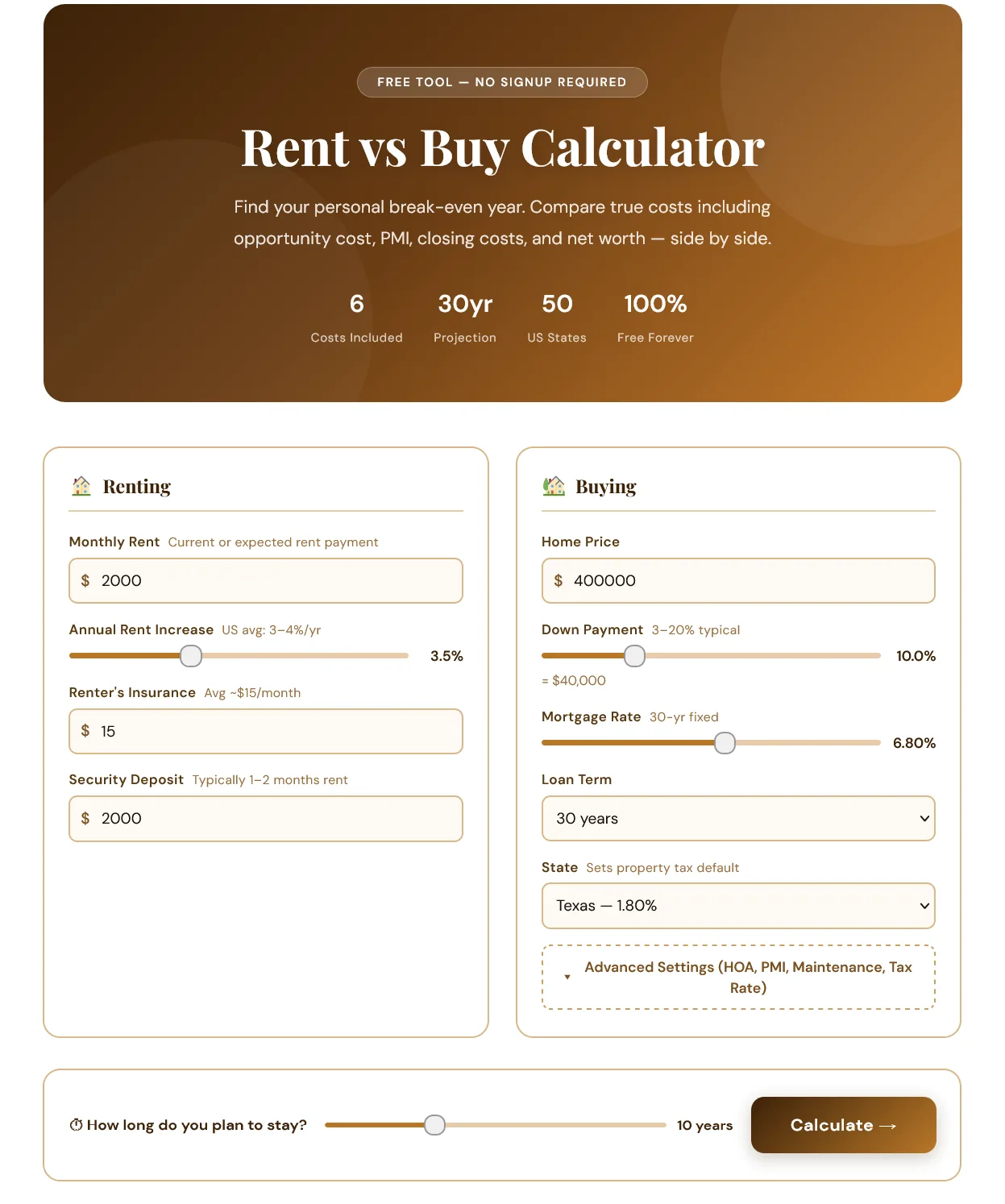
Rent vs Buy Calculator
Find your personal break-even year. Compare true costs including opportunity cost, PMI, closing costs, and net worth — side by side.
Renting
Buying
📈 Net Worth Over Time
Buyer equity vs Renter investment portfolio
💸 Monthly Cost Breakdown
What you actually pay each month, year 1
📊 True Cost Breakdown — Year 1
| Cost Item | Buying | Renting | Notes |
|---|
📅 Year-by-Year Comparison
All figures in today's dollars. Break-even year highlighted in gold.
| Year | Buy: Cumulative Cost | Buy: Home Equity | Buy: Net Worth | Rent: Cumulative Cost | Rent: Portfolio Value | Rent: Net Worth | Winner |
|---|
What Makes This Calculator Different?
True Opportunity Cost
We calculate what your down payment would grow to if invested in the stock market — most calculators skip this entirely.
State Property Tax Data
Pre-loaded property tax rates for all 50 states — pick your state and the correct rate fills in automatically.
Net Worth Projection
See your complete net worth trajectory year by year — not just monthly payments, but the full financial picture.
Exact Break-Even Year
Know precisely when buying becomes financially better than renting based on your specific numbers and market.
2026 Tax Rules
Updated for current standard deductions ($16,100 single / $32,200 married) and $750k mortgage interest cap.
PDF Export & Share
Save your results as PDF or share a link — perfect for showing your lender, partner, or financial advisor.
Ready to Run the Full Numbers?
Also check out our Home Loan Calculator and Barndominium Cost Calculator.
Calculate My Mortgage Payment Estimate Barndominium CostUnderstanding Your Rent vs Buy Home Calculator Results: A Deeper Financial Analysis
The numbers above give you a fast answer, but the real value of the Rent vs Buy Home Calculator is in understanding *why* it lands where it does. Two people using this Rent vs Buy Home Calculator with the same home price and the same rent can get completely different break-even years once their down payment, mortgage rate, and local property tax rate are factored in. This section walks through what your Rent vs Buy Home Calculator results actually mean, which inputs move the needle the most, and how to read the year-by-year table with a critical eye before you make a decision this large.
What Your Break-Even Year Actually Means
The break-even year is the point where the cumulative net worth of buying overtakes the cumulative net worth of renting. Before that year, renting has typically left you with more money in your pocket — either because you avoided closing costs and PMI, or because your invested down payment was compounding in the market. After that year, home equity and appreciation start to outweigh what a renter’s portfolio could realistically produce. A short break-even year, say 3 to 4 years, usually signals a market with a low price-to-rent ratio, a modest down payment, and a competitive mortgage rate. A long break-even year, 8 years or more, is common in expensive coastal markets where home prices are high relative to rent, or where closing costs eat a larger share of the transaction.
It’s worth remembering that the break-even year the Rent vs Buy Home Calculator gives you is not a guarantee — it’s a projection built on the assumptions you entered. If you plan to stay in the home for fewer years than your personal break-even year, the math currently favors renting. If you plan to stay significantly longer, buying is very likely to come out ahead, even if today’s snapshot looks close.
Reading the Net Worth Gap, Not Just the Winner Label
Most people fixate on which side “wins” in year 30, but the size of the gap matters just as much as the direction. A Rent vs Buy Home Calculator result where buying wins by $8,000 after three decades is a near tie — small changes in assumptions could flip it. A result where buying wins by $220,000 is a much more durable conclusion. Scroll through the year-by-year table and notice how the gap widens or narrows over time. In many of these scenarios, the lines cross once, then the gap grows steadily in favor of buying as mortgage principal payments accelerate in the later loan years and rent continues compounding upward.
Why Opportunity Cost Changes the Calculation
The single biggest reason two rent-vs-buy tools can disagree is whether they account for opportunity cost. Your down payment, closing costs, and the monthly difference between renting and owning are all dollars that could otherwise be invested. This Rent vs Buy Home Calculator assumes a renter takes what they would have spent on a down payment and invests it, then continues investing any month where renting costs less than owning. That’s the fairest way to run this comparison, because it treats both paths as active financial strategies rather than assuming a renter simply lets their cash sit idle. If you change the assumed market return, you’ll see your results shift noticeably — a higher assumed return favors renting, a lower one favors buying.
The Hidden Costs Most People Ignore
When homeowners compare their mortgage payment to a rent check, they often stop there. A true rent vs buy comparison needs to include property tax, homeowners insurance, PMI where applicable, routine maintenance, and — critically — the cost of eventually selling. Selling a home typically costs 6 to 10 percent of the sale price once agent commissions, staging, and closing costs are included. That cost is baked into every Rent vs Buy Home Calculator projection above, which is why the break-even year is usually later than a simple “mortgage vs rent” comparison would suggest. On the renting side, don’t forget renters insurance and the security deposit, both of which are small but real costs that a fair comparison should not skip.
How Your State’s Property Tax Rate Shifts the Math
Property tax rates vary by more than 7x across the United States, and that variation alone can shift what the Rent vs Buy Home Calculator gives you as a break-even year by several years. A homeowner in a low-tax state carries a meaningfully lighter annual burden than someone with an identical mortgage in a high-tax state. If you’re comparing markets, not just a single house, use the Property Tax Calculator to check exact rates by state — the rent vs buy answer for the same home price can look completely different in Texas versus New Jersey.
PMI and the Early Years of Buying
If your down payment is below 20 percent, private mortgage insurance adds a real monthly cost that disappears once you cross the 20 percent equity threshold. In the early years, PMI is one of the reasons the Rent vs Buy Home Calculator can show buying as more expensive than renting on a pure cash-flow basis, even though equity is quietly building underneath. Watch how the monthly cost breakdown changes as the loan amortizes — PMI dropping off is a meaningful inflection point that a lot of homeowners don’t anticipate.
Renting vs Buying: When Each One Wins
Both sides of a Rent vs Buy Home Calculator comparison tend to win under a recognizable set of conditions. Use the table below as a quick gut-check against your own situation before digging into the full numbers.
| Factor | Renting Wins | Buying Wins |
|---|---|---|
| Time horizon | Under 3–5 years | 7–8+ years |
| Mortgage rate | Elevated vs. historical norms | Fixed and competitive |
| Price-to-rent ratio | High (20+) | Low (under ~15) |
| Down payment saved | Under 10%, tight emergency fund | 10–20%+, comfortable reserves |
| Local rent growth | Slow / rent-controlled market | Fast-rising rents |
| Market appreciation history | Flat or declining | Steady, historical growth |
Sensitivity: Which Inputs Move Your Result the Most
Not every input carries equal weight in the Rent vs Buy Home Calculator. The table below ranks the inputs by how much they typically shift your break-even year — use it to decide which numbers are worth double-checking before you trust the result.
| Rank | Input | Favors Buying When | Favors Renting When |
|---|---|---|---|
| 1 | Home appreciation rate | Higher than average | Lower than average |
| 2 | Investment return rate | Lower than average | Higher than average |
| 3 | Mortgage rate | Low / competitive | Elevated |
| 4 | Down payment % | 20%+ (avoids PMI) | Below 10% |
| 5 | Property tax rate | Low-tax state | High-tax state |
| 6 | Rent growth rate | High / fast-rising rent | Slow / rent-controlled |
If your break-even year is close to your planned time in the home, it’s worth testing a slightly more conservative appreciation rate and a slightly more optimistic investment return in the Rent vs Buy Home Calculator — if buying still wins under those tougher assumptions, that’s a strong signal. If it doesn’t, the decision is more finely balanced than it first appears.
Common Mistakes When Using a Rent vs Buy Home Calculator
The most common mistake is comparing only the monthly payment, ignoring the wealth-building side entirely. The second most common mistake is assuming you’ll stay in a home for 30 years when Census Bureau housing data puts the national average tenure closer to a decade — recalculating the Rent vs Buy Home Calculator with a realistic, shorter horizon often changes the answer substantially. The third mistake is ignoring opportunity cost on the down payment, which quietly understates how competitive renting can be in the first several years. Finally, many buyers underestimate ongoing maintenance, budgeting nothing for the 1 to 2 percent of home value that typically goes toward repairs and upkeep each year.
A Worked Example: How Two Small Changes Flip the Outcome
Consider a $400,000 home with a 10 percent down payment and a 6.8 percent mortgage rate, compared against $2,000 monthly rent. Under the default assumptions above, buying tends to pull ahead somewhere in the middle years of the projection. Now change just two inputs: raise the mortgage rate to 7.5 percent and lower the assumed home appreciation to 2.5 percent. The break-even year pushes out noticeably, sometimes by two or three additional years, because the higher borrowing cost and slower equity growth both work against the buyer at the same time. This is the value of running the Rent vs Buy Home Calculator more than once. A single result is a snapshot; three or four results with realistic variations around your actual situation is closer to a genuine forecast.
The reverse is also true. Drop the mortgage rate to 5.5 percent and increase the down payment to 20 percent, removing PMI entirely, and the same home can pull ahead of renting years earlier. Small, realistic shifts in financing terms often matter more than people expect, which is exactly why it’s worth spending five extra minutes testing a couple of scenarios in the Rent vs Buy Home Calculator instead of taking the first result at face value.
How Mortgage Rates Ripple Through Every Other Number
Mortgage rate does more than set your monthly payment — it changes how quickly you build equity in the early years, because a larger share of each payment goes toward interest when rates are higher. Two buyers with identical home prices but a two-point difference in mortgage rate can see meaningfully different equity positions after five years, even though their loan balances look similar on paper. This is one of the less obvious mechanics behind why current mortgage rates matter so much to the buying side of the equation — plug today’s rate into the Home Loan Calculator to see the full amortization schedule behind that equity curve, then bring the number back to the Rent vs Buy Home Calculator to see how it changes your break-even year.
Regional Price-to-Rent Differences Worth Testing
Price-to-rent ratio — a home’s purchase price divided by its annual rent — is one of the clearest signals of which way a local market leans. Markets with a ratio under roughly 15 tend to favor buying, since rent is high relative to what it costs to own. Markets with a ratio above 20 or 25 tend to favor renting, at least in the near term, because home prices have run well ahead of what local rents can justify. If you’re weighing a move between two cities, it’s worth running each city’s typical home price and rent through the Rent vs Buy Home Calculator separately rather than assuming national averages apply evenly everywhere.
Maintenance, Renovations, and the Costs That Creep In
The Rent vs Buy Home Calculator budgets a standard maintenance allowance, but real homeownership is lumpier than a flat monthly figure suggests. A roof, water heater, or HVAC system failing in year seven can represent a meaningful one-time hit that a smooth annual average doesn’t fully capture. Renters don’t face this risk directly, since repairs are the landlord’s responsibility, which is part of why renting can feel more predictable month to month even when it isn’t necessarily cheaper over a longer stretch. If your home is older or in a climate with harsh winters or hurricane exposure, it’s reasonable to budget above the standard 1 to 2 percent maintenance guideline used in most projections.
The Non-Financial Factors a Calculator Can’t Score
Stability for children in a school district, the freedom to renovate a kitchen exactly the way you want it, or simply not wanting to deal with a landlord are all real considerations that never show up in a spreadsheet. On the renting side, the ability to relocate for a job opportunity within thirty days’ notice, or to downsize without the friction of a home sale, carries real value too. Neither side of this comparison is purely financial, and it’s worth being honest with yourself about how much weight to give flexibility versus permanence before treating your Rent vs Buy Home Calculator result as the final word.
Tax Benefits: Smaller Than Most People Assume
Mortgage interest and property tax are both deductible, but the 2026 standard deduction is high enough — $16,100 for single filers, $32,200 for married couples filing jointly — that many homeowners end up taking the standard deduction anyway rather than itemizing. The Rent vs Buy Home Calculator factors that in rather than assuming every dollar of mortgage interest translates into a tax saving, which is a common overstatement in older or oversimplified comparisons. If your mortgage balance is large enough that itemizing genuinely beats the standard deduction, the advantage is real, but it’s usually smaller in practice than popular assumptions suggest, particularly with today’s $750,000 cap on deductible mortgage interest for larger loans.
Inflation, Rent Growth, and Why the Curve Isn’t a Straight Line
Rent doesn’t rise by a flat percentage every single year in the real world — it moves in bursts tied to local demand, and can spike well above the historical 3 to 4 percent average during tight-supply years. A fixed mortgage payment, by contrast, truly is flat for the life of the loan aside from property tax and insurance adjustments. That asymmetry is a structural argument in favor of ownership over a long enough horizon, since the buyer is locking in today’s housing cost while the renter’s cost is guaranteed to compound. Over ten or fifteen years, even a modest average rent increase compounds into a meaningfully higher monthly obligation than the year one figure suggests — run both numbers through the Rent vs Buy Home Calculator to see exactly how much that gap costs you over time.
Turning the Numbers Into a Decision
A calculator can’t account for job stability, family plans, or how much you value the flexibility of renting versus the permanence of ownership — those are personal factors no spreadsheet captures. What the Rent vs Buy Home Calculator can do is remove the guesswork from the financial side of the equation, so the only decisions left are the ones that are genuinely yours to make. Use the year-by-year table to find the year that matches how long you realistically expect to stay, check the net worth gap at that year, and weigh it against how much certainty and flexibility are worth to you personally. That combination — hard numbers plus honest self-assessment — is the most reliable way to use a Rent vs Buy Home Calculator to resolve a decision this size.
If your circumstances change — a new job offer, a shift in mortgage rates, a different home price range — it costs nothing to come back to the Rent vs Buy Home Calculator and run the numbers again. Treat this less as a one-time verdict and more as a tool you revisit whenever a major assumption in your life or in the market shifts, so the answer you’re acting on always reflects where things actually stand today rather than where they stood when you first ran the calculation. If building instead of buying resale is on the table, the Barndominium Cost Calculator and the rest of our free home calculators can help you compare that path on the same terms.