
Everything you need to know about building a Amazing barndominium in 2026. From its rich history to modern-day construction costs, framing types, and interior finishing, this guide provides a complete roadmap for your dream home.
History of the Barndominium: Evolution from the Past to the Present
1. The Beginning: Birth of Practicality (18th–19th Centuries)
The earliest roots of the barndominium concept can be seen in the rural areas of America and Europe. Back then, farmers faced two major challenges: limited resources and the need to manage all farm operations efficiently under harsh winter conditions.
Their solution was to combine:
- The barn, equipment storage, and living quarters all under one roof
- Reducing material and labor costs by building only four walls
- Convenience – accessing the barn or workshop without stepping outside during snowstorms or heavy rain
These early structures prioritized survival over aesthetics. They gave owners maximum utility at minimum cost, shaped entirely around their way of life.
2. Mid‑Era: The Abandoned Barn Conversion Trend (1950s–1970s)
As urbanization accelerated, many small farms were abandoned. The children of farmers moved to cities, leaving old barns unused.
But in the 1960s and 70s, a new trend emerged, driven by:
- Hippie culture and the search for eco‑friendly living
- Rising urban housing prices – people wanted an escape
- Growing awareness of recycling and upcycling old buildings
During this time, families began converting old barns into homes. This typically involved:
- Keeping the exterior intact (preserving heritage)
- Installing modern plumbing and electrical systems inside
- Creating a low‑cost living space
This wasn’t just a money‑saving tactic – it became a way to preserve and honor the past.
3. The Birth of the Term “Barndominium” (1980s)
In the mid‑1980s, the word Barndominium first appeared – a blend of Barn + Condominium.
In Texas and Oklahoma, business owners used the term to market metal‑structure homes. Still, at this stage, barndominiums hadn’t gained mainstream popularity. Most people viewed them as cheap housing for poor farmers.
4. Transformation: Revival Through Modern Technology (1990s–2000s)
From the late 1990s into the early 2000s, the barndominium underwent a complete transformation, thanks to major innovations:
| Technology | Impact |
| Spray foam insulation | Made it possible to maintain comfortable temperatures inside metal barns |
| Steel framing systems | Stronger, insect‑resistant, and fire‑resistant structures |
| Energy‑efficient HVAC | Cost‑effective heating/cooling of large open spaces |
These modern upgrades made barndominiums more comfortable and efficient than traditional homes. Today, people across the internet are actively searching for barndo ideas with great enthusiasm.
A Fitting Comparison
The evolution of the barndominium is much like the evolution of denim jeans.
Both were originally used to make everyday work easier.
Today, both have been transformed into beautiful, stylish, and appealing designs – and both have become immensely popular.
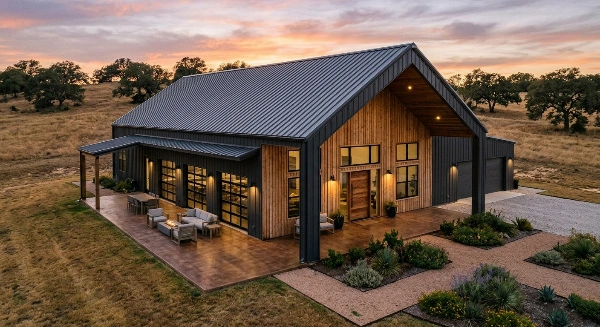
Types of Barndominiums
Barndominiums can be broadly classified based on materials, design/shape, and functionality.
1. Based on Material
Post-Frame: The Classic Choice
This is the original form of the barndominium. Unlike a traditional home where the weight is distributed across continuous foundations, post‑frame construction transfers the entire load to wooden posts embedded in the ground. This allows you to save significantly on foundation costs. Whether you need a full foundation depends on the soil conditions of your property. Choose Post-Frame if you want to move in quickly without breaking the bank.
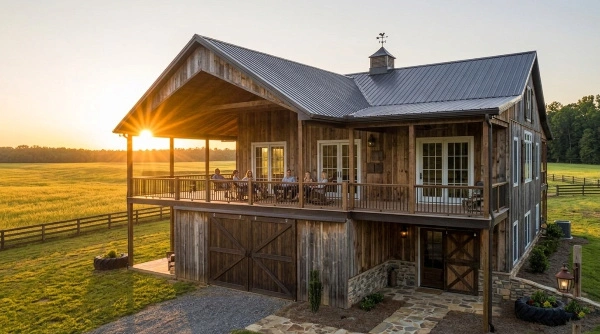
Steel-Frame: Ultimate Durability
The biggest advantages here are near‑complete elimination of insect damage (termites) and fire risk. Plus, if you want a large open‑concept home, steel framing provides the strength to span 40–50 feet without any interior support columns. Go with Steel-Frame if you live in an area with high winds or severe storms.
Hybrid: The Best of Both Worlds
Many people choose this method when they care deeply about interior finishing. The exterior uses steel for protection, while the interior uses standard wood stud framing. This makes running electrical wiring, installing plumbing, and hanging drywall just as easy as in a conventional house. Hybrid is often easier for those who want to handle the interior finishing themselves using traditional wood framing.
Comparison of Barndominium Structural Approaches
| Feature | Post-Frame | Steel-Frame | Hybrid |
|---|---|---|---|
| Primary Material | Large timber posts | Rigid steel | Metal shell + wood frame |
| Cost | Very low / budget‑friendly | High | Moderate |
| Construction Speed | Very fast | Moderate | Moderate |
| Strength | Average (agricultural level) | Very high (withstands severe weather) | High |
| Flexibility | Suitable for simple designs | Maximum for long clear spans | Very easy for interior finishing |
Every barndominium is different — your local labor rates, soil conditions, and finish choices will change the final number dramatically. Get a precise, line‑by‑line estimate using our free cost calculator before you finalize your budget.
2. Based on Design / Shape
• Gambrel Roof Barndominiums
The roof shape resembles that of traditional European farm barns. This design provides extra headroom for an upper loft or second floor.
• Gable Roof Barndominiums
A very simple triangular roof style. It’s most commonly used to achieve a modern look.
• Monitor Style Barndominiums
The center section is raised higher than the two sides. This style is excellent for natural ventilation and daylighting.
3. Based on Functionality
• Residential Barndominiums : Designed exclusively for family living.
• Work-Live Barndominiums (Shop‑houses) : One part of the home is used as a workshop, garage, or business space, while the other part is dedicated to living quarters.
• Vacation / Retreat Barndominiums : Simple structures built as vacation rentals or weekend getaways.
Key Advantages of Choosing a Barndominium in 2026
- Cost-Effectiveness: While a traditional home typically costs $250+ per square foot, a barndominium can drop that to $140 per square foot. That’s a huge savings. For someone building a new home, this is a major opportunity to manage your budget more efficiently.
- Rapid Construction: Because the home can be built very quickly, you can start interior work without being delayed by rain, heat, or other weather conditions. This reduces the overall construction timeline by months.
- Low Maintenance Costs: The use of metal siding and roofing means you avoid frequent painting, wood rot, or cracks in masonry. Maintenance issues that typically pop up every few years are minimal with a barndominium.
- Creative Freedom (Open Floor Plan): The absence of interior load‑bearing walls is a huge advantage. You can keep the space as one large great room, or easily divide it into multiple rooms later as your needs change.
- Everything Under One Roof (Multipurpose Design): This is one of the most unique features of a barndominium. By combining your home, workshop, and vehicle parking all in one design, you avoid the cost of building separate structures and wasting land.
- Environmental Resilience: The metal structure provides high fire resistance. Additionally, it can offer better protection than a traditional home in the face of severe winds or storm conditions.
Still not sure if a barndominium is the right choice for you? We’ve put together a detailed comparison of barndominiums vs. traditional houses – covering costs, construction time, durability, and resale value – to help you decide.
Disadvantages and Challenges of Choosing a Barndo
Along with the many advantages of barndominiums, there are also several downsides and challenges you should consider before making a decision. Here’s a summary:
1. Financing Challenges
Traditional banks and financial institutions do not always recognize a barndominium as a “standard home.“
- Some banks classify these as commercial buildings, making it more difficult to get a home loan compared to a conventional house.
2. Zoning and Codes
Not all areas allow barndominium construction.
- In urban areas or neighborhoods with homeowners’ associations (HOAs), there may be legal restrictions on buildings with a metal exterior.
- Local laws may only permit them on agricultural or rural land.
3. Noise Issues
Metal roofs and walls can create noise problems.
- During heavy rain or thunderstorms, the sound of raindrops hitting the metal roof is much louder than in a traditional home.
- Without proper soundproofing, this can become a real nuisance.
4. Temperature & Ventilation Control (Insulation & HVAC)
Metal is a conductor of heat.
- Without proper insulation, a barndominium can become extremely hot in summer and freezing cold in winter.
- This often requires high‑quality (and expensive) insulation methods like spray foam, which increases the upfront cost.
- When planning your budget, don’t forget to account for high-quality spray foam insulation to keep your energy bills low. You can explore professional-grade options at Tiger Foam.
5. Cell Phone & Wi‑Fi Signal Interference
The metal structure can block outside electromagnetic signals – known as the Faraday Cage effect.
- You may experience weak cell phone signals inside the home, or Wi‑Fi signals that don’t propagate properly.
- You might need to install extra signal boosters to solve this.
6. Resale Value Challenges
Barndominiums are very unique designs, so demand for them may be lower than for a conventional home.
- Not every buyer wants to live in a metal home.
- When you need to sell in the future, finding the right buyer may take longer.
7. Corrosion Risk (Rust)
Steel frames are durable, but if you build in a high‑salt environment (such as a coastal area), there is a risk of rusting.
- Special protective coatings are required to prevent corrosion.
Free · Takes 60 seconds
Turn These Ranges Into a Real Number
These planning ranges are a solid starting point — the exact number for your build depends on your property, finish level, and builder. Answer a few quick questions and get matched with local, vetted barndominium builders who can give you an actual quote for your exact size, budget, and location — free, with zero obligation.
100% free — no credit card needed
How to Accurately Estimate the Cost of Your Dream Barndominium in 2026 : A Professional Architect’s Breakdown
“How much is this actually going to cost me?”
Budgeting for a Barndominium isn’t just about picking a kit. It’s a strategic process. We can break the costs down into two primary phases: The Shell and The Finishing.
Here is my professional blueprint for estimating your Barndo costs like a pro.
1. The Foundation: Square Footage Logistics
Before you look at prices, you need to define your spaces. A Barndominium is unique because it often mixes high-end living quarters with expansive shop or garage space.
- Living Space: This is where the bulk of your money goes. Expect a higher cost per square foot here due to HVAC, insulation, and high-end finishes.
- Shop/Garage Space: This is the “budget-friendly” part of your build. Since you aren’t typically doing drywall or premium flooring here, the cost per square foot drops significantly.
2. Phase One: The Shell (30% – 40% of Budget)
The “Shell” is the skeleton and skin of your home. If the shell isn’t right, nothing else matters.
- The Slab: Don’t cut corners on your concrete foundation. It’s the base for everything.
- Framing & Roofing: You’ll choose between Post-frame or Steel-frame. Steel is king for durability, but your choice here will be a major price driver.
- Exterior Openings: This includes your windows and exterior doors. In a metal building, these need to be high-quality to ensure a proper seal.
The ‘Shell’ is the skeleton and skin of your home. Many owners purchase pre-engineered kits for this phase. See our list of the Best Barndominium Kit Companies for 2026 to compare prices and quality.”
3. Phase Two: Interior Finishing (50% – 60% of Budget)
This is where a Barndominium turns into a home. It’s also where most homeowners blow their budget.
- Insulation: In a metal structure, this is non-negotiable. I always recommend Spray Foam. It’s more expensive upfront, but it pays for itself in energy savings within years.
- Mechanical Systems: This covers your “bones”—Plumbing, Electrical, and HVAC.
- Walls & Ceilings: Whether you go with traditional drywall or a rustic wood paneling, this defines the interior vibe.
- The “Pretty” Stuff: Your kitchen cabinets, countertops, flooring, and bathroom fixtures. This is where your personal style meets your wallet.
4. The “Invisible” Costs
Never forget the costs that don’t show up in the floor plan:
- Site Prep: Clearing trees, leveling the dirt, and building a driveway.
- Permits: Local building codes vary wildly across the U.S. Factor in these fees early.
- Professional Fees: Investing in a solid set of architectural plans and engineering reports will save you thousands in mistakes later.
The Reality Check: A Sample Calculation
Let’s look at a 2,000 sq. ft. project. Prices vary by state, but here is a realistic range for the U.S. market:
| Category | Estimated Cost (per sq. ft.) | Total Estimate (Projected) |
| The Shell | $30 – $60 | $60,000 – $120,000 |
| Interior Finishing | $50 – $90 | $100,000 – $180,000 |
| Total Build | $80 – $150 | $160,000 – $300,000 |
For a more detailed state-by-state cost breakdown for 2026, including real prices in Texas, Oklahoma, Tennessee, Florida, California, Colorado, and other key states see our complete Barndominium Cost Guide.
From Barn to Bliss: The Ultimate Guide to Barndominium Finishing
So you’ve got your barndominium shell up – that strong steel frame, concrete slab, and a whole lot of potential. Now comes the most exciting (and critical) phase: finishing. This is where your metal building transforms from a simple barn into a luxurious, cozy home.
But finishing a barndominium isn’t quite like finishing a traditional stick-built house. The materials, methods, and creative opportunities are unique. Whether you want a rustic farmhouse feel or a sleek industrial loft, here’s everything you need to know about barndominium interior finishing – the right way.
1. Insulation: The Backbone of Comfort
Metal buildings get hot in summer, cold in winter, and can sound like a drum during a rainstorm. That’s why insulation is job one.
- Spray foam (closed-cell) is the gold standard. It sticks directly to the metal panels, seals air leaks, provides high R-value (R-6 to R-7 per inch), and acts as a vapor barrier – preventing condensation and rust.
- Open-cell spray foam costs less (R-3.5 per inch) and absorbs sound better, but it’s not a moisture barrier.
- Pro tip: In colder US climates (think Midwest or Northeast), aim for R-21+ in walls and R-38+ in the ceiling. In warmer regions, R-13 / R-19 is usually sufficient.
- Noise reduction: Closed-cell foam dramatically cuts down rain noise. For even better acoustics, add resilient channels or double stud walls.
Don’t skip insulation or try to cheap out with fiberglass batts alone – they leave air gaps and condensation will haunt you later.
2. Interior Walls & Framing: Rustic or Modern?
Once the insulation is in, you build your interior walls. The beauty of a barndominium? No load-bearing interior walls – you can put rooms anywhere.
Popular wall finishes:
- Drywall – Classic and clean. Use purple board in bathrooms and kitchens for moisture resistance. Because steel buildings expand and contract, install control joints to prevent cracks.
- Shiplap – That signature rustic look. Real wood is beautiful but pricey; MDF or PVC shiplap gives the same vibe with less cost and better moisture resistance.
- Wood paneling – Go for reclaimed barn wood for authentic character.
Framing options:
- Metal studs – No warping, fire-resistant, termite-proof. You’ll need grommets for wiring.
- Wood studs – Easier to work with and more traditional. Just keep humidity under control to avoid twisting.
3. Ceilings: Go Big or Go Home
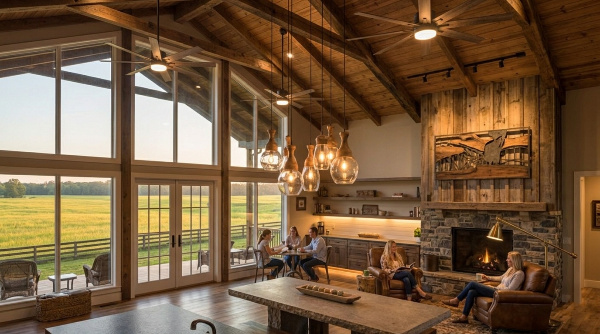
Barndominiums are famous for high, vaulted ceilings. Don’t hide them – show them off.
- Vaulted drywall ceilings – Sleek and modern. Add a ceiling fan (mandatory for hot air circulation) and ridge vents for attic breathing.
- Exposed trusses – Leave the steel or wood rafters visible for an edgy industrial look. Always coat steel trusses with rust-inhibiting primer + paint.
- Acoustic issues: High ceilings echo like crazy. Install acoustic panels, fabric-wrapped baffles, or even perforated wood tiles to tame the reverb.
4. Flooring: Tough & Beautiful
Your barndominium sits on a concrete slab – which is a fantastic starting point.
Top choices for barndominium floors:
- Polished concrete – Super durable, low maintenance, and works great with radiant heating. Add an acid stain or dye for color. Downside: cold and hard (area rugs fix that).
- Luxury Vinyl Plank (LVP) – Waterproof, scratch-resistant, and looks just like wood. SPC (stone plastic composite) vinyl is rigid and UV-stable – perfect for sun-drenched rooms.
- Pro tip: If you ever plan to add radiant floor heating, do it before pouring the slab or over the slab with a self-leveler. Polished concrete + radiant heat = pure luxury.
5. Kitchen & Bathroom Finishes: Farmhouse Flair
These rooms deserve extra attention. You can go as high-end as any traditional home.
- Ventilation is critical. Because barndominiums are tightly sealed, you need a high-CFM range hood (with make-up air system) so you don’t backdraft water heaters or fireplaces.
- Farmhouse sink – Fireclay or stainless steel. Pair with bridge faucets and exposed plumbing for that rustic touch.
- Backsplash – Tin ceiling tiles, subway tile, or even reclaimed wood (sealed well).
- Countertops – Butcher block (seal with tung oil) for warmth, or quartz for easy care.
6. Lighting: Layer It Up
High ceilings demand smart lighting.
- Layered approach: Ambient (general) + Task (under-cabinet, reading) + Accent (wall art, beams).
- Big windows – Let in natural light, but use Low-E, argon-filled glass for energy efficiency. Add UV film on west-facing windows.
- Statement chandeliers or pendant lights – Hang them at least 7 feet from the floor. Use dimmers with LEDs for cozy evenings.
- Don’t forget: Ceiling fans (with lights) are both practical and stylish.
7. Barn Doors: Iconic but Not for Everywhere
Sliding barn doors are almost a barndominium trademark – but use them wisely.
Good for: Pantries, closets, office nooks, or dividing a great room.
Bad for: Bedrooms or bathrooms – they offer zero sound privacy and light leaks through the gaps.
Better alternative for private rooms: Pocket doors (slide into the wall) or solid core hinged doors.
If you must have a barn door, add an acoustic curtain on the inside to muffle noise.
8. Extra Tips the Pros Swear By
- Permits & inspections: Many US counties require detailed insulation R‑values, electrical plans, and fire-rated drywall (Type X) in sleeping areas. Don’t skip this.
- Fire safety: Install interconnected smoke detectors and consider a sprinkler system if you’re in a wildfire-prone area (e.g., California, Texas Hill Country).
- Moisture monitoring: Buy a $30 moisture meter and check wall cavities once a year – especially after heavy rains.
- Floor leveling: Concrete slabs aren’t always flat. Use self‑leveling compound before installing LVP or tile.
- Cost vs. value: Closed‑cell spray foam costs more upfront but saves 30‑40% on energy bills. Polished concrete is cheap at build time but expensive to retrofit later. Make these decisions early.
Conclusion: Is a Barndominium the Right Choice for Your 2026 Dream Home?
After walking through the rich history, structural options, real-world costs, and finishing secrets of barndominiums, one thing becomes clear: the barndo is no longer a niche farmhouse experiment. It’s a mainstream, budget-savvy, and highly customizable way to build your dream home in 2026.
So, should you pull the trigger?
Choose a barndominium if you want:
- Lower cost per square foot – Save 20–30% compared to stick-built homes without sacrificing quality.
- Lightning-fast construction – Get your shell up in weeks, not months.
- Open, flexible floor plans – No load-bearing walls inside means you design the space exactly how you live.
- Low maintenance for decades – Steel siding and roofing laugh at rot, termites, and repainting.
- One building, many purposes – Workshop, home office, RV garage, and living quarters – all under one roof.
Think twice (and plan carefully) if:
- Your local zoning or HOA restricts metal exterior buildings – always check before buying land.
- You need a traditional mortgage from a big bank – but local credit unions and USDA loans can work.
- You hate the sound of rain on a metal roof – though spray foam insulation cuts noise dramatically.
- You plan to sell within 2–3 years – barndos are still niche, but growing fast.
Your 2026 Barndominium Roadmap (TL;DR)
- Check local zoning & soil conditions – Call your county planning department before buying land. Some areas don’t allow metal primary residences.
- Choose your frame type – Post-Frame (lowest cost), Steel-Frame (maximum durability & clear spans), or Hybrid (easier interior finishing with wood studs).
- Budget realistically – Shell costs = 30–40% of total. Interior finishing = 50–60%. Never underestimate the “pretty stuff”.
- Never skip closed‑cell spray foam insulation – This is non-negotiable for metal buildings. It stops condensation, cuts rain noise, and slashes energy bills.
- Finish smart – Polished concrete or LVP flooring + vaulted ceilings + barn doors (only where sound privacy isn’t critical).
- Finance via USDA loan, credit union, or portfolio lender – Avoid big banks that don’t understand barndos. Rural USDA loans and local credit unions are your best friends.
- Plan everything before the slab is poured – Outlets, light fixtures, cabinet hinges, appliance locations. Changes get expensive fast.
Ready to start your own barndominium journey?
Whether you’re leaning toward a rustic post-frame retreat or a modern steel-framed shop-home hybrid, the barndominium trend is only gaining momentum in 2026. With proper planning, the right builder, and a clear vision, you’ll end up with a home that’s not just affordable – but truly unforgettable.
Free · Takes 60 seconds
Turn These Ranges Into a Real Number
These planning ranges are a solid starting point — the exact number for your build depends on your property, finish level, and builder. Answer a few quick questions and get matched with local, vetted barndominium builders who can give you an actual quote for your exact size, budget, and location — free, with zero obligation.
100% free — no credit card needed
Common Questions About Barndominiums (FAQ)
Are barndominiums cheaper to build than traditional houses?
Generally, yes – but it depends. The shell (steel frame, roof, siding) is often 20–30% cheaper than stick framing. However, finishing costs (insulation, drywall, plumbing, electric) are similar to a regular house. Where you save is on labor speed (steel goes up fast) and long-term maintenance (metal exteriors last decades with little upkeep).
A basic barndo can cost $120 per sq ft, while a custom home often runs $200+ per sq ft. Luxury finishes raise both.
Can I get a mortgage for a barndominium?
Yes, but it’s trickier than a traditional home. Many conventional lenders are unfamiliar with barndos. Your best bets:
USDA loans (if in a rural area)
Local credit unions or community banks who understand post-frame or steel construction
Construction-to-permanent loans with a builder’s draw schedule
Portfolio lenders (they keep the loan in-house)
You’ll need to classify the property as a “single‑family residence” and meet local building code
Do barndominiums hold their resale value?
Yes – if well‑built and in a desirable location. In rural markets where land is cheap, they sell easily. In suburban or exurban areas, they’re still niche, but growing popularity is boosting values. Pro tip: stick to neutral, high‑quality finishes (don’t go too “barn” on the inside unless you cater to that specific market).
What about insulation? Won’t a metal building be hot or cold?
That’s the #1 concern, and the answer is spray foam insulation (closed‑cell). It seals the metal, stops condensation, and gives you R‑values equal to or better than a wood house. With proper insulation and HVAC, a barndo is just as comfortable as any modern home. Rain noise? Good spray foam cuts it way down.
Can I have a basement under a barndominium?
Technically yes, but it’s uncommon and expensive. Most barndos sit on concrete slabs (monolithic or stem wall). Adding a basement requires deep excavation, special engineering for the steel frame’s point loads, and lots of waterproofing. In most cases, it’s cheaper to build a larger single‑story barndo than add a basement.
How long does it take to build a barndominium?
The steel shell can go up in 1–3 weeks. The finishing (plumbing, electrical, drywall, flooring, cabinets) takes another 3–6 months, depending on your builder and local permits. Total timeline: typically 4–9 months from slab pour to move‑in – faster than a custom stick‑built home.
Do I need an architect? Can I use a kit?
Most people buy a barndominium kit from companies like Worldwide Steel, Muller, or DC Structures. The kit comes with engineered plans (stamped for permits), so you don’t need an architect. However, you will need a general contractor or experienced builder for the foundation and finishing. Some owners act as their own GC – that saves money but requires time and know‑how.
What are the most common problems with barndominiums?
Condensation & rust – if you skip proper insulation (cured by closed‑cell foam).
Financing hurdles – not every bank says yes.
Resale challenges – in some markets, buyers don’t “get” barndos yet.
Local zoning codes – some counties won’t permit a metal building as a primary residence (always check before buying land).
Can I have a loft or second floor?
Absolutely. Many barndos include a loft for a bedroom, office, or storage. Steel frames can easily support a mezzanine or second floor. Just specify that when ordering your kit – the trusses and columns will be engineered for the extra load.
What’s the best flooring for a barndominium?
Two winners:
Polished concrete – cheap, durable, works with radiant heat.
Luxury Vinyl Plank (LVP) – waterproof, warm underfoot, looks like wood.
Avoid carpet in high‑traffic areas (dust from the shop area?) and solid hardwood (humidity swings in metal buildings can cause cupping).
Are barndominiums energy efficient?
When insulated with closed‑cell spray foam, yes – very efficient. The tight envelope reduces air leaks, and the reflective metal roof can deflect solar heat. With proper windows (Low‑E, argon) and insulation, many barndos have energy bills lower than comparable wood‑frame houses.
Do I need a special HVAC system?
Not necessarily – a standard split system or heat pump works fine. But because barndos often have huge open spaces and high ceilings, size your unit correctly. Many owners add mini‑splits for zones or ceiling fans to circulate air. Ductwork runs easily through the wide ceiling cavities.
Can I build a barndominium on any piece of land?
You need to check local zoning and building codes. Some rural counties welcome them; others require a minimum amount of “traditional” exterior (brick, wood, stone). Always call the planning department before buying land. Also check for HOA restrictions if the lot is in a subdivision.
Is a barndominium a good investment?
For a primary home: yes, if you love open space and low maintenance. As a rental? Unique properties can command high Airbnb rates (“cool barn stay”). As a workshop + home? Unbeatable. Just don’t over‑customize – keep the layout flexible for future buyers.