
Barndominium vs house: a detailed, no-fluff comparison of costs, construction, durability, financing, and resale value to help you make the best decision for your dream home.
You’ve seen the stunning photos on Pinterest: soaring ceilings, exposed steel beams, and an open floor plan that flows from the living room into a massive shop. The barndominium trend is no longer a rural secret. But is it truly better than a traditional stick‑built home? The answer depends entirely on your budget, lifestyle, and long‑term goals.
In this barndominium vs house comparison, we cover seven critical categories using 2026 data. By the end, you’ll know exactly which path fits your situation.
Table of Contents
Quick Verdict: Which One Wins in 2026?
| Category | Barndominium | Traditional House |
|---|---|---|
| Cost to build (per sq. ft.) | Lower: 70–160 | Higher: 150–250+ |
| Construction time | Faster: 1–4 months | Slower: 6–12 months |
| Design flexibility | Open floor plans, few interior walls | More load‑bearing walls, segmented rooms |
| Durability & maintenance | Steel = termite‑proof, fire‑resistant, low‑maintenance | Wood prone to rot, termites, and fire |
| Financing ease | Specialized, harder to get | Standard mortgages everywhere |
| Resale value / demand | Niche, location‑dependent | Broad market, easier to sell |
| Energy efficiency (with spray foam) | Excellent, can beat many wood homes | Good, but air leaks more common |
Choose a barndominium if you want lower upfront costs, faster construction, an open layout, and low maintenance, and you’re willing to work harder for financing. Choose a traditional house if you prefer a standard mortgage, a simpler path to resale, and a more conventional neighborhood feel.
1. Cost to Build Barndominium vs house (2026 Real Numbers)
The most common reason people consider a barndominium is cost. But the savings aren’t always as dramatic as they seem.
Barndominium Cost Breakdown (2,000 sq. ft. shell + finish)
| Component | Low Range | High Range |
|---|---|---|
| Steel or post‑frame kit | $25,000 | $70,000 |
| Concrete slab | $12,000 | $25,000 |
| Assembly labor (professional) | $10,000 | $25,000 |
| Spray foam insulation | $8,000 | $15,000 |
| Plumbing & electrical | $15,000 | $35,000 |
| Interior finishes (drywall, flooring, cabinets) | $25,000 | $60,000 |
| Permits & site prep | $5,000 | $15,000 |
| Total finished | $100,000 | $245,000 |
| Cost per sq. ft. | $50 | $122 |
many barndo owners DIY some work. A fully turnkey barndo from a builder often lands between 120–160/sq. ft.
For a more detailed state-by-state cost breakdown for 2026, including real prices in Texas, Oklahoma, Tennessee, Florida, California, Colorado, and other key states see our complete Barndominium Cost Guide.
Free · Takes 60 seconds
Turn These Ranges Into a Real Number
These planning ranges are a solid starting point — the exact number for your build depends on your property, finish level, and builder. Answer a few quick questions and get matched with local, vetted barndominium builders who can give you an actual quote for your exact size, budget, and location — free, with zero obligation.
100% free — no credit card needed
Traditional House Cost Breakdown (2,000 sq. ft., stick‑built)
- Basic builder‑grade: 150–180/sq. ft.
- Semi‑custom: 180–230/sq. ft.
- High‑end custom: 250–400+/sq. ft.
Barndominiums are 20–40% cheaper than comparable quality stick‑built homes. The savings come from the simple steel structure and faster labor.
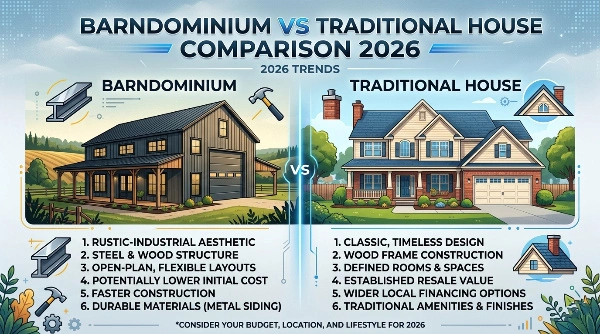
These ranges are national averages. Your actual cost depends heavily on where you build, how large your home is, and what finish level you choose. Run your own numbers through our detailed cost calculator to see a state‑by‑state estimate with all the hidden costs included.
2. Construction Time
Time is money, especially if you’re paying rent or a construction loan.
- Barndominium shell: A professional crew can erect the steel frame, roof, and siding in 1–3 weeks. Interior finishing takes another 3–6 months. Total: 4–9 months.
- Traditional house: Foundation, framing, roofing, then interior – usually 6–12 months start to finish, often delayed by weather or subcontractor schedules.
Barndominiums win easily. The dry‑in shell goes up quickly, and you can begin interior work while protected from the elements.
3. Design & Layout Flexibility
Open concept lovers, this is where barndominiums shine.
- Barndominium: Because the roof and walls are supported by the steel frame or posts, there are no interior load‑bearing walls. You can put rooms anywhere, change your mind later, or keep one massive great room. Lofts, mezzanines, and high ceilings are standard.
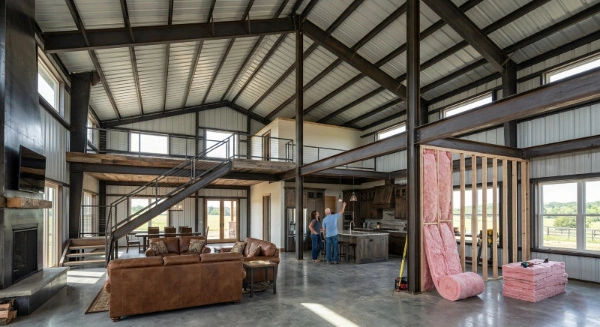
- Traditional house: Interior walls often carry floor and roof loads. Moving walls requires expensive structural changes. Ceiling heights are typically 8–9 feet unless you pay extra for “volume ceilings.”
Barndominiums offer far more creative freedom.
4. Durability & Maintenance
How much work do you want to do over the next 30 years?
| Issue | Barndominium | Traditional House |
|---|---|---|
| Termites | Steel frame = no risk | Wood frame = constant threat, expensive treatment |
| Rot & mold | Metal doesn’t rot; spray foam stops condensation | Wood can rot from leaks or high humidity |
| Fire | Steel is non‑combustible | Wood frame burns readily |
| Exterior paint | Metal siding lasts 40+ years without painting | Wood or fiber cement needs repainting every 7–10 years |
| Roof | Metal roof lasts 40–70 years | Asphalt shingles last 20–25 years |
In the barndominium vs house durability debate, steel wins every time.
To better understand the fire safety benefits of steel framing, you can refer to publications from the American Iron and Steel Institute (AISI)
5. Energy Efficiency (With Proper Insulation)
Barndominium vs house energy efficiency depends entirely on insulation choices. A metal building can be an energy nightmare – or a fortress of efficiency. The difference is closed‑cell spray foam insulation.
- Barndominium with spray foam (R‑21 walls, R‑38 ceiling): No air leaks, no condensation, low heating/cooling bills. Many owners report 30–40% lower energy costs than their previous wood‑frame home.
- Barndominium with fiberglass batts: Terrible. Air moves through gaps, metal sweats, and you freeze in winter.
- Traditional house: Typically well‑insulated with fiberglass or cellulose, but still has air leaks around outlets, windows, and attic hatches.
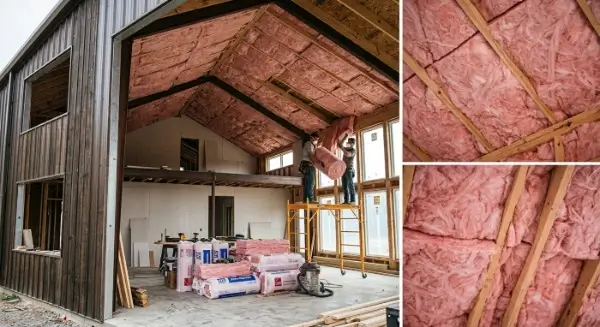
A properly insulated barndominium is as efficient or better than a traditional home. But you must invest in spray foam – no shortcuts.
6. Financing: The Biggest Hurdle
This is where many dream barndo projects stall.
When comparing barndominium vs house financing, the biggest hurdle is appraisal. Traditional lenders need comparable sales data to approve a loan and because barndominiums are less common, appraisers often struggle to find comps. This can push your appraisal value below the agreed purchase price, leaving you to cover the gap in cash. Your best options are USDA loans for rural properties, local credit unions, and portfolio lenders who understand the barndo market. Build a 15–20% down payment if possible it significantly reduces appraisal risk.
| Aspect | Barndominium | Traditional House |
|---|---|---|
| Mortgage availability | Limited; many banks say no | Widely available (FHA, conventional, VA, USDA) |
| Loan types | USDA (rural), portfolio lenders, local credit unions, construction‑to‑perm | All standard products |
| Down payment | Often 10–20% or more | As low as 3–5% (FHA) |
| Appraisal challenges | Hard to find comparable sales – low appraisal | Many comps – reliable valuation |
Pro tips for barndo financing:
- Use a local lender or credit union that knows the barndo market.
- Look for USDA loans if the property is in a rural area.
- Build a larger down payment (15–20%) to offset appraisal gaps.
Traditional houses are far easier to finance. If you have excellent credit and a substantial down payment, a barndo is possible – but be prepared for extra paperwork.
7. Resale Value & Market Demand
What happens when you need to move in 7 years?
- Barndominium: Resale depends heavily on location. In barndo‑friendly states like Texas, Oklahoma, Tennessee, and Missouri, demand is strong. In suburban New England or California, buyers may be scared off. A well‑finished, professionally built barndo with neutral interiors sells much faster than an eccentric DIY project.
- Traditional house: Almost always easier to sell because the buyer pool is huge. Most people understand wood‑frame construction and expect it.
If you prioritize resale flexibility, a traditional house is safer. However, in rural and exurban areas where land is cheap, barndominiums are gaining acceptance and value.
Pros & Cons Summary
Barndominium Pros
- Lower cost per square foot
- Faster construction
- Open, flexible floor plans
- Extremely durable – no termites, rot, or fire risk
- Low maintenance (metal siding and roof)
- Energy efficient with spray foam
- Great for home shops, barns, or mixed‑use
Barndominium Cons
- Financing is harder to get
- Resale market is still niche
- Requires closed‑cell spray foam (expensive upfront)
- Metal can block cell/WiFi signals (Faraday cage – solvable with boosters)
- Some HOAs and counties restrict metal exteriors
- Rain on a metal roof is loud without proper insulation
Traditional House Pros
- Easy financing (FHA, conventional, VA)
- Broad resale market
- Familiar to all buyers, appraisers, and insurers
- No special insulation requirements
- Quiet in the rain
Traditional House Cons
- Higher cost per square foot
- Longer construction time
- Wood frame = termite, rot, and fire vulnerability
- More maintenance (paint, shingles, siding)
- Less open floor plan potential
Decision Matrix: Which One Fits Your Profile?
| If you are… | Recommended choice |
|---|---|
| A first‑time buyer with limited down payment | Traditional house (easier financing) |
| A rural landowner who wants a shop + home | Barndominium |
| Someone who plans to sell within 5 years | Traditional house |
| A DIY enthusiast who wants to save money | Barndominium (DIY shell or interior) |
| Living in a strict HOA suburban neighborhood | Traditional house |
| Living in Texas, Oklahoma, Missouri, Tennessee | Barndominium (strong market) |
| Concerned about termites and fire | Barndominium |
| Wanting a unique, custom open floor plan | Barndominium |
Free · Takes 60 seconds
Turn These Ranges Into a Real Number
These planning ranges are a solid starting point — the exact number for your build depends on your property, finish level, and builder. Answer a few quick questions and get matched with local, vetted barndominium builders who can give you an actual quote for your exact size, budget, and location — free, with zero obligation.
100% free — no credit card needed
FAQs: Barndominium vs House
Is a barndominium cheaper to build than a house in 2026?
Yes, typically 20–40% cheaper for comparable finish levels. The shell costs much less, but interior finishes are similar.
Can I get a conventional mortgage for a barndominium?
Sometimes, but many conventional lenders decline. USDA loans and local credit unions are your best options.
Do barndominiums hold their value?
In barndo‑friendly states, yes – especially if built professionally with quality finishes. In other areas, resale can be slower.
Is a barndominium louder than a house?
Without spray foam insulation, yes – rain on a metal roof is loud. With closed‑cell spray foam, the noise is dampened significantly.
Which is more energy efficient, a barndominium or a house?
A properly insulated barndominium (spray foam) is as efficient or better than a typical wood‑frame house because the metal shell can be made nearly airtight.
Can I build a barndominium in a city or suburb?
Often no – many urban and suburban zoning codes restrict metal buildings as primary residences. Always check local rules.
Your Land, Your Life, Your Choice
The barndominium vs house debate comes down to your priorities.
If you value low upfront cost, fast construction, durability, and an open layout – and you’re willing to work a little harder for financing – a barndominium is an excellent choice for 2026. It’s especially powerful for rural landowners, hobby farmers, or anyone wanting a shop attached to their living space.
If you prefer a simpler, more conventional path with easy financing and broad resale appeal, a traditional house remains the safe bet.
Still undecided? Start by checking your local zoning and talking to a lender. Those two steps will tell you immediately which path is realistic for your situation.
This guide was researched and written for US homeowners planning to build or buy in 2026. Always consult local professionals before making final decisions.